Friday, October 24, 2008

Ambassador Oliver's Farewell to the Executive Board

Ambassador Louise Oliver concluded her remarks to the 180th meeting of UNESCO's Executive Board with the following words:
And now, as this will be my last Executive Board meeting, I would like to make some personal comments, starting with expressing my admiration and gratitude to our interpreters who somehow have always managed to keep up with my very rapid speech. Your professionalism and skills are, in the words of the next generation, awesome.

To the members of the Secretariat, let me say that I have enjoyed working with you. Though we have not always agreed on everything, I respect your commitment to this organization, as I hope you do ours.

To my colleagues in the delegations from all corners of the globe, thank you for your friendship, and for the open-minded way in which you listen to our ideas and concerns.

And finally let me express my profound gratitude to you Mr. Director-General for having successfully encouraged the United States to rejoin the UNESCO family. Your passion for UNESCO and its mandate is extraordinary, and it has made a big impact in my country.

So now it is time to turn our attention back to the challenges that face this Organization. Once again we have too many items on our agenda, and once again we will be tempted to say yes to everything we are asked to do. But if we do that, we will weaken the ability of this Organization to exert the kind of leadership that is expected of us. Instead let us rededicate ourselves to advancing our priorities, so that we can take full advantage of the great potential of this organization.

If we can transform UNESCO’s ideals into action, we will be able to help strengthen mutual understanding among the nations and peoples of the world, which is essential if we are ever to make progress towards our ultimate goal of peace and security worldwide.

Thank you Mr. Chairman.
Comment: Ambassador Oliver has served with distinction as head of the United States Permanent Delegation to UNESCO since the United States rejoined the organization. The country owes her a debt of gratitude for that service. I understand that she has managed to do a great deal assure that U.S. representatives at UNESCO governance bodies would receive the respectful attention the nation's representative deserve. JAD

UNESCO Symposium and exhibition on freedom of expression mark 60th anniversary of Universal Declaration of Human Rights

U Win Tin
Laureate of the UNESCO
World Press Freedom Prize 2001
long term prisoner in Burma
has provided a video for the symposium

A symposium on Freedom of Expression: Development, Democracy and Dialog will be held at UNESCO Headquarters on 29 October as part of celebrations of the 60th anniversary of the Universal Declaration of Human Rights whose 19th article enshrines freedom of expression as a fundamental, inalienable human right.

Wednesday, October 22, 2008

United Nations Day


This Friday, October 24th, people around the world will celebrate UN Day, marking the 63rd anniversary of the founding of the United Nations, which was created with the far-sighted vision and leadership of the United States.

The United Nations was created by the allies who, having won World War II, recognized the need for an intergovernmental organization that could take the political actions needed to prevent future wars. The creators of the United Nations recognized that while the UN Security Council could take necessary short term political actions, that wars begin in the minds of men, and it is there that the long term defenses of peace must be constructed. Thus UNESCO was created in parallel with the United Nations and charged with education, science, culture and communications in order to build those long term defenses.

That founding vision remains as relevant today as it did in 1945.

Check out the Patriotism.Org site on United Nations Day in the United States.

A Positive Step for Iraqi Education and Communication

Installation of a transmission unit
© UNESCO

The Iraqi education and communication network received a large boost yesterday as UNESCO and the Education Minister of Iraq launched the Iraqi Educational TV Channel (IRAQ EDU). This channel will run 24 hours a day on NILESAT at 10775 Hz; it will broadcast programs based on Iraqi school curriculum. Its focus is primary and secondary students within and outside of Iraqi.

This project, funded by the European Union for US$6.5 million, aims to act as a way to counter the high security risks many students feel in attending school. These risks have led to high rates of absenteeism and the subsequent closing of schools. They have also contributed to low initial enrollments rates. In fact, data from UNICEF-Iraq show initial enrollment rates were around 46% in 2006, and the Ministry of Education reported only 28% of 17-year-olds sat for their final exams that same year.

However, there is much optimism about this new measure. It is particularly interesting to note that IRAQ EDU will emphasize peace and tolerance in its programs. Koïchiro Matsuura, Director-General of UNESCO, indicated this and the other contributions IRAQ EDCU will make could certainly"inspire initiatives in other countries and regions that are in conflict or post-conflict situations."

And it seems that there is certainly work to be done to restore the Iraqi educational system to its former regional eminence. In the early 1980s, the Iraqi educational system was seen as one of if not the best in the region. UNESCO reported Gross Enrollment Rates around 100% and illiteracy rates for ages 15 to 45 less than 10%; yet there has been constant instability ever since.

Yet the war with Iran in the mid-1980s, the Gulf War, and the instability beginning in 2003 have left the educational system tattered to say the least. Class size can average in size of 100 students, teachers face constant threats of violence, and the scheduled curriculum may be rarely finished or addressed. Although many positive programs have been enacted, much more clearly needs to be done. It is initiatives such as IRAQ EDU that may provide another way to access this deserving population: the children of Iraq.

Tuesday, October 21, 2008

The Grand Canyon

Last week I visited Grand Canyon National Park, one of the places chosen by UNESCO as a World Heritage site. We visited the north rim of the canyon rather than the more frequented south rim.


One approaches the north rim, which is quite isolated, passing through the forests and meadows of the Colorado Plateau. As the above photo shows, in October the aspens found among the pine forests turn gold. From the road we saw herds of grazing deer, and even a coyote, as well as cattle grazing in the multiple use national forest adjacent to the national park.


The two images above are taken from the lodge on the north rim. Reconstructed after a fire that destroyed the original building, it is again an imposing and interesting building, which we were told is important in the architectural history of the United States, representing a peak achievement of the arts and crafts movement. Certainly the first view of the Grand Canyon itself from the lobby of the lodge leaves an indelible impression.


Walking along a rim trail one sees great views across the ten mile expanse of the mile deep canyon framed by tall and graceful pines.


A road branches off that to the lodge, traveling for miles along the Colorado Plateau, with viewing points provided on the rim providing views such as those provided above.

Archaeologists have discovered many prehistoric sites within Grand Canyon National Park itself, and even today there are Native American communities above and below the national park on the Colorado River. Indeed the history of the region through the expansion of the United States has fascinated Americans, and the larger region surrounding the Grand Canyon has been the site of many western movies.

Monday, October 20, 2008

Teacher Development grows in Africa


The New Partnership for Africa's Development (NEPAD) office of Education held a 3 day conference for the AU from the 17th to the 19th of June, 2008 in South Africa to discuss implementation strategies in teacher development for the second generation of African Education. The focus was Science, Math, and Technology teaching (SMASE) as well as distance learning for teacher training
At the meeting, the role of UNESCO in African teaching was outlined. These include:

Thursday, October 16, 2008

Preserving Underwater Cultural Heritage in Asia-Pacific Waters

Now ratified by twenty States, the Convention on the Protection of the Underwater Cultural Heritage will enter into force on January 2, 2009. The Convention, adopted in 2001 by UNESCO’s General Conference, is designed to help preserve cultural heritage by safeguarding marine archaeological sites and submerged shipwrecks.

The growing threat posed by looting, combined with unintentional damage and negligence from fishing, exploitation of sea-bed resources and major shore-line and offshore constructions, constitutes a great loss to the study of the history of civilizations. Furthermore, legal efforts to protect underwater heritage sites have lagged behind laws protecting cultural heritage sites on the ground. By drafting this treaty, UNESCO sought to correct this imbalance and provide a framework for cooperation to help preserve underwater history and cultural heritage for future study.

The need for the Convention is starkly clear in the Asia-Pacific region, which, with its rich history of maritime commerce, hosts many shipwrecks. The contents of shipwrecked vessels, such as the Tek Sing, which sank in the waters off Indonesia in 1822, have been auctioned off and irretrievably dispersed. By attempting to guard against further harm to cultural heritage, the Convention supports the regional pillars of UNESCO’s efforts in the Asia-Pacific region, including “extending international protection to endangered, vulnerable and minority cultures and cultural expressions.”

While the treaty provides a framework to address the problem, there are practical obstacles to overcome before it can be implemented, including a scarcity of trained underwater archaeologists. This is a particularly pressing need in the Asia-Pacific region, and it should be addressed urgently to help ensure the treaty’s effectiveness.

So far, Cambodia is the only country in the Asia-Pacific region to ratify the treaty, though all Member States agreed that its Annex, which presents detailed guidelines concerning activities directed at underwater cultural heritage, should be accepted and applied as the reference document for interventions concerning underwater cultural heritage.

For more information, please visit UNESCO’s Bankgok’s Underwater Cultural Heritage in Asia-Pacific Waters project site. For information about the efforts of other regions, please see UNESCO’s Underwater Cultural Heritage site.

Sunday, October 12, 2008

UNESCO’s Earthquake Response Programme: "building back better"

Over 73,000 people in Pakistan perished in the devastating 2005 earthquake. In Bam, India, the earthquake of 2003 left 18,000 children without classrooms. In response to these disasters and other similarly affected areas, UNESCO has developed the Earthquake Response Programme which focuses on reactivating the education system through training.
UNESCO's program has challenged the traditional response of rebuilding education. "Building back better" involves more than just physical structures. The Earthquake Response Program focuses on: 
  • initial and follow-up training in management of recovery and reconstruction
  • case specific materials
  • literacy programs
  • much needed psychosocial support 
In addition to the local level response, UNESCO is also working among policy makers to increase awareness regarding the importance of education.

Monday, October 06, 2008

UNESCO and Inter-American Development Bank

The Director-General of UNESCO, Koïchiro Matsuura, and the President of the Inter-American Development Bank (IDB), Luis Alberto Moreno, signed today in Paris a Memorandum of Understanding for a Strategic Partnership to expand existing cooperation between the two organizations.

According to the agreement UNESCO and the IDB will be able to undertake joint activities in Latin America and the Caribbean in the following areas:
  • capacity building for the achievement of Education for All (EFA) goals;
  • the use of information technologies (ICTs) in education;
  • ethics of science and technology;
  • strengthening of national science and technology capacities;
  • youth violence prevention; protection and promotion of biological and cultural diversity, including the promotion of multilingualism;
  • prevention of natural disasters;
  • protection and safeguarding of natural and cultural heritage, including intangible cultural heritage;
  • development of cultural industries; and
  • urban development.

Picturing America

Picturing America is an exhibit developed by the National Endowment for Humanities. It was shown at UNESCO recently as part of American History and Culture Week. The show provides exhibition size and quality photos of masterpieces of American art. It is also available for use in classrooms and libraries. The Picturing America website has an interesting interactive show of the images contained in the exhibit.

Sunday, October 05, 2008

UNESCO and the Investigation of Human Rights Abuses

UNESCO investigates alleged violations of human rights in its fields of competence, namely education, science, culture and communication. This procedure is set out in 104 EX/Decision 3.3 of the Executive Board, and is known as "Procedure 104". The investigations are implemented by a subsidiary organ of the Executive Board, the Committee on Conventions and Recommendations.

Last week the Committee had a special program in commemoration of the 30th anniversary of the creation of Procedure 104. Participatin in the event were such luminaries as Dr. Boutros Boutros-Ghali (President of the National Council for Human Rights of Egypt and Former Secretary-General of the United Nations) and Dr. Torsten Wiesel (1981 Nobel Laureate in Physiology or Medicine).

Farouk Hosni: Candidate for UNESCO Director General

Farouk Hosny -- 2001 -- Acrylic on Canvas - 105x205 cm
Zamalek Art Galary

Farouk Hosni, having served for two decades as Egyptian Minister of Culture, has been nominated by his government to be the next Director General of UNESCO, and is considered to be a leading candidate. He is also know internationally as an abstract artist. One of his paintings is reproduced above. The second term of office of the current Director General, Koïchiro Matsuura, ends in October 2009.

12th International Seminar Forum UNESCO - University and Heritage


Apr 5, 2009 - Apr 10, 2009
Hanoi, Republic of Vietnam


The Seminar is arranged around 3 major themes, physical integrity of historic urban landscapes, functional integrity of historic urban landscapes, visual integrity of historic urban landscapes.

It will be hosted by Hanoi University of Architecture (HAU), Hanoi People’s Committee (Vietnam). The Seminar official languages are English, French and Spanish. Interpretation services will be provided in English, French, Spanish and Vietnamese. More about the Forum.


The Deadline for submission of abstracts is Thursday, October 30, 2008. More about submitting an abstract.

Momaday Nominated UNESCO Artist for Peace

Scott Momaday has been nominated as UNESCO Artist for Peace by Koichiro Matsuura, UNESCO's Director-General. Ambassador Louise Oliver looks on.
© Copyright Michel Ravassard

American History and Culture Week at UNESCO

30 September to 7 October

The week long celebration centers on the ‘Picturing America’ exhibit, a collection of 40 printed representations of some of the country’s greatest works of art. The exhibit enables viewers to gain insights into the principles, ideals and aspirations that have animated American history since its founding and before.

“The exhibit is an engaging way for youth and adults alike to learn more about the United States and its history through art.”
UNESCO Director General Koïchiro Matsuura.
The activities of the week also included the performance of Tha Boyz, a Native American chant group. Native American traditions were also portrayed in the "Picturing America" exhibit through Black Hawk’s "Sans Arc Lakota" ledger book, along with representations of America’s great leaders, such as George Washington and Abraham Lincoln, and important works illustrating American democracy such as Norman Rockwell’s Freedom of Speech.

Tha Boyz - 2007 Red Earth

Happy World Teachers Day -- October 5th

Low salaries, overcrowded classrooms, low job security, inadequate training – World Teachers’ Day, celebrated annually on 5 October, is the occasion to pay tribute to a profession whose role in the education of young people and adults remains essential. The emphasis this year is on developing teacher policies, the only foundation for ensuring sustainable and high-quality recruitment. More on the day from UNESCO!

Friday, October 03, 2008

Add the Eleanor Roosevelt Papers Project to the Memory of the World

Eleanor Roosevelt and United Nations 'Universal Declaration of Human Rights'

Eleanor Roosevelt was a great American in her own right as well as in the role of spokesperson for her husband. Among her greatest accomplishment was the Universal Declaration of Human Rights. She chaired the United Nations Committee that drafted the Declaration. Her enormous prestige, in my opinion, made the Declaration possible. Her skill in the chair brought people together who were otherwise seldom able to negotiate successfully. It was her recognition that, while cultures differ as to why people have these rights, they can agree on a fundamental set of rights which must be regarded as universal.
"Once more we are in a period of uncertainty, of danger, in which not only our own safety but that of all mankind is threatened. Once more we need the qualities that inspired the development of the democratic way of life. We need imagination and integrity, courage and a high heart."
Eleanor Roosevelt
Eleanor Roosevelt was a lifelong supporter of the United Nations and of UNESCO. Not only did she chair the U.N. Human Rights Committee from 1946 to 1952, but she wrote a book to encourage people to support the United Nations, and contributed to the UNESCO Courier. (see "The Children Fight for Life" and "Partners: The United Nations and Youth")

UNESCO's Memory of the World Program seeks to guard against collective amnesia, calling upon the preservation of the valuable archive holdings and library collections all over the world ensuring their wide dissemination. The Memory of the World Register lists documentary heritage which has been recommended by the International Advisory Committee, and endorsed by the Director-General of UNESCO, as of world significance and outstanding universal value. Currently, the only U.S. contribution included in the Register is The Wizard of Oz.

The Eleanor Roosevelt Papers
is a project, hosted at George Washington University, dedicated to bringing Eleanor Roosevelt's writings (and radio and television appearances) on democracy and human rights before an audience as diverse as the ones she addressed. Thus there is not only an organization responsible for maintaining the documentary legacy of this great woman, but one that is actively promoting the dissemination of her works and their use in education.

I can think of no more appropriate collection for the United States to nominate for inclusion in UNESCO Memory of the World Register. Not only do they qualify as of outstanding universal value, there is no better collection that would symbolize the U.S. efforts to create UNESCO as a means for international cooperation to advance peace and human rights.

If you agree, contact the U.S. National Commission for UNESCO and second this suggestion.

John Daly
(This is my opinion, and does not necessarily represent that of Americans for UNESCO.)
Eleanor Roosevelt hosting UNESCO visit to Val-Kill in Hyde Park, NY, 1948

The New Issue Of The UNESCO Courier Is Out

Wall painting at Nagra Silassie Church, detail
© UNESCO/Jasmina Šopova


Ethiopia: three millennia of legend and history

In honour of the recent reinstallation of the Aksum Obelisk in its original location in northern Ethiopia, the UNESCO Courier revisits a few of the country’s cultural sites.

Along this off-the-beaten path itinerary, another treasure is unveiled, less monumental than the castles of Gondar, less visible than the Lalibela rock-hewn churches, but just as impressive: Ethiopia’s intangible heritage.

The Tale of Gengi


UNESCO has posted the 1000 year old Tale of Gengi on the Internet it both English and Japanese. The Internet posting includes images taken from the work of Harumasa Yamamoto in the 17th century.

The Tale of Gengi is perhaps the world's first novel, and remains a widely read masterpiece of Japanese literature that has been translated into more than 30 languages. The illustrations too represent a landmark in Japanese art.

Monday, September 29, 2008

The Santa Fe International Conference on Creative Tourism

September 28 - October 2, 2008

Santa Fe, New Mexico

The United States’ first UNESCO Creative City


The conference is a forum for identifying economic opportunities, improving skills, and developing best practices for creative tourism programs. Broadly defined as engaging visitors in a place’s culture through active participation, creative tourism provides the possibility for economic growth to destinations willing to offer travellers a chance to express themselves by becoming personally involved with a community’s heritage.

Tourism Professionals, Destination Managers, Community Leaders in the Creative Economy, City and Urban Planners, Cultural Experts, Creative Entrepreneurs, Educators, Creative industry Developers, and Artists will all benefit from the skills and best practices learned during this unique participative conference.

World Teachers' Day

October 5 is World Teachers’ Day, a day set aside by the world community to celebrate teachers and the central role they play in nurturing and guiding infants, children, youth and adults through the life-long learning process.

Check out:

Friday, September 26, 2008

The DG and First Ladies

Laura Bush and other First Ladies with Mr Matsuura
© White House/Chris Greenberg


UNESCO Director-General Koïchiro Matsuura attended the Global Campaign for Education event in New York this week, where the new coalition was launched to galvanize action towards achieving the Education for All Goals by the target date of 2015.

$4.5 Billion New Pledges for Education at UN Summit

According to Agence France Press, UN chief Ban Ki-moon announced yesterday that 4.5 billion dollars' worth of new pledges and commitments were made at the United Nations Summit on the Millennium Development Goals to get 24 million children into school by 2010, as a milestone toward universal primary education by 2015.

Thursday, September 25, 2008

Meeting of UNESCO's Executive Board - 30 September to 17 October

UNESCO's Executive Board, chaired by Ambassador Olabiyi Babalola Joseph Yaï (Benin), will meet from 30 September to 17 October in Paris for its 180th session. In addition to the regular oversight of the UNESCO program carried out by the Executive Board, there is to be a thematic debate on the protection of indigenous and endangered languages and on the role of language in promoting Education for All and sustainable development.

Tuesday, September 23, 2008

EFA - Global Monitoring Report 2008

EDUCATION FOR ALL BY 2015: WILL WE MAKE IT?

A mid-term assessment of where the world stands on its commitment to provide basic education for all children, youth and adults by 2015.

What education policies and programmes have been successful? What are the main challenges? How much aid is needed? Is aid being properly targeted?

UNESCO launches new fund to advance Global Literacy

First Lady Laura Bush announced today that UNESCO will receive more than $2 million from the United States Agency for International Development (USAID) to launch the United Nations Literacy Decade (UNLD) Fund, a new initiative that will advance global literacy. UNESCO is the lead agency for the coordination of the UN Literacy Decade.

UNESCO-World Sky Race Join Together

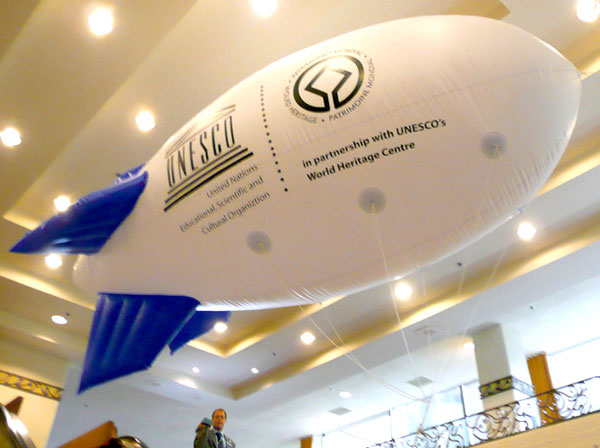
The World Heritage Center and the World Air League, a U.S.-based nongovernmental organization, have established a partnership aiming to promote environmental protection and the use of lighter-than-air skyships as a means to reduce pollution and pressures caused by transportation.

The World Air League is currently promoting the World Sky Race,
an historic tour and competition of lighter-than-air skyships racing 30,000+ miles. It also will be setting up on its website a means to make charitable contributions to the UNESCO World Heritage Sites. Don R. Hartsell, World Air League (WAL) Commissioner and Managing Director is also Chairman of Solex Environmental Systems, Inc.

Monday, September 22, 2008

Training-the-Trainers in Information Literacy

Information Literacy is the set of skills needed to find, retrieve, analyze, and use information.
The American Library Association
Information and media literacy enables people to interpret and make informed judgments as users of information and media, as well as to become skillful creators and producers of information and media messages in their own right. UNESCO encourages the development of national information and media literacy policies, including in education.

In September 2007, the Bureau of the Intergovernmental Council for the Information for All Program (IFAP) decided to fund a global scale-up project on information literacy and agreed on a series of regional Training-The-Trainers workshops in information literacy.

The project foresees to organize a series of 11 Training-the-Trainers workshops in information literacy, to be held from 2008 to 2009 in several institutions of higher education covering all regions of the world.

Saturday, September 20, 2008

UNESCO Director-General Koïchiro Matsuura to Visit U.S.A.

UNESCO Director-General Koïchiro Matsuura will attend the 63rd session of the United Nations General Assembly. During his visit to New York, 21 - 25 September. He will meet UN Secretary-General Ban Ki-Moon and participate in a series of high-level events:

  • 22 September: White House Symposium on literacy; luncheon hosted by First Lady Laura Bush; high-level meeting on Africa’s development needs

  • 23 September: meeting of the five UN agencies responsible for the Education For All (EFA) program; host lunch on “Financing Education for the Millennium Development Goals (MDGs)”, and present Rumi Medal to Afghanistan President Karzai

  • 24 September: side event hosted by United Nations Development Program (UNDP) and Spain on the MDG Achievement Fund

  • 25 September: act as rapporteur in Roundtable on Education and Health.

White House Symposium on Literacy

Mrs. Bush, who serves as an Honorary Ambassador
to the United Nations Decade of Literacy,
addresses a UNESCO roundtable in 2007.


First lady Laura Bush will host a symposium titled “Advancing Global Literacy: Building a Foundation for Freedom,” in New York on September 22, 2008.

First Ladies from over 80 countries, ministers of education and other high-ranking representatives are expected to underscore how literacy helps build a strong foundation for freedom during this White House Symposium.

International Day of Peace, 21 September 2008

Each year the United Nations system celebrates the International Day of Peace on September 21st. As part of the observation of the day, this week UNESCO Director-General Koïchiro Matsuura awarded the 2008 UNESCO Prize for Peace Education to the Institute for Justice and Reconciliation (South Africa) in recognition of its outstanding efforts in building sustainable reconciliation through education and in addressing systemic injustice in Africa.

UNESCO Global Literacy Conference in Mexico City Highlights U.S.-Sponsored Programs

A Bolivian mother reads to her infant son
© Photo Whitehouse Conference on Global Literacy

Two U.S. government funded literacy programs will be among the organizations highlighted at the upcoming UNESCO Regional Conference for Global Literacy in Mexico City, on September 10-13, 2008.
  • Alfalit International, Inc. (Bolivia), a USAID funded non-profit educational organization that offers literacy and basic education programs in 25 countries.
  • Educatodos (Honduras), an alternative basic education delivery system created by the Ministry of Education and USAID for out-of-school youth and adults to complete a primary and lower secondary (grades 7-9) education.

HP-UNESCO Partnership

Scientists at the Cheikh Anta Diop University (UCAD) in Dakar (Senegal) are now better placed to cooperate with researchers overseas thanks to the installation of the first computing grid at the university, the fruit of a joint effort by the UNESCO/Hewlett-Packard project “Reversing Brain Drain into Brain Gain for Africa” and the Grid Computing Institute of France’s National Centre for Scientific Research (CNRS).

The project aims to provide universities in five African countries with grid computing technology so as to reduce migration of African university graduates by giving them the tools they need for their research.

The joint project “Reversing Brain Drain into Brain Gain for Africa” follows the successful implementation of a similar UNESCO/Hewlett-Packard initiative for Southeast Europe, launched in 2003.

Read more!

Friday, September 19, 2008

Some Great World Heritage Sites on the Internet


Here are some sites to help you learn about and experience the world heritage sights selected by UNESCO:

Decentralization in the Culture Program

Underwater archaeology
the Saint-Honorat1 wreck 17th century
© UNESCO; M L Hour / Drassm

While UNESCO's Culture Program is centered in UNESCO's headquarters in Paris, a great deal of its work is decentralized into a network of Institutes and Centers, as well as country field offices and cluster offices providing education related services to a cluster of nations. The UNESCO Institute for Statistics provides statistical support for the education programs as well as the other UNESCO programs.

The World Heritage Center although located in Paris has its own World Heritage Committee which provides oversight for the program implementing the World Heritage Convention.

Other centers under the auspices of UNESCO and its culture program are:
The Cluster and Regional Offices for Culture
  • Venice (Europe and North America)
  • Havana (Latin America and the Caribbean)

Wednesday, September 17, 2008

Decentralization in the Education Program

While UNESCO's Education Program is centered in UNESCO's headquarters in Paris, a great deal of its work is decentralized into a network of Institutes and Centers, as well as country field offices and cluster offices providing education related services to a cluster of nations. The UNESCO Institute for Statistics provides statistical support for the education programs as well as the other UNESCO programs.

The Centers and Institutes of the Education Program are:
Other Centers or Institutes under the auspices of UNESCO
The Cluster and Regional Offices for Education

The Intangible Heritage Network

This network's website is dedicated to the involvement of non-governmental organizations and civil society in topics related with the intangible cultural heritage. The network's founders feel that "the UNESCO Convention for the Safeguarding of the Intangible Cultural Heritage represents an important achievement concerning the recognition and advancement of cultural rights. Moreover, it has involved State Parties undersigning it in a consistent exercise towards the identification and study of their intangible cultural heritage."

YOu might want to check out this site with interesting photos posted by the Intangible Heritage Network.

Monday, September 15, 2008

Online Volunteer Needed

One or more online volunteers sought to help post materials on this blog. The volunteer would scan the UNESCO websites to identify materials from UNESCO's educational and/or cultural programs worth spotlighting, such as news, new events or publications, or interesting programs. The blog is widely read internationally, but is especially focused on materials of interest to people in the United States.

Several neophyte bloggers have learned to post on the site in less than one hour. An effort of an hour or two per week on the average should do the job, and would be greatly appreciated.

If you are interested, please send an email to me with your biography or a brief description of your background and interests.

john.daly@gmail.com

Sunday, September 14, 2008

UNESCO Courier: Claude Lévi-Strauss

A recent issue of the UNESCO Courier is devoted to remembrance of Claude Lévi-Strauss, the great Anthropologist who published often in The Courier, was very close to UNESCO during his life, and was even in his 90's an active participant in the celebrations of UNESCO's 60th anniversary in 2005.


Quotations:
“The efforts of science should not only enable mankind to surpass itself; they must also help those who lag behind to catch up.”
“No doubt we take comfort in the dream that equality and fraternity will one day reign among men, without compromising their diversity.”
“Nothing indicates racial prejudices are diminishing and indications are not lacking to suggest that after brief local respites, they surge up again elsewhere with renewed intensity. Which is why UNESCO feels the need periodically to take up again a struggle whose outcome is uncertain, to say the least.”
“But who better than UNESCO can draw the attention of scientists and technicians to the fact (which they so often tend to overlook) that the purposes of science are not only to solve scientific problems but to find answers to social problems as well.”

UNESCO roundtable on the development, culture and identity of indigenous peoples

Image © Ayodele Banjo

A roundtable titled “Indigenous Peoples: Development with Culture and Identity” is to take place 15 September at UNESCO Headquarters*. It is to lay the ground for reflection on this theme which will also be discussed at the 9th session of the U.N. Permanent Forum on Indigenous Issues (UNPFII) to be held in New York in 2010. Participants are to focus on the contribution of indigenous approaches to sustainable development in the age of globalization. They will also seek to reinforce cooperation among indigenous peoples, governments and the United Nations system as a whole.

The event will be opened by the UNESCO Director-General Koïchiro Matsuura. Participants will include Victoria Tauli-Corpuz (Igorot, Philippines), Margaret Lokawua (Karamoja, Uganda) and Carlos Mamani Condorí (Aymará, Bolivia), respectively chair and members of the UNPFII. John Scott of the Secretariat for the Convention on Biological Diversity; Julian Burger, Coordinator, Indigenous Peoples and Minorities Unit, Office of the UN High Commissioner for Human Rights (OHCHR); Anaisabel Prera, Guatemala’s Ambassador to France and Permanent Delegate to UNESCO; and Darriann Riber of the Danish International Development Agency will also be participating.

An estimated 350 million indigenous peoples live in over 70 countries and speak more than 5,000 languages: such is the importance of indigenous people today. Their cultures express the powerful links between humanity and nature, between tradition and modernity, offering a holistic view of the world. They could become a source of renewal for the future. Despite their major contribution to cultural diversity and to sustainable development, many of them are marginalized and deprived of basic human rights.

Thanks to the Readers of this Blog!


Technorati rank for this blog is 1,542,567.

Last year David Sifry wrote that, as is shown in the graph above, " Technorati is now tracking over 70 million weblogs". New blogs are starting all the time, and that number has no doubt increased.

Thus, our readers have put this blog in the top two percent of all blogs.

Thank you very much!

We hope it has and will continue to provide useful information and insights,

Thursday, September 11, 2008

UNESCO's Abdul Waheed Khan: ICT to shape the future of education and learning


Abdul Waheed Khan, UNESCO’s Assistant Director-General for Communication and Information, shares his insights on education and the role of ICT for socio-economic development in the Global Knowledge Partnership (GKP) Through The Looking Glass Series. More!

Juan Luis Guerra: UNESCO Artist for Peace

UNESCO's Director-General will designate the Dominican musician Juan Luis Guerra UNESCO Artist for Peace during a ceremony on 15 September at the Organization’s Headquarters in Paris.


Tuesday, September 09, 2008

Friends of World Heritage on Facebook


Friends of World Heritage, a U.S. based non-governmental organization, has created a group on Facebook, and also has established a Facebook fanpage where you can share information with the other members of the group.

Indigenous Peoples: Development with Culture and Identity

From 15 to 17 September, UNESCO will host the annual meeting of the Inter-Agency Support Group on Indigenous Peoples and welcome the first official visit to UNESCO of the UN Permanent Forum on Indigenous Issues.

“Water and Peace for the People”

What if the countries in the Middle East had no choice but to get along in order to share the region’s meagre water resources? This is the starting premise of Jon Martin Trondalen’s book “Water and Peace for the People”, which will be launched on 11 September at UNESCO.

“Water and Peace for the People”, released by UNESCO Publishing, offers a practical guide that suggests concrete ways to resolve these crises. Analyzing what is at stake in each situation while releasing new information, the author examines the conflicts in the Upper Jordan River between Israel and Syria around the Golan Heights, between Israel and Lebanon over the Wazzani Spring, and the longstanding water dispute between Palestinians and Israelis. Challenges confronting Turkey, Syria and Iraq in sharing water of the Euphrates and Tigris Rivers are also assessed.

UNESCO commemorates the 60th anniversary of the Universal Declaration of Human Rights

The 60th anniversary of the Universal Declaration of Human Rights is being commemorated in a year-long campaign by the UN system. UNESCO, like the rest of the agencies of the system, is evaluating its progress in respecting and promoting human rights. The motto of this campaign is “Dignity and Justice for All of Us”.

In addition, the 61st Annual Conference of Non-Governmental Organizations (NGOs), which was held at UNESCO Headquarters from 3 to 5 September 2008 by the United Nations Department of Public Information, focused on the commemoration of the Declaration’s 60th anniversary.

Tuesday, September 02, 2008

About the UNESCO Website

Alexa, a company providing information about website use, reports that 0.014 percent of global internet users visit the UNESCO website. Consequently, at the moment, UNESCO's website ranks number 8,136 in cyberspace in terms of traffic. (By comparison, the Americans for UNESCO website ranks 9,968,024; the AU education and culture blog ranks 5,434,393; the AU science and communications blog ranks 5,790,834.) Alexa also reports that the percentage of global Internet users who used UNESCO's website has gone down over the past three months. On the average, a visitor to the UNESCO website downloads about 2.5 pages of material.

10.7 percent of the visitors to the UNESCO website are from the United States.

The most visited pages are:

Monday, September 01, 2008

U.N. Conference of Non-Governmental Organizations

For the first time in its 60 year history the annual meeting of some 1,700 non-governmental organizations affiliated with the United Nations will take place outside of the United Nations headquarters in New York.

More than 2000 delegates are to meet at UNESCO Headquarters in Paris from 3 to 5 September 2008 under the banner of the 60th anniversary of the Universal Declaration of Human Rights.

The Declaration was signed in Paris, and it was therefore considered fitting that the NGO meeting be held there. UNESCO played a key role in the deliberations leading to the Declaration, carrying out a landmark study to demonstrate that indeed, all cultures did recognize common human rights.

The Conference will provide:
  • background on the human rights treaty system (Day 1);
  • perspectives on the implementation of human rights in the context of on-going challenges as well as emerging issues worldwide (Day 2); and
  • outlooks on how to make better use of existing mechanisms for the protection of human rights at the international and national levels, as well as to examine ways to empower civil society at the local level (Day 3).
It will be opened by United Nations Secretary-General Ban Ki-moon via video-conference at 10:00 a.m. on 3 September 2008.

The UNESCO Courier: 2008 - number 7

Literacy is the best remedy

Finishing primary school makes it five time more likely that the person is informed about HIV and AIDS. Malaria, which kills a million people a year, is most deadly among the illiterate. Literacy and good health are inseparable. This is the theme of International Literacy Day (8 September) and the 2008 UNESCO International Literacy Prizes.

Read the new issue of the UNESCO Courier focusing on literacy and health!