Read U.S. Secretary of Education Margaret Spelling's remarks to the Plenary Session, and the note she transmitted from the First Lady, Laura Bush.
An excerpt from the remarks:
"Together, we have helped countries move toward a more hopeful and sustainable future of freedom and prosperity. As we all know, the road to democracy starts with a commitment to education. In Iraq, UNESCO has led the effort to replace hateful propaganda in schools with math and science textbooks. And in Afghanistan, UNESCO has helped strengthen teacher training and literacy programs for women.
"Last spring, Mrs. Bush and I visited the new Women’s Teacher Training Institute in Kabul. The women at this school want to help spread literacy and opportunity to every corner of Afghanistan. They are anxious to learn and to have a voice in their nation’s future.
"Although we come from many different places, we all understand the importance of education. And we all agree that we must work together to achieve the goals of UNESCO’s Education for All effort. We know that literacy and education are the keys to success for individuals and for nations. And we face the challenge of ensuring everyone has access to them."
Secretary Spellings also spoke to the Ministerial Round Table on Education for All.
Tuesday, October 25, 2005


Information Society: The Next Steps
Read the entire Special edition on the Development Gateway's Information and Communications Technology for Development topic page.:
"The Information Society has produced a tantalizing array of new information and communication technologies (ICT) that today have transformed the approach to global development. Access to these technologies is spreading rapidly. In 2005, the number of Internet users in developing countries will cross the 500 million mark, surpassing industrial nations for the first time. By some estimates, more than 75 percent of the world’s population now lives within range of a mobile network. Yet the long-heralded promise of ICT remains out of reach for most of the developing world. For the information poor, economic and social gaps are in fact widening both within and between countries.
Following on the rapid expansion of the Information Society, the United Nations called for a World Summit on the Information Society (WSIS) organized under the auspices of the International Telecommunication Union. The two-phase summit, begun in Geneva in 2003, concludes in November 2005 with WSIS Phase II in Tunisia. The goal of this meeting is to assess progress and prompt further global action to capture the promise of ICT for all. This Special Report 'Information Society: The Next Steps' looks at how the ICT landscape is changing in the developing world and what lies ahead. Experts from governments, donors, NGOs and the private sector speak out about effective policies, promising applications and innovative business models."
UNESCO is one of the organizing agencies for WSIS, and is to play a key role in implementing its recommendations. Indeed, it is the participation of UNESCO in the Summit (in addition to its co-organizer, the International Telecommunications Union) that assures that the focus will be not only on telecommunications, but on the broader issues of education, science, culture and communications fundamental to creation of just, effective Information Societies.
"The Information Society has produced a tantalizing array of new information and communication technologies (ICT) that today have transformed the approach to global development. Access to these technologies is spreading rapidly. In 2005, the number of Internet users in developing countries will cross the 500 million mark, surpassing industrial nations for the first time. By some estimates, more than 75 percent of the world’s population now lives within range of a mobile network. Yet the long-heralded promise of ICT remains out of reach for most of the developing world. For the information poor, economic and social gaps are in fact widening both within and between countries.
Following on the rapid expansion of the Information Society, the United Nations called for a World Summit on the Information Society (WSIS) organized under the auspices of the International Telecommunication Union. The two-phase summit, begun in Geneva in 2003, concludes in November 2005 with WSIS Phase II in Tunisia. The goal of this meeting is to assess progress and prompt further global action to capture the promise of ICT for all. This Special Report 'Information Society: The Next Steps' looks at how the ICT landscape is changing in the developing world and what lies ahead. Experts from governments, donors, NGOs and the private sector speak out about effective policies, promising applications and innovative business models."
UNESCO is one of the organizing agencies for WSIS, and is to play a key role in implementing its recommendations. Indeed, it is the participation of UNESCO in the Summit (in addition to its co-organizer, the International Telecommunications Union) that assures that the focus will be not only on telecommunications, but on the broader issues of education, science, culture and communications fundamental to creation of just, effective Information Societies.
Monday, October 24, 2005
Choike,org on the UNESCO adoption of the Convention on Cultural Diversity
Read the full statement on the Choike website.
"The United Nations cultural body adopted an international treaty Thursday to protect cultural diversity, marking what experts say is a first but important moral victory in the long-running fight to preserve the world's cultural richness.
"After more than three years of sometimes cantankerous debates, the General Conference of UNESCO (United Nations Educational, Scientific, and Cultural Organisation), meeting at the Paris headquarters, adopted by overwhelming majority the Convention on the Protection of the Diversity of Cultural Contents and Artistic Expressions.
"In the Thursday vote, 148 countries approved the convention, two -- the United States and Israel -- voted against it, and four abstained. The new rules will enter into force three months after its ratification by 30 states.
"Although the treaty is seen as a triumph for developing and European countries in the struggle to preserve their unique cultural identities from domination by the so-called "entertainment industry", à la Hollywood, many experts see it as only a first step.
"'The adoption of this convention is a moral victory, but the real test is whether developing countries will resist U.S. pressure to commit their audiovisual services and information services during trade negotiations,' Sasha Constanza Koch, media expert with the coalition Communication Rights in the Information Society, told IPS."
Read Choike's materials published on its website in September in support of the Convention.
Choike is a portal dedicated to improving the visibility of the work done by NGOs and social movements from the South. It serves as a platform where citizen groups can disseminate their work and at the same time enrich it with information from diverse sources, which is presented from the perspective of Southern civil society.
The word Choike is taken from the language of the Mapuche, a tribe living in the southern South America, and refers to the Southern Cross -- the guidestar of the southern hemesphere.
"The United Nations cultural body adopted an international treaty Thursday to protect cultural diversity, marking what experts say is a first but important moral victory in the long-running fight to preserve the world's cultural richness.
"After more than three years of sometimes cantankerous debates, the General Conference of UNESCO (United Nations Educational, Scientific, and Cultural Organisation), meeting at the Paris headquarters, adopted by overwhelming majority the Convention on the Protection of the Diversity of Cultural Contents and Artistic Expressions.
"In the Thursday vote, 148 countries approved the convention, two -- the United States and Israel -- voted against it, and four abstained. The new rules will enter into force three months after its ratification by 30 states.
"Although the treaty is seen as a triumph for developing and European countries in the struggle to preserve their unique cultural identities from domination by the so-called "entertainment industry", à la Hollywood, many experts see it as only a first step.
"'The adoption of this convention is a moral victory, but the real test is whether developing countries will resist U.S. pressure to commit their audiovisual services and information services during trade negotiations,' Sasha Constanza Koch, media expert with the coalition Communication Rights in the Information Society, told IPS."
Read Choike's materials published on its website in September in support of the Convention.
Choike is a portal dedicated to improving the visibility of the work done by NGOs and social movements from the South. It serves as a platform where citizen groups can disseminate their work and at the same time enrich it with information from diverse sources, which is presented from the perspective of Southern civil society.
The word Choike is taken from the language of the Mapuche, a tribe living in the southern South America, and refers to the Southern Cross -- the guidestar of the southern hemesphere.
UNESCO has prominent role in WSIS, says General Conference: UNESCO-CI
Read the full UNESCO news release. (10/21/05)
"Unanimous support to UNESCO’s active involvement in the World Summit on the Information Society (WSIS) and its focus on knowledge societies was given by the Organization's General Conference at its 33rd Session yesterday in Paris.........
"In particular, the Member States endorsed UNESCO’s mandate and competence to act as a facilitator for the implementation of the Action Lines: “Access to information and knowledge”; “Capacity-building”; “E-learning and e-science (under ‘ICT applications’)”; “Cultural diversity and identity, linguistic diversity and local content”; “Media”, and “Ethical dimensions of the information society” included in the Plan of Action adopted at the first phase of WSIS, in December 2003, in Geneva."
"Unanimous support to UNESCO’s active involvement in the World Summit on the Information Society (WSIS) and its focus on knowledge societies was given by the Organization's General Conference at its 33rd Session yesterday in Paris.........
"In particular, the Member States endorsed UNESCO’s mandate and competence to act as a facilitator for the implementation of the Action Lines: “Access to information and knowledge”; “Capacity-building”; “E-learning and e-science (under ‘ICT applications’)”; “Cultural diversity and identity, linguistic diversity and local content”; “Media”, and “Ethical dimensions of the information society” included in the Plan of Action adopted at the first phase of WSIS, in December 2003, in Geneva."
Saturday, October 22, 2005
"US official heads to France for talks on UNESCO convention"
Read the full Yahoo! News story.
"A top US official said she would meet her French counterpart and UNESCO officials in Paris as part of a diplomatic effort to prevent ratification of UNESCO's cultural diversity convention.
"The United States suffered a resounding diplomatic defeat Thursday when an overwhelming majority of UNESCO's 191 member-states approved the convention to protect and promote cultural diversity, which Washington fears will hit sales of American movies and music.
"'We want to try to prevent people from ratifying it,' said Kristin Silverberg, a top US State Department official for relations with UN bodies, following talks with Italian officials in Rome.
"'The biggest thing we can do is get countries to agree not to misuse it, that they not cite it in the Hong Kong talks in support of cultural exceptions,' said Silverberg, referring to the next major meeting of the World Trade Organisation (WTO) "Doha Round" negotiations in December.
"Silverberg said she would take Washington's grievances to UNESCO Director General Koichiro Matsuura in a meeting in Paris on Monday."
Kristen Silverberg was recently appointed Assistant Secretary of State, and is in charge of the Bureau of International Organization Affairs. (Read her biography.) Prior to her current assignment, Ms. Silverberg worked in the White House. She is a lawyer, and served as a policy advisor on the 2000 presidential campaign in Austin, Texas.
"A top US official said she would meet her French counterpart and UNESCO officials in Paris as part of a diplomatic effort to prevent ratification of UNESCO's cultural diversity convention.
"The United States suffered a resounding diplomatic defeat Thursday when an overwhelming majority of UNESCO's 191 member-states approved the convention to protect and promote cultural diversity, which Washington fears will hit sales of American movies and music.
"'We want to try to prevent people from ratifying it,' said Kristin Silverberg, a top US State Department official for relations with UN bodies, following talks with Italian officials in Rome.
"'The biggest thing we can do is get countries to agree not to misuse it, that they not cite it in the Hong Kong talks in support of cultural exceptions,' said Silverberg, referring to the next major meeting of the World Trade Organisation (WTO) "Doha Round" negotiations in December.
"Silverberg said she would take Washington's grievances to UNESCO Director General Koichiro Matsuura in a meeting in Paris on Monday."
Kristen Silverberg was recently appointed Assistant Secretary of State, and is in charge of the Bureau of International Organization Affairs. (Read her biography.) Prior to her current assignment, Ms. Silverberg worked in the White House. She is a lawyer, and served as a policy advisor on the 2000 presidential campaign in Austin, Texas.
Sparks fly over UNESCO bioethics pact
Read David Dickson's full article in SciDev.Net.
"The governing body of the United Nations Educational, Scientific and Cultural Organisation (UNESCO) has approved a controversial declaration setting out guidelines for protecting individuals against potential harm from bioscience developments.
"The text, adopted this week (19 October) in Paris, has sparked a huge debate. It is widely seen — by both supporters and critics — as a vehicle for persuading developing countries to adopt policies outlawing research involving human embryos, itself part of a wider campaign against human abortion..........
"At the heart of the document, however, is language that addresses — usually implicitly — the use of embryos in research. This is particularly significant for developing countries, given that a number of them — such as China, India and South Korea — are developing sophisticated capabilities in areas such as stem-cell research that might use human embryos.
"This part of the text, and the declaration's stress on the need to defend 'human dignity', for example, have been widely welcomed by conservative religious groups deeply opposed to abortion or embryo research. So too has the statement that 'the interests and welfare of the individual should have priority over the sole interest of science or society'.
"An advisor to the US delegation at the Paris meeting wrote on the website Christianity Today, 'These resonant assertions of the centrality of human dignity and the limitations of science give us hope and ammunition.'.......
"Many in the professional bioethics community have been less impressed. They argue that the recommendations in the declaration are too vague, and seek to impose unwarranted ideological constraints on areas of research that could have important medical and social benefits.
"It is remarkable that a policy document that is clearly untenable in crucial areas has been approved by the UNESCO general assembly," says Udo Schuklenk, co-editor of the journal Developing World Bioethics, which recently published several articles attacking a draft of the declaration.
"He adds, 'What is problematic, to me as a professional in the field of bioethics, is that as professionals we might be tainted by a document that so clearly should not be called 'bioethics' in the first place.'
"Richard Ashcroft, reader in biomedical ethics at Imperial College London, is similarly concerned. He says it is strange that the document was adopted without being amended after near-universal criticism of the draft declaration by academics."
"The governing body of the United Nations Educational, Scientific and Cultural Organisation (UNESCO) has approved a controversial declaration setting out guidelines for protecting individuals against potential harm from bioscience developments.
"The text, adopted this week (19 October) in Paris, has sparked a huge debate. It is widely seen — by both supporters and critics — as a vehicle for persuading developing countries to adopt policies outlawing research involving human embryos, itself part of a wider campaign against human abortion..........
"At the heart of the document, however, is language that addresses — usually implicitly — the use of embryos in research. This is particularly significant for developing countries, given that a number of them — such as China, India and South Korea — are developing sophisticated capabilities in areas such as stem-cell research that might use human embryos.
"This part of the text, and the declaration's stress on the need to defend 'human dignity', for example, have been widely welcomed by conservative religious groups deeply opposed to abortion or embryo research. So too has the statement that 'the interests and welfare of the individual should have priority over the sole interest of science or society'.
"An advisor to the US delegation at the Paris meeting wrote on the website Christianity Today, 'These resonant assertions of the centrality of human dignity and the limitations of science give us hope and ammunition.'.......
"Many in the professional bioethics community have been less impressed. They argue that the recommendations in the declaration are too vague, and seek to impose unwarranted ideological constraints on areas of research that could have important medical and social benefits.
"It is remarkable that a policy document that is clearly untenable in crucial areas has been approved by the UNESCO general assembly," says Udo Schuklenk, co-editor of the journal Developing World Bioethics, which recently published several articles attacking a draft of the declaration.
"He adds, 'What is problematic, to me as a professional in the field of bioethics, is that as professionals we might be tainted by a document that so clearly should not be called 'bioethics' in the first place.'
"Richard Ashcroft, reader in biomedical ethics at Imperial College London, is similarly concerned. He says it is strange that the document was adopted without being amended after near-universal criticism of the draft declaration by academics."
Friday, October 21, 2005
Close of the General Conference of UNESCO
Read the full UNESCO message on the closure of the General Conference.
"The adoption of three standard-setting texts and the re-election of Ko�chiro Matsuura as Director-General of UNESCO marked the 33rd session of UNESCO’s General Conference, which closed today. The texts adopted are: the Convention on the Protection and Promotion of the Diversity of Cultural Expressions; the International Convention Against Doping in Sport; and the Universal Declaration on Bioethics and Human Rights. A day of reflection about human dignity, as well as two Ministerial Round Tables – one on Education for All (EFA), another on the basic sciences – and an exhibition about EFA, were also organized during the 33rd session. Every two years the General Conference, UNESCO’s highest decision-making body, brings together representatives from all Member States (191, since Brunei Darussalam joined the Organization recently). Eight heads of state and more than 200 ministers1 were among the 3,700 participants of the session, held at UNESCO Headquarters from October 3 to 21.........
"For 2006-2007, the General Conference adopted a budget of US$610 million - in keeping with the scenario proposed by the Director General – to which are to be added US$25 million in extra-budgetary voluntary funding to reinforce activities in priority areas. Education – 'priority of priorities,' according to Mr Matsuura – received a budget of US$107 and will benefit from the lion’s share of the extra budgetary funding. The Natural Sciences sector is to receive close to US$56 million, and the Social and Human Sciences close to US$31 million. The Culture Programme was allocated US$50.5 million, and the Communication and Information Programme close to US$33 million."
In an unusual step, the U.S. Delegation called for a vote on the budget at the General Conference, and voted against the budget. An observer reported that the U.S. delegation said its negative vote was because of: (1) lack of program concentration on priorities, and (2) funding of the Cultural Diversity Convention is in the budget, which the U.S. thinks will do harm. The vote was 126-1, with no abstentions.
The U.S. Mission to UNESCO has provided links to statements on issues raised in the General Conference on its website, as well as on the Executive Board Meeting that preceeded the General Conference, and on the Science Round Table held in conjunction with the General Conference.
"The adoption of three standard-setting texts and the re-election of Ko�chiro Matsuura as Director-General of UNESCO marked the 33rd session of UNESCO’s General Conference, which closed today. The texts adopted are: the Convention on the Protection and Promotion of the Diversity of Cultural Expressions; the International Convention Against Doping in Sport; and the Universal Declaration on Bioethics and Human Rights. A day of reflection about human dignity, as well as two Ministerial Round Tables – one on Education for All (EFA), another on the basic sciences – and an exhibition about EFA, were also organized during the 33rd session. Every two years the General Conference, UNESCO’s highest decision-making body, brings together representatives from all Member States (191, since Brunei Darussalam joined the Organization recently). Eight heads of state and more than 200 ministers1 were among the 3,700 participants of the session, held at UNESCO Headquarters from October 3 to 21.........
"For 2006-2007, the General Conference adopted a budget of US$610 million - in keeping with the scenario proposed by the Director General – to which are to be added US$25 million in extra-budgetary voluntary funding to reinforce activities in priority areas. Education – 'priority of priorities,' according to Mr Matsuura – received a budget of US$107 and will benefit from the lion’s share of the extra budgetary funding. The Natural Sciences sector is to receive close to US$56 million, and the Social and Human Sciences close to US$31 million. The Culture Programme was allocated US$50.5 million, and the Communication and Information Programme close to US$33 million."
In an unusual step, the U.S. Delegation called for a vote on the budget at the General Conference, and voted against the budget. An observer reported that the U.S. delegation said its negative vote was because of: (1) lack of program concentration on priorities, and (2) funding of the Cultural Diversity Convention is in the budget, which the U.S. thinks will do harm. The vote was 126-1, with no abstentions.
The U.S. Mission to UNESCO has provided links to statements on issues raised in the General Conference on its website, as well as on the Executive Board Meeting that preceeded the General Conference, and on the Science Round Table held in conjunction with the General Conference.
Google Map links for Unesco World Heritage Sites
Google Map links for Unesco World Heritage Sites
Brad Templeton has created this website on the UNESCO World Heritage Sites. It is complementary to UNESCO's own website. Go to any country that interests you, and click on the site. You will see a satellite image of the region from Google, and you can zoom into or out of the picture to see the site in more detail or in its larger context. Google also provides maps, and combinations of the map and satellite images.
Templeton was the founder and publisher of ClariNet Communications Corp., the world's first ever ".com" company (founded in 1989) and which was also the net's first and for a long time largest electronic newspaper.
Brad Templeton has created this website on the UNESCO World Heritage Sites. It is complementary to UNESCO's own website. Go to any country that interests you, and click on the site. You will see a satellite image of the region from Google, and you can zoom into or out of the picture to see the site in more detail or in its larger context. Google also provides maps, and combinations of the map and satellite images.
Templeton was the founder and publisher of ClariNet Communications Corp., the world's first ever ".com" company (founded in 1989) and which was also the net's first and for a long time largest electronic newspaper.
Media Coverage of the Convention on Cultural Diversity
Check out the links to current articles.
MediaTradeMonitor editor, Sasha Costanza-Chock, has posted links to a number of articles on the Convention on the Social Bookmarking website, del.cio.us.
MediaTradeMonitor editor, Sasha Costanza-Chock, has posted links to a number of articles on the Convention on the Social Bookmarking website, del.cio.us.
UNESCO approves convention on cultural diversity | Media Trade Monitor
Visit the Media Trade Monitor website on the Convention on Cultural Diversity
"UNESCO has approved the Convention on Cultural Diversity (CCD), after several years of negotiations. The CCD (formally known as the Convention on the Protection and Promotion of the Diversity of Cultural Contents and Artistic Expressions) is meant to provide legal backing to the principle that culture cannot be reduced to a commodity. Concretely, it is meant to allow each country to exclude its cultural policies, including 'audiovisual services' - otherwise known as the mass media - from 'free trade' deals like the WTO.
"During the negotiations, progressive NGO networks like the International Network on Cultural Diversity and the campaign for Communication Rights in the Information Society called for broad civil society support for the CCD, but warned that it must not be subordinated to the WTO and must be written to support cultural and media diversity inside countries, not only between them. In addition, they successfully lobbied for the elimination of language that would have supported the current extremist copyright regime, but failed to insert references to the importance of the public domain, fair use, and the creative commons."
Media Trade Monitor is a partnership between Free Press, the International Network for Cultural Diversity (INCD), and the campaign for Communication Rights in the Information Society (CRIS).
"UNESCO has approved the Convention on Cultural Diversity (CCD), after several years of negotiations. The CCD (formally known as the Convention on the Protection and Promotion of the Diversity of Cultural Contents and Artistic Expressions) is meant to provide legal backing to the principle that culture cannot be reduced to a commodity. Concretely, it is meant to allow each country to exclude its cultural policies, including 'audiovisual services' - otherwise known as the mass media - from 'free trade' deals like the WTO.
"During the negotiations, progressive NGO networks like the International Network on Cultural Diversity and the campaign for Communication Rights in the Information Society called for broad civil society support for the CCD, but warned that it must not be subordinated to the WTO and must be written to support cultural and media diversity inside countries, not only between them. In addition, they successfully lobbied for the elimination of language that would have supported the current extremist copyright regime, but failed to insert references to the importance of the public domain, fair use, and the creative commons."
Media Trade Monitor is a partnership between Free Press, the International Network for Cultural Diversity (INCD), and the campaign for Communication Rights in the Information Society (CRIS).
The Cultural Diversity Convention Coverage in the Washington Post
Read the full article in the Washington Post.
"In a vote cast as a battle of global conformity vs. cultural diversity, delegates to a U.N. agency turned aside strong U.S. objections Thursday and overwhelmingly approved the first international treaty designed to protect movies, music and other cultural treasures from foreign competition.
"The 148 to 2 vote at the U.N. Educational, Scientific and Cultural Organization emerged as a referendum on the world's love-hate relationship with Hollywood, Big Macs and Coca-Cola......
"U.S. officials say the measure could be used to unfairly obstruct the flow of ideas, goods and services across borders. Films and music are among the United States' largest exports -- the foreign box-office take for American movies was $16 billion in 2004. Assuring access to overseas markets for these products has been a prime U.S. goal at the World Trade Organization..........
"The vote came less than a month after delegates at a U.N.-organized summit in Geneva sided against the United States to try to remove technical control of the Internet from U.S. hands. Talks deadlocked after the European Union refused to support the United States, in a move that stunned American officials.
"'In the battles over issues critical to shaping the globe in the 21st century,' French sociologist Eric Fassin said, 'each side is defending its own best interests.' Most of the world, he said, is asking: 'Is there only one way to look at things?'
"Proponents are uncertain how the convention would be enforced or how potential conflicts with the free-trade rules of the World Trade Organization would be resolved. The convention states that it is not intended to overrule existing treaties but would have equal force with future ones."
From the blogosphere:
Accidental Deliberations: "While the U.S. position was based on a claim to freedom of information (in this case, the freedom to dump whatever information it wants whenever and wherever it pleases), the real question was whether local languages and cultures could be defended and allowed to survive when faced with well-funded foreign influences - whether from the U.S. or otherwise. It's only appropriate that the U.N. nearly unanimously chose the right side of that question."
"In a vote cast as a battle of global conformity vs. cultural diversity, delegates to a U.N. agency turned aside strong U.S. objections Thursday and overwhelmingly approved the first international treaty designed to protect movies, music and other cultural treasures from foreign competition.
"The 148 to 2 vote at the U.N. Educational, Scientific and Cultural Organization emerged as a referendum on the world's love-hate relationship with Hollywood, Big Macs and Coca-Cola......
"U.S. officials say the measure could be used to unfairly obstruct the flow of ideas, goods and services across borders. Films and music are among the United States' largest exports -- the foreign box-office take for American movies was $16 billion in 2004. Assuring access to overseas markets for these products has been a prime U.S. goal at the World Trade Organization..........
"The vote came less than a month after delegates at a U.N.-organized summit in Geneva sided against the United States to try to remove technical control of the Internet from U.S. hands. Talks deadlocked after the European Union refused to support the United States, in a move that stunned American officials.
"'In the battles over issues critical to shaping the globe in the 21st century,' French sociologist Eric Fassin said, 'each side is defending its own best interests.' Most of the world, he said, is asking: 'Is there only one way to look at things?'
"Proponents are uncertain how the convention would be enforced or how potential conflicts with the free-trade rules of the World Trade Organization would be resolved. The convention states that it is not intended to overrule existing treaties but would have equal force with future ones."
From the blogosphere:
Accidental Deliberations: "While the U.S. position was based on a claim to freedom of information (in this case, the freedom to dump whatever information it wants whenever and wherever it pleases), the real question was whether local languages and cultures could be defended and allowed to survive when faced with well-funded foreign influences - whether from the U.S. or otherwise. It's only appropriate that the U.N. nearly unanimously chose the right side of that question."
Thursday, October 20, 2005
"UNESCO adopts culture convention despite opposition from US"
Read the full Xinhuanet story. (China)
"The United Nations Educational, Scientific and Culture Organization (UNESCO) adopted Thursday to the great displeasure of the United States a convention aiming at protecting and promoting the diversity of cultural expressions.
"Out of 154 countries represented at the two-yearly General Conference of UNESCO, 148 voted the text seen by most of UNESCO's 191 member states as an important tool to protect local languages,arts and culture against English-speaking globalisation and US 'cultural imperialism'.
"Only the United States and Israel voted against it and four countries abstained."
"The United Nations Educational, Scientific and Culture Organization (UNESCO) adopted Thursday to the great displeasure of the United States a convention aiming at protecting and promoting the diversity of cultural expressions.
"Out of 154 countries represented at the two-yearly General Conference of UNESCO, 148 voted the text seen by most of UNESCO's 191 member states as an important tool to protect local languages,arts and culture against English-speaking globalisation and US 'cultural imperialism'.
"Only the United States and Israel voted against it and four countries abstained."
Ministerial Round Table "Education for All"
View a Webcast On-demand
More than 50 education ministers and high-ranking officials responsible for education met to take stock of the main challenges of Education for All at UNESCO Headquarters on October 7 and 8, 2005.
UNESCO provided releases with supporting materials:
Click here to see the communiqué issued by 90 education ministers and high-ranking officials present at UNESCO’s headquarters for the Ministerial Round Table.
There was also a Parlementary Round Table on the subject, held October 12, 2005.
More than 50 education ministers and high-ranking officials responsible for education met to take stock of the main challenges of Education for All at UNESCO Headquarters on October 7 and 8, 2005.
UNESCO provided releases with supporting materials:
- on the first day of the meeting; and
- on the second day of the meeting.
Click here to see the communiqué issued by 90 education ministers and high-ranking officials present at UNESCO’s headquarters for the Ministerial Round Table.
There was also a Parlementary Round Table on the subject, held October 12, 2005.
Koïchiro Matsuura appointed to a second term as Director-General of UNESCO
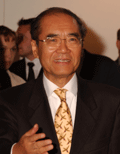
Read the UNESCO announcement.:
"Koichiro Matsuura was re-elected as Director-General of UNESCO by the Organization’s General Conference and is to take office in a ceremony on October 21. He was first elected in 1999 to a six-year term. This time he will serve for four years, following a reform instituted by the 29th session of the General Conference. Mr Matsuura was born in 1937 in Tokyo. He studied law at the University of Tokyo and economics at Haverford College (Pennsylvania, U.S.A.) and began his diplomatic career in 1959. Posts held by Mr Matsuura include those of Director-General of the Economic Co-operation Bureau of Japan’s Ministry of Foreign Affairs (1988); Director-General of the North American Affairs Bureau, Ministry of Foreign Affairs (1990); and Deputy Minister for Foreign Affairs (1992-1994). He was Japan’s Ambassador to France from 1994 to 1999. After one year as the Chairperson of UNESCO’s World Heritage Committee, he became UNESCO’s ninth Director-General on November 12, 1999."
There will be a live Webcast - Friday 21 October - of the Ceremony for the installation of the Director-General. It will take place from 10 a.m to 1 p.m. (GMT 1), and will include a performance by Chico Bouchikhi (founder of Gipsy Kings), UNESCO Artist for Peace. The site for the live webcast is:
http://www.unesco.org/confgen/webcast
UNESCO General Conference adopts International Convention Against Doping in Sport
Read the full UNESCO press release.
"The International Convention Against Doping in Sport was adopted unanimously by the UNESCO General Conference meeting in Paris for its 33 d session. This is the first time a legal instrument aimed at eradicating doping is both binding and universal. A global response to a global problem, such is the challenge put to the new Convention. It supplies governments with a legal framework for an international harmonization of efforts in the fight against a scourge that flouts the ethical and social values of sport while putting the health of athletes at risk."
"The International Convention Against Doping in Sport was adopted unanimously by the UNESCO General Conference meeting in Paris for its 33 d session. This is the first time a legal instrument aimed at eradicating doping is both binding and universal. A global response to a global problem, such is the challenge put to the new Convention. It supplies governments with a legal framework for an international harmonization of efforts in the fight against a scourge that flouts the ethical and social values of sport while putting the health of athletes at risk."
October 24 -- UN Day
Read the United Nations Association discussion of UN Day
The U.N. Charter went into effect on October 24, 1945. Two years later the U.N. General Assembly adopted a U.S.-sponsored resolution declaring October 24th United Nations Day, to be commemorated annually by all member-states of the United Nations. Since 1947, U.N. Day has been observed in nations large and small around the world.
The U.N. Charter went into effect on October 24, 1945. Two years later the U.N. General Assembly adopted a U.S.-sponsored resolution declaring October 24th United Nations Day, to be commemorated annually by all member-states of the United Nations. Since 1947, U.N. Day has been observed in nations large and small around the world.
Wednesday, October 19, 2005
"US isolated over cultural diversity"
Read the full Financial Times article.:
"A United Nations treaty to protect and promote cultural diversity is likely to be overwhelmingly approved on Thursday in the face of lonely opposition from the US, which fears the impact on exports of US films and television programmes.
"In an emotional debate in Unesco (the UN Educational, Scientific and Cultural Organisation) that preceded Thursday's vote, supporters of the treaty - led by France and Canada - said it would help countries defend domestic culture from the homogenising influence of globalisation.
"In a preliminary vote this week, 151 countries backed the pact, with the US and Israel the sole opponents. Australia and the Pacific island of Kiribati abstained."
"A United Nations treaty to protect and promote cultural diversity is likely to be overwhelmingly approved on Thursday in the face of lonely opposition from the US, which fears the impact on exports of US films and television programmes.
"In an emotional debate in Unesco (the UN Educational, Scientific and Cultural Organisation) that preceded Thursday's vote, supporters of the treaty - led by France and Canada - said it would help countries defend domestic culture from the homogenising influence of globalisation.
"In a preliminary vote this week, 151 countries backed the pact, with the US and Israel the sole opponents. Australia and the Pacific island of Kiribati abstained."
U.S. v. the World, Again - The U.N. Convention on Cultural Diversity
Read the entire entry from Opinio Juris
"Sometimes, the U.S. government seems at odds with all of its allies. The most recent example is the battle over the Convention for the Protection of the Diversity of Cultural Contents and Artistic Expressions sponsored by UNESCO, the U.N. Educational, Scientific and Cultural Organization. U.S. Ambassador to UNESCO Louise Oliver criticizes the draft treaty, and UNESCO in general, for failing to deal seriously with the issues in the treaty:
"'The preliminary text addresses a number of very complex issues. They involve culture, development, intellectual property rights, trade, and most important of all, human rights. Have we discussed all of these issues thoroughly? Is this preliminary text coherent, with clearly defined obligations and objectives? Are we convinced that there are no potentially negative consequences that may result from the provisions of this convention? For us the answers to these questions unfortunately are no, no, and no.'"
"Sometimes, the U.S. government seems at odds with all of its allies. The most recent example is the battle over the Convention for the Protection of the Diversity of Cultural Contents and Artistic Expressions sponsored by UNESCO, the U.N. Educational, Scientific and Cultural Organization. U.S. Ambassador to UNESCO Louise Oliver criticizes the draft treaty, and UNESCO in general, for failing to deal seriously with the issues in the treaty:
"'The preliminary text addresses a number of very complex issues. They involve culture, development, intellectual property rights, trade, and most important of all, human rights. Have we discussed all of these issues thoroughly? Is this preliminary text coherent, with clearly defined obligations and objectives? Are we convinced that there are no potentially negative consequences that may result from the provisions of this convention? For us the answers to these questions unfortunately are no, no, and no.'"
Sunday, October 09, 2005
World Heritage Forum
Check out the blog.
Matthias Ripp has provided a blog "to support the exchange of information on UNESCO World Heritage topics and UNESCO World Heritage Sites". It is intended as a starting point for people who are interested in these issues.
This is a very nicely produced blog. For example, this is one of Ripp's photos of Machu Pichu.

Matthias Ripp has provided a blog "to support the exchange of information on UNESCO World Heritage topics and UNESCO World Heritage Sites". It is intended as a starting point for people who are interested in these issues.
This is a very nicely produced blog. For example, this is one of Ripp's photos of Machu Pichu.

Tuesday, October 04, 2005
"FEDERAL ADVISORY COMMITTEES: Additional Guidance Could Help Agencies Ensure Independence and Balance"
Read the full GAO Report.
"In recent years, controversies regarding the federal advisory committee system have included concerns about the appointment of specific individuals to committees and agency decisions to create or terminate some committees. Although a variety of concerns have been raised, the overarching concern was that ideological bias was influencing the selection of experts for scientific and health advisory panels. Publications such as Science, The Lancet, and Chemical and Engineering News have published editorials and articles containing criticisms of decisions seen as injecting ideology into a committee system that should be nonideological. Further, some current and potential federal advisory committee members reported being asked about their political views in the context of decisions regarding their appointment or reappointment to committees." (pages 7 & 8)
"Generally composed of individuals from outside of the federal government, federal advisory committees play an important role in the development of public policy and government regulations by providing advice to policymakers on a wide array of issues. In fiscal year 2003, 54 agencies sponsored approximately 950 committees with about 62,000 members to provide advice by performing peer reviews of scientific research; developing recommendations on specific policy decisions; identifying longrange issues facing the nation; and evaluating grant proposals, among other functions. Their advice—on issues such as stem cell research, space exploration, trade policy, drinking water standards, and drug approvals—can enhance the quality and credibility of federal decision making." (page 14)
"To address controversial and other important matters, scientific and technical advisory committees—which are the primary focus of this report—play a number of different roles on behalf of agencies. One role of science committees is to advise agencies on how to address a set of particular problems." (page 15)
"OGE and GSA governmentwide guidance and the policies and procedures of the nine departments and agencies we reviewed have limitations that reduce their effectiveness in ensuring that advisory committee members are independent and that advisory committees are, and are perceived as being, balanced." (page 17)
What GAO Recommends:
"GAO recommends that GSA and/or OGE, as appropriate, give direction to agencies on: the proper use of representative appointments; information that would help ensure committees are, and are perceived as, balanced; and practices that would better ensure independence and balance and enhance transparency in the advisory committee process. GSA agreed with GAO’s findings and agreed to work with OGE to implement the recommendations. OGE agreed that representative appointments need review but disagreed that its guidance has limitations. GAO continues to believe the guidance could be improved to better ensure that agencies are appropriately appointing committee members." GAO Highlights
This report, of the U.S. General Accounting Office, includes descriptions of the practices and measures by which several U.S. government agencies and the U.S. National Academy of Sciences use to ensure independence and balance and to promote transparency in the federal advisory committee system. Some practices, the report suggessts, should be more widely adopted, such as obtaining nominations from the public and making public information about how members are identified and screened.
Wider use of these practices—particularly for committees addressing sensitive or controversial topics—could reduce the likelihood that committees are, or are perceived as being, biased or imbalanced.
The U.S. National Commission for UNESCO is a duely constituted Federal Advisory Committee, and its charter would seem to include the wide range of scientific and technological issues that engage UNESCO. Thus, the GAO report might well bo of interest to the NatCom members and staff.
Moreover, UNESCO itself as an important function under its charter, gathers scientific and technological advisory groups. Americans are often invited to participate in such groups, and indeed the NatCom may be expected in the future to have a role helping UNESCO to find such participants, as well as to encourage UNESCO toward independence, balance, and transparency in the selection of participants. Note especially, that scientific and technological expertise in the topics under discussion are critical, but not sufficient. U.S. agencies seek scientific balance, as well as geographic, ethnic and gender balance. The GAO report might well also be of interest to UNESCO staff and advisors.
"In recent years, controversies regarding the federal advisory committee system have included concerns about the appointment of specific individuals to committees and agency decisions to create or terminate some committees. Although a variety of concerns have been raised, the overarching concern was that ideological bias was influencing the selection of experts for scientific and health advisory panels. Publications such as Science, The Lancet, and Chemical and Engineering News have published editorials and articles containing criticisms of decisions seen as injecting ideology into a committee system that should be nonideological. Further, some current and potential federal advisory committee members reported being asked about their political views in the context of decisions regarding their appointment or reappointment to committees." (pages 7 & 8)
"Generally composed of individuals from outside of the federal government, federal advisory committees play an important role in the development of public policy and government regulations by providing advice to policymakers on a wide array of issues. In fiscal year 2003, 54 agencies sponsored approximately 950 committees with about 62,000 members to provide advice by performing peer reviews of scientific research; developing recommendations on specific policy decisions; identifying longrange issues facing the nation; and evaluating grant proposals, among other functions. Their advice—on issues such as stem cell research, space exploration, trade policy, drinking water standards, and drug approvals—can enhance the quality and credibility of federal decision making." (page 14)
"To address controversial and other important matters, scientific and technical advisory committees—which are the primary focus of this report—play a number of different roles on behalf of agencies. One role of science committees is to advise agencies on how to address a set of particular problems." (page 15)
"OGE and GSA governmentwide guidance and the policies and procedures of the nine departments and agencies we reviewed have limitations that reduce their effectiveness in ensuring that advisory committee members are independent and that advisory committees are, and are perceived as being, balanced." (page 17)
What GAO Recommends:
"GAO recommends that GSA and/or OGE, as appropriate, give direction to agencies on: the proper use of representative appointments; information that would help ensure committees are, and are perceived as, balanced; and practices that would better ensure independence and balance and enhance transparency in the advisory committee process. GSA agreed with GAO’s findings and agreed to work with OGE to implement the recommendations. OGE agreed that representative appointments need review but disagreed that its guidance has limitations. GAO continues to believe the guidance could be improved to better ensure that agencies are appropriately appointing committee members." GAO Highlights
This report, of the U.S. General Accounting Office, includes descriptions of the practices and measures by which several U.S. government agencies and the U.S. National Academy of Sciences use to ensure independence and balance and to promote transparency in the federal advisory committee system. Some practices, the report suggessts, should be more widely adopted, such as obtaining nominations from the public and making public information about how members are identified and screened.
Wider use of these practices—particularly for committees addressing sensitive or controversial topics—could reduce the likelihood that committees are, or are perceived as being, biased or imbalanced.
The U.S. National Commission for UNESCO is a duely constituted Federal Advisory Committee, and its charter would seem to include the wide range of scientific and technological issues that engage UNESCO. Thus, the GAO report might well bo of interest to the NatCom members and staff.
Moreover, UNESCO itself as an important function under its charter, gathers scientific and technological advisory groups. Americans are often invited to participate in such groups, and indeed the NatCom may be expected in the future to have a role helping UNESCO to find such participants, as well as to encourage UNESCO toward independence, balance, and transparency in the selection of participants. Note especially, that scientific and technological expertise in the topics under discussion are critical, but not sufficient. U.S. agencies seek scientific balance, as well as geographic, ethnic and gender balance. The GAO report might well also be of interest to UNESCO staff and advisors.
"Science and Technology in the National Interest: Ensuring the Best Presidential and Federal Advisory Committee Science and Technology Appointments"
Read the full National Academy of Sciences report online.
"With regard to appointing scientists and engineers to federal advisory committees, charges have surfaced recently that the process of making these appointments has become politicized and results in a skewing of the impartial perspective critical to independent advice. It is essential that the government’s capacity to consider and incorporate S&T information as part of the basis for public-policy decisions not be compromised by unnecessary obstacles."
This is the report of a very distinguished group, including former Science Advisors to U.S. Presidents, produced by the National Academies of Science in 2005. Key recommendations are:
The U.S. National Committee for UNESCO is a "federal advisory committee" and the recommendations of this report would appear to be directly applicable to it. However, the spirit of the report might also be extended to science and technology appointments made to UNESCO advisory committies. Certainly, one would expect the U.S. government to use this advice itself, and encourage UNESCO to use it in the relevant appointment processes.
"With regard to appointing scientists and engineers to federal advisory committees, charges have surfaced recently that the process of making these appointments has become politicized and results in a skewing of the impartial perspective critical to independent advice. It is essential that the government’s capacity to consider and incorporate S&T information as part of the basis for public-policy decisions not be compromised by unnecessary obstacles."
This is the report of a very distinguished group, including former Science Advisors to U.S. Presidents, produced by the National Academies of Science in 2005. Key recommendations are:
-When a federal advisory committee requires scientific or technical proficiency, persons nominated to provide that expertise should be selected on the basis of their scientific and technical knowledge and credentials and their professional and personal integrity. It is inappropriate to ask them to provide nonrelevant information, such as voting record, political-party affiliation, or position on particular policies.
- Presidential administrations should make the process for nominating and appointing people to advisory committees more explicit and visible and should examine current
federal advisory committee appointment categories to see whether they are sufficient to meet the nation’s needs.
- To build confidence in the advisory committee system and increase the willingness of scientists and engineers to serve, department and agency heads should establish an appointment process supported by explicit policies and procedures and hold staff accountable for its implementation.
The U.S. National Committee for UNESCO is a "federal advisory committee" and the recommendations of this report would appear to be directly applicable to it. However, the spirit of the report might also be extended to science and technology appointments made to UNESCO advisory committies. Certainly, one would expect the U.S. government to use this advice itself, and encourage UNESCO to use it in the relevant appointment processes.
Monday, October 03, 2005
Latest on the $100 per child laptop
This is a major initiative of MIT's Media Laboratory, including Nicholas Negroponte and Symore Papert, that should have major implications for UNESCO:
A non-profit association, One Laptop per Child (OLPC), has been created to implememt the initiative launched early this year by the MIT Media Lab. Currently, the proposed $100 machine is to be a Linux-based, full-color, full-screen laptop that will use innovative power (including wind-up), a flash memory, and puts all the components behind the screen. It is to be WiFi- and cell phone-enabled, and have multiple USB ports. The machines current specifications are: 500MHz, 1GB, 1 Megapixel. Currently the estimated price has come down to $130, but apparently the design effort is continuing. Low hardware cost is to be achieved by simplifying systems, using novel display technology, and economies of scale by producing these machines by the million. When the machines pop out of the box, they are to immediately make a mesh network of their own, peer-to-peer, and it is intended also to connect them to the Internet at very low cost. Five initial companies are reported to have committed to this project: AMD, Brightstar, Google, News Corporation, and Red Hat, as well as the 2B1 Foundation. The Economist magazine reports that China, Brazil, Egypt, Thailand and South Africa have said they will buy one million of the machines each, and that the Governer of Massacheusetts said the state would purchase one for every secondary school student when they became available.
Read the article in the Economist (subscription required)
and an Interview with Nicholas Negroponte
A non-profit association, One Laptop per Child (OLPC), has been created to implememt the initiative launched early this year by the MIT Media Lab. Currently, the proposed $100 machine is to be a Linux-based, full-color, full-screen laptop that will use innovative power (including wind-up), a flash memory, and puts all the components behind the screen. It is to be WiFi- and cell phone-enabled, and have multiple USB ports. The machines current specifications are: 500MHz, 1GB, 1 Megapixel. Currently the estimated price has come down to $130, but apparently the design effort is continuing. Low hardware cost is to be achieved by simplifying systems, using novel display technology, and economies of scale by producing these machines by the million. When the machines pop out of the box, they are to immediately make a mesh network of their own, peer-to-peer, and it is intended also to connect them to the Internet at very low cost. Five initial companies are reported to have committed to this project: AMD, Brightstar, Google, News Corporation, and Red Hat, as well as the 2B1 Foundation. The Economist magazine reports that China, Brazil, Egypt, Thailand and South Africa have said they will buy one million of the machines each, and that the Governer of Massacheusetts said the state would purchase one for every secondary school student when they became available.
Read the article in the Economist (subscription required)
and an Interview with Nicholas Negroponte
Saturday, September 24, 2005
"Report: U.S. Image in Bad Shape"
Full Washington Post article: September 24, 2005
"As Karen Hughes, longtime presidential adviser and new public diplomacy guru at the State Department, prepares to leave this weekend on a 'listening tour' of the Middle East, a congressionally mandated advisory panel to the department warned that 'America's image and reputation abroad could hardly be worse.'
"The panel's report, which has been seen by senior officials but not yet officially released, said a fact-finding mission to the Middle East last year found that 'there is deep and abiding anger toward U.S. policies and actions.' The Advisory Committee on Cultural Diplomacy cited polling that found that large majorities in Egypt, Morocco and Saudi Arabia 'view George W. Bush as a greater threat to the world order than Osama bin Laden.'........
"The committee recommended a series of steps, including increased funding and staffing, to rebuild efforts to promote U.S. culture and ideas -- an essential task that it said has been eroded through bureaucratic shuffling and indifference."
Perhaps multilateral cultural diplomacy, working with UNESCO, should be reconsidered within the State Department's plans.
"As Karen Hughes, longtime presidential adviser and new public diplomacy guru at the State Department, prepares to leave this weekend on a 'listening tour' of the Middle East, a congressionally mandated advisory panel to the department warned that 'America's image and reputation abroad could hardly be worse.'
"The panel's report, which has been seen by senior officials but not yet officially released, said a fact-finding mission to the Middle East last year found that 'there is deep and abiding anger toward U.S. policies and actions.' The Advisory Committee on Cultural Diplomacy cited polling that found that large majorities in Egypt, Morocco and Saudi Arabia 'view George W. Bush as a greater threat to the world order than Osama bin Laden.'........
"The committee recommended a series of steps, including increased funding and staffing, to rebuild efforts to promote U.S. culture and ideas -- an essential task that it said has been eroded through bureaucratic shuffling and indifference."
Perhaps multilateral cultural diplomacy, working with UNESCO, should be reconsidered within the State Department's plans.
Wednesday, September 21, 2005
Update from the U.S. National Committee for UNESCO
The August/September 2005 newsletter (Volume 1, Issue 6) is now available. Its contents are:
- Comments from the Executive Director
- U.S. Architect of World Heritage Committee Stumps for U.S. Candidacy
- NGO Briefings on Draft UNESCO Cultural Diversity Convention
- Four U.S. Institutes and Universities Awarded UNESCO Chairs
- Launch of Indian Ocean Tsunami Warning System Program
- Expedia and UN Foundation: Agreement on Joint World Heritage Program
- Ambassador’s Fund Supports Work at World Heritage Sites
- Job Vacancies
Monday, September 19, 2005
Open Educational Resources | Development Gateway
Open Educational Resources | Development Gateway
The Development Gateway provides this topic page thanks to a grant from the William & Flora Hewlett Foundation. The term "Open Educational Resources" was first adopted at UNESCO's 2002 Forum on the Impact of Open Courseware for Higher Education in Developing Countries. Open Educational Resources (OERs) are digitized materials offered freely and openly for educators, students and self-learners to use and re-use for teaching, learning and research. The Development Gateway's goal with this service is to support efforts to equalize access to education, and to improve life chances for people in developing countries. This site is to serve as a freely accessible venue for the aggregation and dissemination of OERs worldwide.
The Development Gateway provides this topic page thanks to a grant from the William & Flora Hewlett Foundation. The term "Open Educational Resources" was first adopted at UNESCO's 2002 Forum on the Impact of Open Courseware for Higher Education in Developing Countries. Open Educational Resources (OERs) are digitized materials offered freely and openly for educators, students and self-learners to use and re-use for teaching, learning and research. The Development Gateway's goal with this service is to support efforts to equalize access to education, and to improve life chances for people in developing countries. This site is to serve as a freely accessible venue for the aggregation and dissemination of OERs worldwide.
Saturday, September 17, 2005
The Economist: Survey of Higher Education
Read the full survey. (Subscription required.)
"Bigger is Worse"
Kingsley Amis
“Better brain drain than brain in the drain."
Rajiv Gandhi
The Economist has a very good survey of higher education, reflecting of course its conservative economic views. Some excerpts are included below:
"Mass higher education is forcing universities to become more diverse, more global and much more competitive." The Brains Business
"America's system of higher education is the best in the world. That is because there is no system." Secrets of Success Competition rules, institutions are diverse, and all use diverse sources of finance. The model stresses knowledge creation, education, and service.
"The Institute of Higher Education at Shanghai's Jiao Tong University ranks the world's universities on a series of objective criteria such as the number of Nobel prizes and articles in prestigious journals. Seventeen of the top 20 universities in that list are American (see table in article); indeed, so are 35 of the top 50. American universities currently employ 70% of the world's Nobel prize-winners. They produce about 30% of the world's output of articles on science and engineering, according to a survey conducted in 2001, and 44% of the most frequently cited articles."
"Europe hopes to become the world's pre-eminent knowledge-based economy. Not likely!" (Head in the Clouds) The hand of government is too heavy for The Economist's taste.
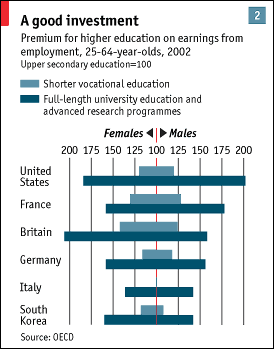
Developing countries see the point of higher education. (A World of Opportunity)
"Public spending on universities in developing countries is highly regressive. In Latin America the professional classes, who account for 15% of the population, take up nearly half of all university places. In Rwanda, 15% of the total education budget is spent on the 0.2% of students who attend universities. Most universities in the developing world are also hopelessly badly managed. But there are a few bright spots on the horizon."
"India has two valuable things going for it. One is its collection of elite institutions. For decades, India has been pouring resources into the All India Institute of Medical Sciences, the Indian Institute of Science in Bangalore and, above all, the Indian Institutes of Technology. These institutions take their pick from an army of candidates every year, with 180,000 hopefuls taking the screening test for around 3,500 places in the seven IITs. They provide a highly intensive education, with all students and often professors too living on campus. And they produce a stream of highly educated people who help to set professional standards. “They are a class apart, like Oxford and Cambridge,” says P.V. Indiresan, an expert on universities. These elite institutions help to keep India plugged into the global knowledge economy.........India's other big advantage is a more recent development: a booming private sector."
"In higher education, as in so much else, China is visibly pulling ahead of India. The Chinese are engaged in the biggest university expansion in history. In the 1980s, only 2-3% of school-leavers went to university. In 2003, the figure was 17%. The watershed year was 1999, when the number of students enrolled jumped by almost half. The expansion at the doctoral level is even faster than for undergraduates: in 1999-2003, nearly 12 times as many doctorates were awarded as in 1982-89 (see chart 4). And there is more to come: the number of new doctoral students jumped from 14,500 in 1998 to 48,700 in 2003. The Chinese are determined to create a super-league of universities to rival the best in the world."
For students, higher education is becoming a borderless world. (Wandering Scholars)
"For the past 50 years America has effortlessly dominated the market for international students, who have brought both direct and indirect benefits. Not only are they contributing some $13 billion a year to America's GDP, they are also supplying brainpower for its research machine and energy for its entrepreneurial economy. But now America's leadership is under challenge. The Institute of International Education reports that the number of foreign students on American campuses declined by 2.4% in 2003-04, the first time the number has gone down in 30 years. Foreign applications to American graduate schools fell by 28% last year, and actual enrolment dropped by 6%." While the demand for international education is growing, the competition for students from other developed nations is increasing, and the Bush Administration's policies have made it more difficult to foreign students to get into the United States.
Universities have become much more businesslike, but they are still doing the same old things. (Higher Ed Inc)
"The University of Phoenix is America's largest for-profit university (and indeed America's largest university, full stop), with 280,000 students, 239 campuses and various offshoots around the world, including some in China and India.....The University of Phoenix is designed to cater for the needs of working adults, who make up 95% of its students. The emphasis is on practical subjects, such as business and technology, that will help them with their careers, and on fitting in with busy schedules......in designing a university for working adults, Mr Sperling also introduced two other far-reaching innovations. The first was to concentrate power in the organisation. In traditional universities academics are semi-independent contractors who devote as much time as possible to their own research. In Phoenix they are simply employees. It is the university, not the teachers, that owns the curriculum. Todd Nelson, the company's boss, claims that this has allowed the university to become a “learning organisation”: it is constantly improving its ability to teach by measuring performance and disseminating successful techniques. The only research it cares about is the sort that improves teaching. The second innovation is to turn higher education into a business." The University also emphasizes distance education.
There is an audio streaming interview with the author.
And a nice set of links for sources.
"Bigger is Worse"
Kingsley Amis
“Better brain drain than brain in the drain."
Rajiv Gandhi
The Economist has a very good survey of higher education, reflecting of course its conservative economic views. Some excerpts are included below:
"Mass higher education is forcing universities to become more diverse, more global and much more competitive." The Brains Business
"America's system of higher education is the best in the world. That is because there is no system." Secrets of Success Competition rules, institutions are diverse, and all use diverse sources of finance. The model stresses knowledge creation, education, and service.
"The Institute of Higher Education at Shanghai's Jiao Tong University ranks the world's universities on a series of objective criteria such as the number of Nobel prizes and articles in prestigious journals. Seventeen of the top 20 universities in that list are American (see table in article); indeed, so are 35 of the top 50. American universities currently employ 70% of the world's Nobel prize-winners. They produce about 30% of the world's output of articles on science and engineering, according to a survey conducted in 2001, and 44% of the most frequently cited articles."
"Europe hopes to become the world's pre-eminent knowledge-based economy. Not likely!" (Head in the Clouds) The hand of government is too heavy for The Economist's taste.
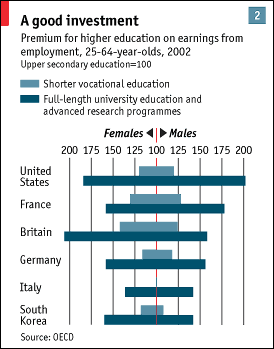
Developing countries see the point of higher education. (A World of Opportunity)
"Public spending on universities in developing countries is highly regressive. In Latin America the professional classes, who account for 15% of the population, take up nearly half of all university places. In Rwanda, 15% of the total education budget is spent on the 0.2% of students who attend universities. Most universities in the developing world are also hopelessly badly managed. But there are a few bright spots on the horizon."
"India has two valuable things going for it. One is its collection of elite institutions. For decades, India has been pouring resources into the All India Institute of Medical Sciences, the Indian Institute of Science in Bangalore and, above all, the Indian Institutes of Technology. These institutions take their pick from an army of candidates every year, with 180,000 hopefuls taking the screening test for around 3,500 places in the seven IITs. They provide a highly intensive education, with all students and often professors too living on campus. And they produce a stream of highly educated people who help to set professional standards. “They are a class apart, like Oxford and Cambridge,” says P.V. Indiresan, an expert on universities. These elite institutions help to keep India plugged into the global knowledge economy.........India's other big advantage is a more recent development: a booming private sector."
"In higher education, as in so much else, China is visibly pulling ahead of India. The Chinese are engaged in the biggest university expansion in history. In the 1980s, only 2-3% of school-leavers went to university. In 2003, the figure was 17%. The watershed year was 1999, when the number of students enrolled jumped by almost half. The expansion at the doctoral level is even faster than for undergraduates: in 1999-2003, nearly 12 times as many doctorates were awarded as in 1982-89 (see chart 4). And there is more to come: the number of new doctoral students jumped from 14,500 in 1998 to 48,700 in 2003. The Chinese are determined to create a super-league of universities to rival the best in the world."
For students, higher education is becoming a borderless world. (Wandering Scholars)
"For the past 50 years America has effortlessly dominated the market for international students, who have brought both direct and indirect benefits. Not only are they contributing some $13 billion a year to America's GDP, they are also supplying brainpower for its research machine and energy for its entrepreneurial economy. But now America's leadership is under challenge. The Institute of International Education reports that the number of foreign students on American campuses declined by 2.4% in 2003-04, the first time the number has gone down in 30 years. Foreign applications to American graduate schools fell by 28% last year, and actual enrolment dropped by 6%." While the demand for international education is growing, the competition for students from other developed nations is increasing, and the Bush Administration's policies have made it more difficult to foreign students to get into the United States.
Universities have become much more businesslike, but they are still doing the same old things. (Higher Ed Inc)
"The University of Phoenix is America's largest for-profit university (and indeed America's largest university, full stop), with 280,000 students, 239 campuses and various offshoots around the world, including some in China and India.....The University of Phoenix is designed to cater for the needs of working adults, who make up 95% of its students. The emphasis is on practical subjects, such as business and technology, that will help them with their careers, and on fitting in with busy schedules......in designing a university for working adults, Mr Sperling also introduced two other far-reaching innovations. The first was to concentrate power in the organisation. In traditional universities academics are semi-independent contractors who devote as much time as possible to their own research. In Phoenix they are simply employees. It is the university, not the teachers, that owns the curriculum. Todd Nelson, the company's boss, claims that this has allowed the university to become a “learning organisation”: it is constantly improving its ability to teach by measuring performance and disseminating successful techniques. The only research it cares about is the sort that improves teaching. The second innovation is to turn higher education into a business." The University also emphasizes distance education.
There is an audio streaming interview with the author.
And a nice set of links for sources.
Sunday, September 04, 2005
UNESCO: Education in Emergency, Crisis and Reconstruction
UNESCO Dossier on Education in Emergency, Crisis and Reconstruction:
"Armed conflicts, natural disasters (such as earthquakes, floods and cyclones), ecological and man-made disasters (desertification, drought, deforestation, and so forth) and deterioration of living conditions (poverty, unemployment, famine, and other afflictions) results in large scale fatalities and injuries to the population. It often creates massive displacement and migration of population and devastating physical destruction.
Since 1945 we have seen 150 conflicts erupt throughout the five continents, resulting in 20 million deaths and 60 million casualties."
This page may be of use to U.S. Educators in the wake of Katrina.
"Armed conflicts, natural disasters (such as earthquakes, floods and cyclones), ecological and man-made disasters (desertification, drought, deforestation, and so forth) and deterioration of living conditions (poverty, unemployment, famine, and other afflictions) results in large scale fatalities and injuries to the population. It often creates massive displacement and migration of population and devastating physical destruction.
Since 1945 we have seen 150 conflicts erupt throughout the five continents, resulting in 20 million deaths and 60 million casualties."
This page may be of use to U.S. Educators in the wake of Katrina.
Thursday, September 01, 2005
The Global Heritage Fund
Global Heritage Fund website
The Global Heritage Fund's mission, according to its website, "is to enable successful long-term preservation of mankind's most important Global Heritage cultural sites in developing countries with acute pressures and without resources for preservation and planned development." It is a private, California non-profit organization.
The Global Heritage Fund's mission, according to its website, "is to enable successful long-term preservation of mankind's most important Global Heritage cultural sites in developing countries with acute pressures and without resources for preservation and planned development." It is a private, California non-profit organization.
Friday, August 26, 2005
"Sex Traffickers Prey on Eastern Europeans"
seeurope.net :: View Story:
"UNESCO, the UN's cultural organization, has proclaimed August 23 as International Day for the Remembrance of the Slave Trade and its Abolition. But despite laws against slavery in all of the world's countries, modern-day slavery continues to thrive in illegal underground forms. In the second of a two-part series, RFE/RL correspondent Ron Synovitz examines how the latest wave of sex-slave trafficking preys upon Eastern European women to fuel the global sex trade. "
"UNESCO, the UN's cultural organization, has proclaimed August 23 as International Day for the Remembrance of the Slave Trade and its Abolition. But despite laws against slavery in all of the world's countries, modern-day slavery continues to thrive in illegal underground forms. In the second of a two-part series, RFE/RL correspondent Ron Synovitz examines how the latest wave of sex-slave trafficking preys upon Eastern European women to fuel the global sex trade. "
Sunday, August 21, 2005
Games people play - for peace
Israel21c full article
"Working toward intercultural understanding and world peace may seem like serious business, but to Tamar Meshulam, it's a game.
"Not just any game, however, - a large, beautifully designed prize-winning game.
"A unique project that Meshulam designed and built, entitled 'Master Peace' won first place at the recent UNESCO Design contest in Japan, which has been held annually every five years in order to encourage young designers to develop creations that contribute to society and help to change the world for the better.
"The contest, which carried a $10,000 prize, included more than 700 entrants from around the world, with a different theme each year. This year's theme was interpersonal communication, with the title 'Love/Why?'"
"Working toward intercultural understanding and world peace may seem like serious business, but to Tamar Meshulam, it's a game.
"Not just any game, however, - a large, beautifully designed prize-winning game.
"A unique project that Meshulam designed and built, entitled 'Master Peace' won first place at the recent UNESCO Design contest in Japan, which has been held annually every five years in order to encourage young designers to develop creations that contribute to society and help to change the world for the better.
"The contest, which carried a $10,000 prize, included more than 700 entrants from around the world, with a different theme each year. This year's theme was interpersonal communication, with the title 'Love/Why?'"
Saturday, August 13, 2005
4th UNESCO Youth Forum
"The 4th edition of the UNESCO Youth Forum of the 33rd UNESCO General Conference, will be highly visible and is an opportunity for young people to express and exchange their ideas, make their voice heard and ensure their views are integrated in to UNESCO's programmes and policies.
"This year's theme will be 'Young People and the Dialogue among Civilisations, Cultures and Peoples - Ideas for action in education, the sciences, culture and communication'. In the field of science, dialogue-oriented initiatives focus on the link to sustainable development, the promotion of the natural and social sciences as a means for social transformation and increased networking and cooperation."
"This year's theme will be 'Young People and the Dialogue among Civilisations, Cultures and Peoples - Ideas for action in education, the sciences, culture and communication'. In the field of science, dialogue-oriented initiatives focus on the link to sustainable development, the promotion of the natural and social sciences as a means for social transformation and increased networking and cooperation."
Friday, August 12, 2005
UNESCO Draft program's and Budget, 2006-2007
The 33rd session of the General Conference will take place from 3 to 21 October at the UNESCO Headquarters in Paris (France). The General Conference takes place every other year, and is the top governance body for UNESCO. The full budget is published and available for review now. It is a PDF file, and is 3.55 MB in length (448 pages.)
Wednesday, August 10, 2005
Scotsman.com News - Entertainment - Arts - Lasers to recreate statues destroyed by Taleban
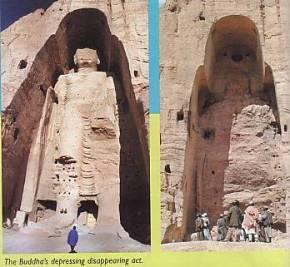
Scotsman.com full News story
"AFGHANISTAN'S famous Bamiyan Buddhas are due to be recreated by multicoloured laser images projected on to the cliffs where they once stood. The 1,600-year-old statues were destroyed by the Taleban in 2001.
"Artist Hiro Yamagata will use solar and wind power to drive fourteen laser systems and project 140 faceless images, standing up to 175ft (52.5m) tall, onto the cliff-face for four hours every Sunday night.
"Afghan government officials, who approached the Japanese artist in 2003, are awaiting approval from United Nations cultural organisation, UNESCO, who must assess whether the laser beams could damage the cliffs."
UNESCO Kicks Off 40th Youth Camp
The Korea Times full article.:
"One hundred thirty youths from 30 countries tomorrow will kick off the International Youth Camp (IYC) hosted by the Korean National Commission for UNESCO.
"The 40th annual camp will continue through Aug. 22 at the Korea UNESCO Culture Center in Ichon, Kyonggi Province, and seven other local venues. "
"One hundred thirty youths from 30 countries tomorrow will kick off the International Youth Camp (IYC) hosted by the Korean National Commission for UNESCO.
"The 40th annual camp will continue through Aug. 22 at the Korea UNESCO Culture Center in Ichon, Kyonggi Province, and seven other local venues. "
Tuesday, August 09, 2005
International Day of the World's Indigenous People - August 9
The Dag Hammarskjold Library website commemorating the day:
"By resolution 49/214 of 23 December 1994, the General Assembly decided to celebrate the International Day of the World's Indigenous People on 9 August every year during the International Decade of the World's Indigenous People. In 2004 the Assembly proclaimed a Second International Decade by resolution 59/174. The goal of this Decade is to further strengthen international cooperation for the solution of problems faced by indigenous people in such areas as culture, education, health, human rights, the environment, and social and economic development. "
"By resolution 49/214 of 23 December 1994, the General Assembly decided to celebrate the International Day of the World's Indigenous People on 9 August every year during the International Decade of the World's Indigenous People. In 2004 the Assembly proclaimed a Second International Decade by resolution 59/174. The goal of this Decade is to further strengthen international cooperation for the solution of problems faced by indigenous people in such areas as culture, education, health, human rights, the environment, and social and economic development. "
Monday, August 08, 2005
Canadian software firm to help in the automation of central Iraq Museum in Baghdad
albawaba.com full article:
"The Iraq National Museum supported by the United Nations Educational, Scientific and Cultural Organization, (UNESCO-Paris) has launched an initiative to automate their collections for documentation, research, preservation and the sharing of information. Through this project, the Iraq Museum will ensure that the important and unique antiquities of the Iraqi People will be available in electronic format to promote and protect the culture and heritage of Iraq. The project is funded by a generous contribution to UNESCO from the Swiss Government."
"The Iraq National Museum supported by the United Nations Educational, Scientific and Cultural Organization, (UNESCO-Paris) has launched an initiative to automate their collections for documentation, research, preservation and the sharing of information. Through this project, the Iraq Museum will ensure that the important and unique antiquities of the Iraqi People will be available in electronic format to promote and protect the culture and heritage of Iraq. The project is funded by a generous contribution to UNESCO from the Swiss Government."
World conference for the UNESCO Clubs movement
The Times & The Sunday Times (Malta) full article
About 300 representatives from 120 countries participated in a recent conference of the World Federation of UNESCO Clubs Associations. The UNESCO Clubs movement has developed hand-in-hand with UNESCO since the establishment of the first club in Sendai, Japan, on July 19, 1947.
"According to the results of the survey recently conducted by UNESCO, there are more than 3,600 UNESCO clubs, which are engaged in a range of activities in the fields of its competence in 89 member states. Over 1,400 clubs are to be found in the Asia-Pacific Region, 1,200 in Africa, over 600 in Europe and North American, 250 in Latin America and the Caribbean, and over 70 in the Arab States."
The Director General of UNESCO, Mr Koichiro Matsuura, addressed the meeting. He is quoted as saying, "The UNESCO Clubs movement must be seen........as one of UNESCO's most important partners in civil society, the UNESCO Clubs are a distinctive, indeed unique, asset within the UN system. This reflects the fact that, at meetings of our governing bodies over the years, member states have reaffirmed their interest in and support for this movement........I see potential roles of UNESCO clubs, complementary to those of governments, non-governmental organisations and other civil society organisations at national, regional and international levels, as crucial in achieving the goals of the decade, and this is just one example."
In 2004, UNESCO's formal associate relations with the world Federation of UNESCO clubs was suspended, on an interim basis, due to a number of reasons. Since that time, an Ad Hoc Committee for the renewal of WFUCA, has been working to re-examine WFUCA's rationale and to identify its best way forward. The article states that a possible solution was reached that the World Federation of UNESCO Clubs might again resume to function within the scope of its creation.
About 300 representatives from 120 countries participated in a recent conference of the World Federation of UNESCO Clubs Associations. The UNESCO Clubs movement has developed hand-in-hand with UNESCO since the establishment of the first club in Sendai, Japan, on July 19, 1947.
"According to the results of the survey recently conducted by UNESCO, there are more than 3,600 UNESCO clubs, which are engaged in a range of activities in the fields of its competence in 89 member states. Over 1,400 clubs are to be found in the Asia-Pacific Region, 1,200 in Africa, over 600 in Europe and North American, 250 in Latin America and the Caribbean, and over 70 in the Arab States."
The Director General of UNESCO, Mr Koichiro Matsuura, addressed the meeting. He is quoted as saying, "The UNESCO Clubs movement must be seen........as one of UNESCO's most important partners in civil society, the UNESCO Clubs are a distinctive, indeed unique, asset within the UN system. This reflects the fact that, at meetings of our governing bodies over the years, member states have reaffirmed their interest in and support for this movement........I see potential roles of UNESCO clubs, complementary to those of governments, non-governmental organisations and other civil society organisations at national, regional and international levels, as crucial in achieving the goals of the decade, and this is just one example."
In 2004, UNESCO's formal associate relations with the world Federation of UNESCO clubs was suspended, on an interim basis, due to a number of reasons. Since that time, an Ad Hoc Committee for the renewal of WFUCA, has been working to re-examine WFUCA's rationale and to identify its best way forward. The article states that a possible solution was reached that the World Federation of UNESCO Clubs might again resume to function within the scope of its creation.
Friday, August 05, 2005
U.S. National Commission for UNESCO, Newsletter published
U.S. National Commission for UNESCO, Volume 1, Issue 5, June/July 2005:
The contents are:
The contents are:
- Highlights
- U.S. National Commission Annual Meeting
- U.S. Candidacy for World Heritage Committee
- Francesco Bandarin Visit
- International Oceanographic Committee
- NASA and UNESCO
- Creative Cities -- Santa Fe, New Mexico
- Young Professionals Program
- UNESCO External Relations and Cooperation
- Job Vacancies
Wednesday, August 03, 2005
IAAF Withdraws Proposal for Lifetime Bans
AP story via Yahoo! News:
"USA Track & Field withdrew its proposal Wednesday for lifetime bans for first-time steroid violations after the sport's world governing body promised to push for an increase of suspensions from two years to four years for all serious doping offenses.
"USATF wanted life bans for a first steroid infraction as part of its zero-tolerance policy on doping. But it withdrew the measure after the International Association of Athletics Federations said it would lobby for a return to four-year suspensions for all sports in 2007.
"The IAAF switched from four-year bans to two-year suspensions in 1997 to avoid costly litigation.
"The IAAF fears that life bans would lead to drawn-out court cases and undermine the World Anti-Doping Code, which calls for two-year suspensions. The code has already been adopted by major international sports federations, while national governments are scheduled to sign a UNESCO convention accepting the treaty this fall."
"USA Track & Field withdrew its proposal Wednesday for lifetime bans for first-time steroid violations after the sport's world governing body promised to push for an increase of suspensions from two years to four years for all serious doping offenses.
"USATF wanted life bans for a first steroid infraction as part of its zero-tolerance policy on doping. But it withdrew the measure after the International Association of Athletics Federations said it would lobby for a return to four-year suspensions for all sports in 2007.
"The IAAF switched from four-year bans to two-year suspensions in 1997 to avoid costly litigation.
"The IAAF fears that life bans would lead to drawn-out court cases and undermine the World Anti-Doping Code, which calls for two-year suspensions. The code has already been adopted by major international sports federations, while national governments are scheduled to sign a UNESCO convention accepting the treaty this fall."
Monday, August 01, 2005
UNESCO, International Law and Internet Governance
The UN Working Group on Internet Governance (WGIG) has completed its Report for the World Summit on the Information Society (WSIS).
UNESCO in turn has issued a Position Statement on Internet Governance. The preamble to that Statement reads:
The WGIG report makes a number of recommendations to address Internet-related issues. Among these are three that I believe to be of special relevance to UNESCO:
Intellectual Property Rights
UNESCO has a lead role among UN agencies in the field of copyrights, and would seem to be a logical entity to take an expanded role in copyright aspects of Internet governance.
UNESCO’s set of copyright tools includes its Network of Copyright Chairs in universities in a number of developing countries and countries in transition, UNESCO publications, including the e-Copyright Bulletin, now in five languages, the Collection of national copyright laws, the studies of copyright issues carried out in the framework of the administration of the Universal Copyright Convention and the Guide to the Collective Administration of Authors’ Rights, a useful tool for the development of collecting societies.
A number of Conventions administered by UNESCO set the current international legal framework for copyright issues:
Within the framework of the Global Alliance for Cultural Diversity, UNESCO is working on the theme of Copyright, Piracy and Cultural Industries, and is currently developing new initiatives and projects in order to fight against piracy.
Freedom of Expression and UNESCO
UNESCO has a long standing program on Freedom of Expression. Indeed, UNESCO held a conference on Freedom of Expression in Cyberspace in 2002, in its headquarters, as part of the preparation for WSIS. The report of that meeting is now online.
Important international understandings form the basis for this program. Article 19 of the Univesal Declaration of Human Rights states:
The Constitution of UNESCO also designates its functions with regard to Freedom of Expression. UNESCO's first given purpose is:
The UNESCO website affirms that "Since the adoption of the New Communication Strategy by the General Conference in 1989, UNESCO has contributed to a wider recognition and public awareness of the importance of freedom of expression and freedom of information as a fundamental human right......The Organization has also continuously provided assistance to media organizations in setting up legal statutes to ensure independent flow of information, editorial independence, financial autonomy and safety of media professionals."
Multilingualism and UNESCO
UNESCO held two meetings directly pertinent to this topic in preparation for WSIS:
The reports of these meetings are available online.
The concern for multilingualism relates to UNESCO's larger interest in Cultural Diversity, as expressed in the UNESCO Universal Declaration on Cultural Diversity. UNESCO is currently working towards a Convention on the Protection of the Diversity of Cultural Contents and Artistic Expressions.
UNESCO also is responsible for international cultural conventions that help establish an international legal framework for some of the broader aspects of Internet governance including multilingualism and endangered languages:
UNESCO, Participation and Capacity Building
The WGIG report also calls for efforts to promote "meaningful participation in global policy development" by and "capacity-building" for developing nations. UNESCO is well placed to assist in these efforts. This is especially true since the United States representative presented a draft decision for the Creation of a Cross-Sectoral Program in Technical Capacity Building which was accepted by the last meeting of UNESCO's Executive Board, and is likely to be accepted by UNESCO's General Conference later this year. Capacity building for Internet governance, as well as for the larger issues in entry into the Information Society might well form an important part of this new initiative.
UNESCO in turn has issued a Position Statement on Internet Governance. The preamble to that Statement reads:
The Internet is a major opportunity to improve free flow of information and ideas throughout the world. Internet governance mechanisms should be based on the principle of “openness”, encompassing interoperability, freedom of expression in Knowledge Societies and measures to resist any attempt to censor content. There should be no changes in Internet governance mechanisms that impede the free flow of information and ideas on the Internet. The effect of these mechanisms should be to enable greater use of the Internet by citizens with diverse linguistic and cultural backgrounds.
The WGIG report makes a number of recommendations to address Internet-related issues. Among these are three that I believe to be of special relevance to UNESCO:
23. Intellectual property rights (IPR)Application of intellectual property rights to cyberspace.
• While there is agreement on the need for balance between the rights of holders and the rights of users, there are different views on the precise nature of the balance that will be most beneficial to all stakeholders, and whether the current IPR system is adequate to address the new issues posed by cyberspace. On the one hand, intellectual property rights holders are concerned about the high number of infringements, such as digital piracy, and the technologies developed to circumvent protective measures to prevent such infringements; on the other hand, users are concerned about market oligopolies, the impediments to access and use of digital content and the perceived unbalanced nature of current IPR rules.
81. Freedom of expression• Ensure that all measures taken in relation to the Internet, in particular those on grounds of security or to fight crime, do not lead to violations of human rights principles.
85. Multilingualism(a) Domain names:
• Ensuring bottom-up and inclusive development of a transparent policy for the introduction of multilingual domain names.
• Strengthening the participation and coordination of all Governments and all stakeholders in the governance process. This is required to push forward the development and implementation of multilingual domain name solutions, including multilingual e-mail addresses and key word lookup.
• Strengthening cooperation between IETF and IDN registries,[15] thus creating a sound international environment for the further development of technical standards and action plan for global deployment.
(b) Content:
• More effort should be put into developing content development tools to facilitate the creation of multilingual content.
• Governments, the private sector and civil society are encouraged to promote and create more content in local languages to be posted on the Internet.
Intellectual Property Rights
UNESCO has a lead role among UN agencies in the field of copyrights, and would seem to be a logical entity to take an expanded role in copyright aspects of Internet governance.
UNESCO’s set of copyright tools includes its Network of Copyright Chairs in universities in a number of developing countries and countries in transition, UNESCO publications, including the e-Copyright Bulletin, now in five languages, the Collection of national copyright laws, the studies of copyright issues carried out in the framework of the administration of the Universal Copyright Convention and the Guide to the Collective Administration of Authors’ Rights, a useful tool for the development of collecting societies.
A number of Conventions administered by UNESCO set the current international legal framework for copyright issues:
- Multilateral Convention for the Avoidance of Double Taxation of Copyright Royalties, with model bilateral agreement and additional Protocol.
Madrid, 13 December 1979
- Convention relating to the Distribution of Programme-Carrying Signals Transmitted by Satellite
Brussels, 21 May 1974
- Convention for the Protection of Producers of Phonograms against Unauthorized Duplication of their Phonograms
Geneva, 29 October 1971
- Universal Copyright Convention as revised at Paris on 24 July 1971, with Appendix Declaration relating to Article XVII and Resolution concerning Article XI
Paris, 24 July 1971
- International Convention for the Protection of Performers, Producers of Phonograms and Broadcasting Organizations
Rome, 26 October 1961
- Convention concerning the Exchange of Official Publications and Government Documents between States
Paris, 3 December 1958
- Convention concerning the International Exchange of Publications
Paris, 3 December 1958
- Universal Copyright Convention, with Appendix Declaration relating to Articles XVII and Resolution concerning Article XI
Geneva, 6 September 1952
- Agreement on the Importation of Educational, Scientific and Cultural Materials, with Annexes A to E and Protocol annexed
Florence, 17 June 1950
- Agreement For Facilitating the International Circulation of Visual and Auditory Materials of an Educational, Scientific and Cultural character with Protocol of Signature and model form of certificate provided for in Article IV of the above-mentioned Agreement
Beirut, 10 December 1948
Within the framework of the Global Alliance for Cultural Diversity, UNESCO is working on the theme of Copyright, Piracy and Cultural Industries, and is currently developing new initiatives and projects in order to fight against piracy.
Freedom of Expression and UNESCO
UNESCO has a long standing program on Freedom of Expression. Indeed, UNESCO held a conference on Freedom of Expression in Cyberspace in 2002, in its headquarters, as part of the preparation for WSIS. The report of that meeting is now online.
Important international understandings form the basis for this program. Article 19 of the Univesal Declaration of Human Rights states:
Everyone has the right to freedom of opinion and expression; this right includes freedom to hold opinions without interference and to seek, receive and impart information and ideas through any media and regardless of frontiers.
The Constitution of UNESCO also designates its functions with regard to Freedom of Expression. UNESCO's first given purpose is:
Collaborate in the work of advancing the mutual knowledge and understanding of peoples, through all means of mass communication and to that end recommend such international agreements as may be necessary to promote the free flow of ideas by word and image.
The UNESCO website affirms that "Since the adoption of the New Communication Strategy by the General Conference in 1989, UNESCO has contributed to a wider recognition and public awareness of the importance of freedom of expression and freedom of information as a fundamental human right......The Organization has also continuously provided assistance to media organizations in setting up legal statutes to ensure independent flow of information, editorial independence, financial autonomy and safety of media professionals."
Multilingualism and UNESCO
UNESCO held two meetings directly pertinent to this topic in preparation for WSIS:
- Multilingualism for Cultural Diversity and Participation of All in Cyberspace(6-7 May 2005, Bamako, Mali)
- Cultural Diversity in Knowledge Societies
(17-19 May 2005, St. Petersburg, Russian Federation)
The reports of these meetings are available online.
The concern for multilingualism relates to UNESCO's larger interest in Cultural Diversity, as expressed in the UNESCO Universal Declaration on Cultural Diversity. UNESCO is currently working towards a Convention on the Protection of the Diversity of Cultural Contents and Artistic Expressions.
UNESCO also is responsible for international cultural conventions that help establish an international legal framework for some of the broader aspects of Internet governance including multilingualism and endangered languages:
- Convention For the Safeguarding of the Intangible Cultural Heritage
Paris, 17 October 2003
- Convention on the Means of Prohibiting and Preventing the Illicit Import, Export and Transfer of Ownership of Cultural Property
Paris, 14 November 1970
UNESCO, Participation and Capacity Building
The WGIG report also calls for efforts to promote "meaningful participation in global policy development" by and "capacity-building" for developing nations. UNESCO is well placed to assist in these efforts. This is especially true since the United States representative presented a draft decision for the Creation of a Cross-Sectoral Program in Technical Capacity Building which was accepted by the last meeting of UNESCO's Executive Board, and is likely to be accepted by UNESCO's General Conference later this year. Capacity building for Internet governance, as well as for the larger issues in entry into the Information Society might well form an important part of this new initiative.
UNESCO: Action in favour of Indigenous Peoples
UNESCO website on its relevant actions:
"The International Decade of the World's Indigenous People was officially launched on 10 December 1994 by the United Nations General Assembly. It is in this framework that International Day of the World's Indigenous Peoples is celebrated every year on 9 August, being the anniversary of the opening of the first session of the Working Group on Indigenous Populations in 1982.
"In partnership with the United Nations and its agencies, UNESCO plays a key role in the Decade which is intended to 'strengthen international cooperation for the solution of problems faced by indigenous people in such areas as human rights, the environment, development, education and health'. In this respect the programme of activities of the International Decade of the World's Indigenous People recognizes the value and diversity of the cultures of indigenous communities and of their specific forms of social organization, and attaches value to the contributions that they can make to humanity."
"The International Decade of the World's Indigenous People was officially launched on 10 December 1994 by the United Nations General Assembly. It is in this framework that International Day of the World's Indigenous Peoples is celebrated every year on 9 August, being the anniversary of the opening of the first session of the Working Group on Indigenous Populations in 1982.
"In partnership with the United Nations and its agencies, UNESCO plays a key role in the Decade which is intended to 'strengthen international cooperation for the solution of problems faced by indigenous people in such areas as human rights, the environment, development, education and health'. In this respect the programme of activities of the International Decade of the World's Indigenous People recognizes the value and diversity of the cultures of indigenous communities and of their specific forms of social organization, and attaches value to the contributions that they can make to humanity."
Tuesday, July 26, 2005
Kristen Silverberg Nominated to be Assistant Secretary of State
University of Texas announcement
"Silverberg currently serves as Deputy Assistant to the President and Advisor to the Chief of Staff in the White House, where she helps coordinate the development of Administration policy. She previously served as Deputy Assistant to the President for Domestic Policy. Until October 2003, she served as Senior Advisor to Ambassador L. Paul Bremer in Baghdad, Iraq. Before her service in Iraq, she served as Special Assistant to the President in the Office of the Chief of Staff.
"Before joining the Bush administration, Silverberg was a policy advisor on the 2000 presidential campaign in Austin. She earlier practiced law at Williams & Connolly in Washington, D.C. She also served as a law clerk to U.S. Supreme Court Justice Clarence Thomas and U.S. Court of Appeals for the District of Columbia Judge David Sentelle. Silverberg received her bachelor’s degree from Harvard."
"Silverberg currently serves as Deputy Assistant to the President and Advisor to the Chief of Staff in the White House, where she helps coordinate the development of Administration policy. She previously served as Deputy Assistant to the President for Domestic Policy. Until October 2003, she served as Senior Advisor to Ambassador L. Paul Bremer in Baghdad, Iraq. Before her service in Iraq, she served as Special Assistant to the President in the Office of the Chief of Staff.
"Before joining the Bush administration, Silverberg was a policy advisor on the 2000 presidential campaign in Austin. She earlier practiced law at Williams & Connolly in Washington, D.C. She also served as a law clerk to U.S. Supreme Court Justice Clarence Thomas and U.S. Court of Appeals for the District of Columbia Judge David Sentelle. Silverberg received her bachelor’s degree from Harvard."
U.S. Seeks Membership on UNESCO Committees and Councils
US Mission to UNESCO
The United States was recently elected to the Executive Council of the Intergovernmental Oceanographic Commission (IOC) of UNESCO.
It is currently a candidate for the following UNESCO council and committee:
The United States was recently elected to the Executive Council of the Intergovernmental Oceanographic Commission (IOC) of UNESCO.
It is currently a candidate for the following UNESCO council and committee:
The Intergovernmental Council of the International Hydrological Programme (IHP),
elections to be held during the 33rd session of the General Conference of UNESCO in October 2005; and,
The World Heritage Committee (WHC),
elections to be held during the General Assembly of States Parties to the Convention in October 2005.
Editorial by UNESCO's new Assistant Director-General for Education Peter Smith
Education Today newsletter, July - September, 2003:
"'I will develop a leadership framework and programme management model, which will emphasize decentralization and results through collaboration and teamwork,' Mr Smith says."
"'I will develop a leadership framework and programme management model, which will emphasize decentralization and results through collaboration and teamwork,' Mr Smith says."
Science and society: Bombs, books, and bucks
Daily Times (Pakistan) article (By David Bloom and Joel E Cohen, Tuesday, July 26, 2005.)
"The $82 billion 'emergency supplemental' bill to finance American military operations in Iraq and Afghanistan leaves the United States spending more money on military power than is needed on a yearly basis to permit every child in the world to receive, within one decade, both primary and secondary education. Clearly, the question is not whether universal education is affordable, but whether America and the world can afford to neglect the political, economic, social, and health benefits of educating the roughly 380 million children around the globe who currently do not attend school.............
"The World Bank, UNICEF, and UNESCO have estimated that achieving UPE by 2015 will entail annual expenditures of between $6.5 billion and $35 billion, on top of the approximately $82 billion that developing countries spend each year on primary education. These funds will be needed for schools, teachers, teacher training, materials and equipment, administration, and assessments.
"Based on a five-year project that we led at the American Academy of Arts and Sciences, we believe that the UPE goal is not ambitious enough: the world should aim for, and can achieve, high-quality, universal secondary education, as well as universal primary education. Developing countries spend approximately $93 billion per year on secondary education. If a gradual approach is taken between now and 2015, the annual additional cost of extending secondary education to every child will likely be between $27 billion and $34 billion."
"The $82 billion 'emergency supplemental' bill to finance American military operations in Iraq and Afghanistan leaves the United States spending more money on military power than is needed on a yearly basis to permit every child in the world to receive, within one decade, both primary and secondary education. Clearly, the question is not whether universal education is affordable, but whether America and the world can afford to neglect the political, economic, social, and health benefits of educating the roughly 380 million children around the globe who currently do not attend school.............
"The World Bank, UNICEF, and UNESCO have estimated that achieving UPE by 2015 will entail annual expenditures of between $6.5 billion and $35 billion, on top of the approximately $82 billion that developing countries spend each year on primary education. These funds will be needed for schools, teachers, teacher training, materials and equipment, administration, and assessments.
"Based on a five-year project that we led at the American Academy of Arts and Sciences, we believe that the UPE goal is not ambitious enough: the world should aim for, and can achieve, high-quality, universal secondary education, as well as universal primary education. Developing countries spend approximately $93 billion per year on secondary education. If a gradual approach is taken between now and 2015, the annual additional cost of extending secondary education to every child will likely be between $27 billion and $34 billion."
Monday, July 25, 2005
“Academics Across Borders”
The United Nations Educational, Scientific and Cultural Organization (UNESCO) has announced the anticipated launch of its new “Academics Across Borders” program in November 2005. This project is aimed at reducing the high-level training and research gap between industrial and developing countries. The program will seek to identify volunteer academics from industrially developed nations and match them with targeted higher education needs in developing and transitional nations. Expatriate academics, in particular, are encouraged to return to their countries of origin to assist in strengthening universities and research institutions. UNESCO is currently developing a database of distinguished academics and researchers from developing countries in the fields of medicine, engineering and natural sciences, and computer sciences who may be willing to return to their home countries to participate in the program. US-based individuals interested in volunteering should email the Department of State, while potential volunteers based in other countries should contact Winsome Gordon.
Public Diplomacy Chief-Designate Seeks Dialogue and Advocacy
FindLaw.com report:
"In reaching out to publics around the world, the United States is seeking both a dialogue with other cultures and faiths and the opportunity to create “the connections and conditions that allow people to make up their own minds,” says Karen Hughes, President Bush’s choice for under secretary of state for public diplomacy."
"In reaching out to publics around the world, the United States is seeking both a dialogue with other cultures and faiths and the opportunity to create “the connections and conditions that allow people to make up their own minds,” says Karen Hughes, President Bush’s choice for under secretary of state for public diplomacy."
Friday, July 22, 2005
"China, UNESCO jointly protect endangered languages"
People's Daily Online article:
"Bouchenaki Mounir, assistant director-general of the United Nations Educational, Scientific and Cultural Organization (UNESCO), said in Beijing on July 21 that China and UNESCO are now jointly protecting the endangered languages in China.
"At the on-going World Chinese Conference, which opened here on July 20, Mounir said more and more languages in the world were endangered, including Shui Shu, a Chinese language specially used by the local women in south China's Hunan Province. Some languages have a large population of speakers while some have few, therefore the native speakers for the less-spoken languages are no longer willing to use them."
"Bouchenaki Mounir, assistant director-general of the United Nations Educational, Scientific and Cultural Organization (UNESCO), said in Beijing on July 21 that China and UNESCO are now jointly protecting the endangered languages in China.
"At the on-going World Chinese Conference, which opened here on July 20, Mounir said more and more languages in the world were endangered, including Shui Shu, a Chinese language specially used by the local women in south China's Hunan Province. Some languages have a large population of speakers while some have few, therefore the native speakers for the less-spoken languages are no longer willing to use them."
Sunday, July 17, 2005
UN to investigate climate threat
Green Consumer Guide.Com article:
"The UNESCO World Heritage Committee (WHC) is to set up a dedicated working group to assess the threat posed by climate change to sensitive locations around the world, it has been announced. The expert team will look at the global warming effects on World Heritage Sites and devise strategic response programmes to combat the issue. The first reports from the group will be in 2006."
"The UNESCO World Heritage Committee (WHC) is to set up a dedicated working group to assess the threat posed by climate change to sensitive locations around the world, it has been announced. The expert team will look at the global warming effects on World Heritage Sites and devise strategic response programmes to combat the issue. The first reports from the group will be in 2006."
Biblical remains, Macau added to U.N. heritage list
RedNova News article:
"Biblical-era archaeological remains, the Chinese island of Macau and a war-ravaged Bosnian bridge were among 17 cultural sites added to the U.N.'s World Heritage list this week.
"UNESCO, the U.N. environmental and cultural body, also added a Belgian renaissance printing house, archaeological findings in Bahrain dating from 2300 BC, the Albanian Ottoman town of Gjirokastra, and Greek and Roman era tombs in Italy."
"Biblical-era archaeological remains, the Chinese island of Macau and a war-ravaged Bosnian bridge were among 17 cultural sites added to the U.N.'s World Heritage list this week.
"UNESCO, the U.N. environmental and cultural body, also added a Belgian renaissance printing house, archaeological findings in Bahrain dating from 2300 BC, the Albanian Ottoman town of Gjirokastra, and Greek and Roman era tombs in Italy."
Friday, July 15, 2005
UNESCO Partnerships
Partnerships: UNESCO website:
"UNESCO cooperates with numerous partners from the private sector: big multinationals or small and medium enterprises, private foundations, professional, administrative or economics associations, philanthropist organisms and individuals. The field of cooperation with the private sector is at present very wide."
Click here to read about various examples of cooperation between the private sector and UNESCO."
"UNESCO cooperates with numerous partners from the private sector: big multinationals or small and medium enterprises, private foundations, professional, administrative or economics associations, philanthropist organisms and individuals. The field of cooperation with the private sector is at present very wide."
Click here to read about various examples of cooperation between the private sector and UNESCO."
Thursday, July 14, 2005
Norwegian Fjords and Japan's Shiretoko peninsula are among the seven natural sites added to UNESCO's World Heritage List
UNESCO press release:
"The World Heritage Committee chaired by Themba Wakashe, South Africa's Deputy Director-General for Heritage and National Archives, today inscribed seven natural sites on UNESCO's World Heritage List. The Committee also decided to extend two natural sites already on the List. The one is extended in size while the extension of the other makes it both a natural and cultural site. With today's inscriptions, UNESCO World Heritage List numbers 160 natural sites and 24 mixed sites (i.e. both natural and cultural) of outstanding universal value around the world."
"The World Heritage Committee chaired by Themba Wakashe, South Africa's Deputy Director-General for Heritage and National Archives, today inscribed seven natural sites on UNESCO's World Heritage List. The Committee also decided to extend two natural sites already on the List. The one is extended in size while the extension of the other makes it both a natural and cultural site. With today's inscriptions, UNESCO World Heritage List numbers 160 natural sites and 24 mixed sites (i.e. both natural and cultural) of outstanding universal value around the world."
Wednesday, July 13, 2005
The Ninth Edition of the Pirelli Internetional Award: UNESCO
UNESCO's Venice Office's Announcement of the Awards:
"After having evaluated more than 1,000 entries, coming from over 50 countries, particularly (around 70%) from universities and educational institutions, the international Jury has assigned the awards, subdivided into the categories: Multimedia Education, the Environment, Information and Communication Technologies (ICT) and Alice Generation Award.
"The 25,000 Euro-worth Top Pirelli Prize has been awarded to Patrick J. Lynch, Director of the “MedMedia Group” of the School of Medicine of the University of Yale for the project “'NTRODUCTION TO CARDIOTHORACIC IMAGING': it is a broad virtual voyage into the human heart and lungs through anatomy, the pathologies and the techniques for analysis and treatment of illnesses and discomforts that strike these important organs of the human body. The work has also been awarded as the best entry coming from the world of education in the category Multimedia Education.
"Within the same Multimedia Education category, the 15,000 Euro award for the best multimedia product oriented toward the world of education, the project 'MicroArrays MediaBook', that describes the principles of genomics and the technological and scientific effects of these new studies. The work has been produced by 'Media Group' of the University of North Carolina, a team comprised of researchers, programmers and graphic artists coordinated by Walter 'Skip' E. Bollenbacher, who received the award.
"The Environment category has been won by the American company 'EarthTalk Studios', specialized in the production of multimedia tools for schools and education, with “Environmental Science in Practice”, a project commissioned by the renown publishing group, Prentice Hall and dedicated to environmental safekeeping, won an award of 15,000 Euro.
"The ICT Award (20,000 Euro offered by Telecom Italia) was granted to William Sarnaki of the Department of Health of the State of New York for a video-presentation of an innovative technology, the 'Brain-Computer Interfaces For Communication and Control', that uses thecomputer to improve the communication options of people with grave disabilities.
"For the Alice Generation Award, offered by Telecom Italia and reserved to projects by Italian authors, the winners: in the Senior category the 'BANCA DATI AMBIENTALE SULLA LAGUNA DI VENEZIA', a project of the Istituto Veneto di Scienze, Lettere ed Arti; in the Junior category, reserved for candidates under the age of 21, the elementary school “Don Milani” of Altamura in Bari, Italy for the multimedia work 'THE ENGLISH VOWELSOUNDS FOR KIDS', for the study of the English phonetic language. The two projects have been awarded 15.000 and 10.000 Euro respectively.
"The next event with the Pirelli Award is scheduled for next autumn, featuring the awarding ceremony for the Pirelli Relativity Challenge, the contest dedicated to Albert Einstein that the Pirelli Group has organized for the International Year of Physics and that challenges participants to explain the theory of relativity using multimedia tools in less than five minutes."
"After having evaluated more than 1,000 entries, coming from over 50 countries, particularly (around 70%) from universities and educational institutions, the international Jury has assigned the awards, subdivided into the categories: Multimedia Education, the Environment, Information and Communication Technologies (ICT) and Alice Generation Award.
"The 25,000 Euro-worth Top Pirelli Prize has been awarded to Patrick J. Lynch, Director of the “MedMedia Group” of the School of Medicine of the University of Yale for the project “'NTRODUCTION TO CARDIOTHORACIC IMAGING': it is a broad virtual voyage into the human heart and lungs through anatomy, the pathologies and the techniques for analysis and treatment of illnesses and discomforts that strike these important organs of the human body. The work has also been awarded as the best entry coming from the world of education in the category Multimedia Education.
"Within the same Multimedia Education category, the 15,000 Euro award for the best multimedia product oriented toward the world of education, the project 'MicroArrays MediaBook', that describes the principles of genomics and the technological and scientific effects of these new studies. The work has been produced by 'Media Group' of the University of North Carolina, a team comprised of researchers, programmers and graphic artists coordinated by Walter 'Skip' E. Bollenbacher, who received the award.
"The Environment category has been won by the American company 'EarthTalk Studios', specialized in the production of multimedia tools for schools and education, with “Environmental Science in Practice”, a project commissioned by the renown publishing group, Prentice Hall and dedicated to environmental safekeeping, won an award of 15,000 Euro.
"The ICT Award (20,000 Euro offered by Telecom Italia) was granted to William Sarnaki of the Department of Health of the State of New York for a video-presentation of an innovative technology, the 'Brain-Computer Interfaces For Communication and Control', that uses thecomputer to improve the communication options of people with grave disabilities.
"For the Alice Generation Award, offered by Telecom Italia and reserved to projects by Italian authors, the winners: in the Senior category the 'BANCA DATI AMBIENTALE SULLA LAGUNA DI VENEZIA', a project of the Istituto Veneto di Scienze, Lettere ed Arti; in the Junior category, reserved for candidates under the age of 21, the elementary school “Don Milani” of Altamura in Bari, Italy for the multimedia work 'THE ENGLISH VOWELSOUNDS FOR KIDS', for the study of the English phonetic language. The two projects have been awarded 15.000 and 10.000 Euro respectively.
"The next event with the Pirelli Award is scheduled for next autumn, featuring the awarding ceremony for the Pirelli Relativity Challenge, the contest dedicated to Albert Einstein that the Pirelli Group has organized for the International Year of Physics and that challenges participants to explain the theory of relativity using multimedia tools in less than five minutes."
UNESCO Chairs/UNITWIN Networks
UNESCO Chairs/UNITWIN Networks website
UNITWIN/UNESCO Chairs projects deal with training and research activities and cover all major fields of knowledge within UNESCO’s competence, including Education, Human Rights, Cultural Development, Environment, Basic and Engineering Sciences, and Communication. UNITWIN is the abbreviation for the UNIVERSITY TWINNING and networking scheme. The program includes projects located at over 600 institutions in some 121 countries and involving thousands of academics, scholars and graduate students, as well as key partners from civil society and the economic sector. Over the last five years these partners have brought some $30 million US dollars towards UNITWIN projects, a sum six times greater than UNESCO’s own funding.
The principal beneficiaries of this programme are institutions of higher learning in developing countries and countries in transition. The program began in 1992, and an external evaluation took place in 2000. The evaluation appears to be based on a questionnaire answered by UNESCO staff, and another answered by 24 national commissions for UNESCO. Ths success of the program is varied, with developing countries limited by financial problems. Generally, programs appeared to have high relevance and efficiency, and acceptable inpact.
A complete list of the Chairs and Networks is available on the UNESCO website.
UNESCO has published "Procedures for the UNITWIN/UNESCO Chairs Programme: A Practical Guide (2002)".
UNITWIN/UNESCO Chairs projects deal with training and research activities and cover all major fields of knowledge within UNESCO’s competence, including Education, Human Rights, Cultural Development, Environment, Basic and Engineering Sciences, and Communication. UNITWIN is the abbreviation for the UNIVERSITY TWINNING and networking scheme. The program includes projects located at over 600 institutions in some 121 countries and involving thousands of academics, scholars and graduate students, as well as key partners from civil society and the economic sector. Over the last five years these partners have brought some $30 million US dollars towards UNITWIN projects, a sum six times greater than UNESCO’s own funding.
The principal beneficiaries of this programme are institutions of higher learning in developing countries and countries in transition. The program began in 1992, and an external evaluation took place in 2000. The evaluation appears to be based on a questionnaire answered by UNESCO staff, and another answered by 24 national commissions for UNESCO. Ths success of the program is varied, with developing countries limited by financial problems. Generally, programs appeared to have high relevance and efficiency, and acceptable inpact.
A complete list of the Chairs and Networks is available on the UNESCO website.
UNESCO has published "Procedures for the UNITWIN/UNESCO Chairs Programme: A Practical Guide (2002)".
Tuesday, July 12, 2005
Education Makes News! workshop in Zimbabwe
noticias.info news story:
"Journalists from Botswana, Malawi, Mozambique, Zambia and the host Zimbabwe attended recently a workshop entitled 'Education Makes News!'. The workshop that run concurrently with Zimbabwe�s celebration of the Education for All (EFA) Week familiarized journalists with EFA�s Goals and objectives.
"The workshop also studied the linkages of the concepts of communication and education using the UNESCO produced Education for All media training resource kit, which comes in resource-packed CD-Rom and print versions, the works reporting on education and encouraging wider media coverage of EFA issues and goals."
"Journalists from Botswana, Malawi, Mozambique, Zambia and the host Zimbabwe attended recently a workshop entitled 'Education Makes News!'. The workshop that run concurrently with Zimbabwe�s celebration of the Education for All (EFA) Week familiarized journalists with EFA�s Goals and objectives.
"The workshop also studied the linkages of the concepts of communication and education using the UNESCO produced Education for All media training resource kit, which comes in resource-packed CD-Rom and print versions, the works reporting on education and encouraging wider media coverage of EFA issues and goals."
Nelson Mandela joins the ranks of UNESCO Goodwill Ambassadors
UNESCO Media services release:
"Nelson Mandela, former President of South Africa, has been designated UNESCO Goodwill Ambassador by Director-General Koichiro Matsuura, in a ceremony today at the Nelson Mandela Foundation in Johannesburg, South Africa. Mr Mandela has been awarded the title 'in recognition of his outstanding leadership in the fight against apartheid and racial discrimination, in his country and worldwide; for his dedication to reconciliation between different communities; his unfailing commitment to democracy, equality and learning; his support for all the oppressed of the Earth; and his exemplary contribution to international peace and understanding.'"
"Nelson Mandela, former President of South Africa, has been designated UNESCO Goodwill Ambassador by Director-General Koichiro Matsuura, in a ceremony today at the Nelson Mandela Foundation in Johannesburg, South Africa. Mr Mandela has been awarded the title 'in recognition of his outstanding leadership in the fight against apartheid and racial discrimination, in his country and worldwide; for his dedication to reconciliation between different communities; his unfailing commitment to democracy, equality and learning; his support for all the oppressed of the Earth; and his exemplary contribution to international peace and understanding.'"
Monday, July 11, 2005
Heritage is much more than mere monuments
NZZ Online (Switzerland) article:
"The World Heritage Committee, which approves new sites, believes Europe is generally over-represented among the 788 listed objects worldwide, particularly when it comes to monuments.
"To correct this imbalance, it has begun to implement a new strategy that takes into account regions with little or no heritage sites, and considers objects of industrial or architectural interest."
"The World Heritage Committee, which approves new sites, believes Europe is generally over-represented among the 788 listed objects worldwide, particularly when it comes to monuments.
"To correct this imbalance, it has begun to implement a new strategy that takes into account regions with little or no heritage sites, and considers objects of industrial or architectural interest."
Sunday, July 10, 2005
ICT and Creativity
Address by UNESCO Director-General Koïchiro Matsuura on the occasion of the opening of the WSIS Contributory Conference on “ICT and Creativity” in June 2005.
"In the shift from the idea of a global information society to the notion of diverse knowledge societies, the role of applications is central. With the added ingredient of creativity, one moves toward the re-imagining of society itself. Through the digitization of personal experience, views and information, ICT and the digital revolution are bringing opportunities for the democratization of creativity, often in minor ways but sometimes, especially in the aggregate, in significant forms. It is important, however, that the very openness and profusion of the Internet do not lead to an undermining of the rightful claims of expertise. A balance is needed and this, I believe, can only be achieved through education and the spread of information literacy."
"In the shift from the idea of a global information society to the notion of diverse knowledge societies, the role of applications is central. With the added ingredient of creativity, one moves toward the re-imagining of society itself. Through the digitization of personal experience, views and information, ICT and the digital revolution are bringing opportunities for the democratization of creativity, often in minor ways but sometimes, especially in the aggregate, in significant forms. It is important, however, that the very openness and profusion of the Internet do not lead to an undermining of the rightful claims of expertise. A balance is needed and this, I believe, can only be achieved through education and the spread of information literacy."
New Sites to be inscribed on UNESCO World Heritage List
UNESCO Media Services release:
"Forty-two new sites will be proposed for inscription on the UNESCO World Heritage List during the 29th session of the World Heritage Committee scheduled for July 10-17 at the International Convention Centre (ICC) in Durban, South Africa. Extensions will be proposed for nine already inscribed sites." To date, the 1972 Convention on the Protection of the World Cultural and Natural Heritage protects 788 sites “of outstanding universal value” located in 134 States Parties and includes 611 cultural sites, 154 natural and 23 mixed sites.
UNESCO's World Heritage website provides a list of all the sites now approved, as well as an interactive map of their locations.
The twenty World Heritage Sites in the United States are listed below. (click on the name for UNESCO's description of the site.)
The website devoted to the United States World Heritage sites lists eight cultural and 12 natural sites. The low level of respresentation of the United States in the list is further indicated by the fact that no U.S. site has been included in the last decade.
The low representation in the list of cultural sites may contribute to the impression so common in other nations that the United States is lacking in culture. I would suggest Broadway and the Manhattan skyline, the Washington Mall, the French Quarter of New Orleans, and the historic district of Santa Fe are worthy of inclusion. Even the list of natural heritage sites fails to include such places as the Big Sur coastline, Sequoia, Grand Tetons, Arches, Bryce Canyon and Zion National Parks.
"Forty-two new sites will be proposed for inscription on the UNESCO World Heritage List during the 29th session of the World Heritage Committee scheduled for July 10-17 at the International Convention Centre (ICC) in Durban, South Africa. Extensions will be proposed for nine already inscribed sites." To date, the 1972 Convention on the Protection of the World Cultural and Natural Heritage protects 788 sites “of outstanding universal value” located in 134 States Parties and includes 611 cultural sites, 154 natural and 23 mixed sites.
UNESCO's World Heritage website provides a list of all the sites now approved, as well as an interactive map of their locations.
The twenty World Heritage Sites in the United States are listed below. (click on the name for UNESCO's description of the site.)
Mesa Verde (1978 )
Yellowstone (1978 )
Kluane/Wrangell-St Elias/Glacier Bay/Tatshenshini-Alsek (1979 , 1992, 1994 ) *
Grand Canyon National Park (1979 )
Everglades National Park (1979 )
Independence Hall(1979 )
Redwood National Park (1980 )
Mammoth Cave National Park (1981 )
Olympic National Park (1981 )
Cahokia Mounds State Historic Site (1982 )
Great Smoky Mountains National Park (1983 )
La Fortaleza and San Juan Historic Site in Puerto Rico (1983 )
Statue of Liberty (1984 )
Yosemite National Park (1984 )
Chaco Culture National Historical Park (1987 )
Hawaii Volcanoes National Park (1987 )
Monticello and the University of Virginia in Charlottesville (1987 )
Pueblo de Taos (1992 )
Waterton Glacier International Peace Park (1995 ) *
Carlsbad Caverns National Park (1995 )
The website devoted to the United States World Heritage sites lists eight cultural and 12 natural sites. The low level of respresentation of the United States in the list is further indicated by the fact that no U.S. site has been included in the last decade.
The low representation in the list of cultural sites may contribute to the impression so common in other nations that the United States is lacking in culture. I would suggest Broadway and the Manhattan skyline, the Washington Mall, the French Quarter of New Orleans, and the historic district of Santa Fe are worthy of inclusion. Even the list of natural heritage sites fails to include such places as the Big Sur coastline, Sequoia, Grand Tetons, Arches, Bryce Canyon and Zion National Parks.
Saturday, July 09, 2005
Santa Fe named a UNESCO Creative City
New Mexico Business Weekly article, 2005-07-08:
"The city of Santa Fe was designated a UNESCO Creative City today in a ceremony at City Hall. It is the first such city to be designated in the U.S. by UNESCO."
"The city of Santa Fe was designated a UNESCO Creative City today in a ceremony at City Hall. It is the first such city to be designated in the U.S. by UNESCO."
Friday, July 08, 2005
UNESCO's changing partnership with the private sector
UNESCO New Courier article:
"Once limited to sponsoring, partnerships between the private sector and UNESCO are now becoming more numerous and ambitious. Information and communications technology (ICT) are providing a special opportunity to experiment with a new form of cooperation with business........
"The new cooperation is also key to meeting the Education For All goals. As Mr Abhimanyu Singh, Director of UNESCO’s Division of International Coordination and Monitoring of EFA points out: 'If we are to have a better chance of achieving the EFA goals, then it cannot be done without broadening the partnership to the private sector, globally and in-country.'
"Elizabeth Longworth, Director of UNESCO’s Information Society Division, agrees. 'The digital divide is one of the greatest obstacles to the fulfilment of UNESCO’s key mandate to help create, share, disseminate and preserve knowledge,' she said.
"UNESCO’s growing list of partnerships with ICT companies include Hewlett-Packard, Intel, Microsoft, Alcatel and Hitachi, and range from teacher syllabus programmes to community access centres, science networks and recording cultural heritage. .......
"In recent months, much attention has been focused on two particularly high profile partnerships between UNESCO and the private sector: a Memorandum of Understanding with Intel and a Cooperation Agreement with Microsoft. These represent a new level of strategic engagement with the private sector, taking partnerships beyond the more traditional idea of funding and sponsorship to defining how to meet the needs of developing countries. While these new partnerships have attracted much media attention, not all reactions have been positive. In December 2004, the French newspaper Le Monde cited fears that such agreements were diluting UNESCO’s strong support for Free and Open Source Software (FOSS)."
"Once limited to sponsoring, partnerships between the private sector and UNESCO are now becoming more numerous and ambitious. Information and communications technology (ICT) are providing a special opportunity to experiment with a new form of cooperation with business........
"The new cooperation is also key to meeting the Education For All goals. As Mr Abhimanyu Singh, Director of UNESCO’s Division of International Coordination and Monitoring of EFA points out: 'If we are to have a better chance of achieving the EFA goals, then it cannot be done without broadening the partnership to the private sector, globally and in-country.'
"Elizabeth Longworth, Director of UNESCO’s Information Society Division, agrees. 'The digital divide is one of the greatest obstacles to the fulfilment of UNESCO’s key mandate to help create, share, disseminate and preserve knowledge,' she said.
"UNESCO’s growing list of partnerships with ICT companies include Hewlett-Packard, Intel, Microsoft, Alcatel and Hitachi, and range from teacher syllabus programmes to community access centres, science networks and recording cultural heritage. .......
"In recent months, much attention has been focused on two particularly high profile partnerships between UNESCO and the private sector: a Memorandum of Understanding with Intel and a Cooperation Agreement with Microsoft. These represent a new level of strategic engagement with the private sector, taking partnerships beyond the more traditional idea of funding and sponsorship to defining how to meet the needs of developing countries. While these new partnerships have attracted much media attention, not all reactions have been positive. In December 2004, the French newspaper Le Monde cited fears that such agreements were diluting UNESCO’s strong support for Free and Open Source Software (FOSS)."
30 teachers to graduate Columbia University Online Course Saturday in Tobago
Tobago News article:
"Thirty Tobago teachers who did the Columbia University Teachers College online certificate programme in special education will graduate tomorrow.........The program was mounted in collaboration with the United Nations Educational, Scientific and Cultural Organisation (UNESCO)."
"Thirty Tobago teachers who did the Columbia University Teachers College online certificate programme in special education will graduate tomorrow.........The program was mounted in collaboration with the United Nations Educational, Scientific and Cultural Organisation (UNESCO)."
Thursday, July 07, 2005
Cultural Property: its Illicit Trafficking and Restitution
UNESCO website dealing with Cultural Property: its Illicit Trafficking and Restitution
This year celebrates the tenth anniversary of the UNIDROIT Convention on Stolen or Illegally Exported Cultural Objects.
This year celebrates the tenth anniversary of the UNIDROIT Convention on Stolen or Illegally Exported Cultural Objects.
UNESCO General Conference to Discuss Protection and Renovation of Historical Sites in Jerusalem
INTERNATIONAL PRESS CENTER report:
"The permanent representative of Palestine at the United Nations Educational, Scientific and Cultural Organization (UNESCO), Ahmad Abdul Razeq, announced on Wednesday that the organization's General Conference will discuss a plan to protect and renovate the historical sites in the occupied East Jerusalem."
"The permanent representative of Palestine at the United Nations Educational, Scientific and Cultural Organization (UNESCO), Ahmad Abdul Razeq, announced on Wednesday that the organization's General Conference will discuss a plan to protect and renovate the historical sites in the occupied East Jerusalem."
Wednesday, July 06, 2005
"International project seeks speakers of Native languages: Goal is to create online database"
Native American Times report:
"Voices of the World aims to build international popular awareness of the diversity of mankind through a worldwide documentary film and media project.........
"Voices of the World is an international non-profit initiative of UNESCO’s Goodwill Ambassador for Languages Mrs. Vigdis Finnbogadottír, based on an original idea by the internationally acclaimed filmmaker Janus Billeskov. Jansen is supported by the Danish Government, the UN and by leading linguists from all over the world.
"Our first task is to create a media event in connection with the UN's 60th anniversary in October 2005."
"Voices of the World aims to build international popular awareness of the diversity of mankind through a worldwide documentary film and media project.........
"Voices of the World is an international non-profit initiative of UNESCO’s Goodwill Ambassador for Languages Mrs. Vigdis Finnbogadottír, based on an original idea by the internationally acclaimed filmmaker Janus Billeskov. Jansen is supported by the Danish Government, the UN and by leading linguists from all over the world.
"Our first task is to create a media event in connection with the UN's 60th anniversary in October 2005."
Remarks of the Director General to the Parlamentary Assemblee of the Francophonie
Read the remarks in French (not available in English)
The speech is notable for the Director General's support for the proposed Convention on the Protection of the Diversity of Cultural Contents and Artistic Expressions.
The speech is notable for the Director General's support for the proposed Convention on the Protection of the Diversity of Cultural Contents and Artistic Expressions.
Australian Marine Park Authority and Mexican Ecologist Receive 2005 Sultan Qaboos Prize for Environmental Protection
UNESCO press release:
This year's Sultan Qaboos Prize for Environmental Protection has been awarded "jointly to the Great Barrier Reef Marine Park Authority (Australia) and to Dr Ernesto C. Enkerlin-Hoeflich (Mexico). The Bureau of the International Co-ordinating Council of UNESCO's Man and the Biosphere (MAB) Programme chose them at its meeting on June 29, during which it also selected ten young researchers to receive the 2006 MAB Young Scientist Awards. The Great Barrier Reef Marine Park Authority (GBRMPA), principal adviser to the Australian Government on managing the Great Barrier Reef Marine Park, received the prize for its crucial contributions to the conservation of the Great Barrier Reef, a critical global resource. Guided by the principle of balancing conservation and sustainable use, the GBRMPA has created an innovative framework that, whilst allowing for reasonable human use, will still ensure the healthy survival of the coastal and marine ecosystems.
"The Bureau also recommended that the prize be given to Dr Ernesto C. Enkerlin-Hoeflich (Mexico), President of the National Commission on Natural Protected Areas of Mexico (CONANP), for his outstanding contributions to nature and wildlife conservation, ecological research and environmental education. Born in 1958 in Monterrey, Mexico, and an expert on the ecology of parrots, Mr Enkerlin-Hoeflich is active in a number of research areas. During his four-year tenure at CONANP, which is charged with the conservation of all protected areas in Mexico, five new sites have been incorporated in the World Network of Biosphere Reserves."
This year's Sultan Qaboos Prize for Environmental Protection has been awarded "jointly to the Great Barrier Reef Marine Park Authority (Australia) and to Dr Ernesto C. Enkerlin-Hoeflich (Mexico). The Bureau of the International Co-ordinating Council of UNESCO's Man and the Biosphere (MAB) Programme chose them at its meeting on June 29, during which it also selected ten young researchers to receive the 2006 MAB Young Scientist Awards. The Great Barrier Reef Marine Park Authority (GBRMPA), principal adviser to the Australian Government on managing the Great Barrier Reef Marine Park, received the prize for its crucial contributions to the conservation of the Great Barrier Reef, a critical global resource. Guided by the principle of balancing conservation and sustainable use, the GBRMPA has created an innovative framework that, whilst allowing for reasonable human use, will still ensure the healthy survival of the coastal and marine ecosystems.
"The Bureau also recommended that the prize be given to Dr Ernesto C. Enkerlin-Hoeflich (Mexico), President of the National Commission on Natural Protected Areas of Mexico (CONANP), for his outstanding contributions to nature and wildlife conservation, ecological research and environmental education. Born in 1958 in Monterrey, Mexico, and an expert on the ecology of parrots, Mr Enkerlin-Hoeflich is active in a number of research areas. During his four-year tenure at CONANP, which is charged with the conservation of all protected areas in Mexico, five new sites have been incorporated in the World Network of Biosphere Reserves."
Destruction of Cultural Heritage in Iraq: A Report from the Istanbul Initiative
www.uruknet.info article
In this article (in English, published on an Italian website devoted to the war in Iraq), Gül Pulhan of the World Tribunal on Iraq reports on the destruction of (and effort to preserve) the cultural heritage of Iraq.
In this article (in English, published on an Italian website devoted to the war in Iraq), Gül Pulhan of the World Tribunal on Iraq reports on the destruction of (and effort to preserve) the cultural heritage of Iraq.
Tuesday, July 05, 2005
SUMMARY OF THE HIGH-LEVEL SEGMENT OF THE ECONOMIC AND SOCIAL COUNCIL
Millennium Review Meeting Bulletin:
"The High-level Segment of the UN Economic and Social Council (ECOSOC) substantive session of 2005 took place from 29 June to 1 July 2005, at UN Headquarters in New York."
At the meeting:
"The UN Educational, Scientific and Cultural Organization (UNESCO) urged more investment in education to develop human capital" and
"Peter Smith, UNESCO, called for innovative approaches to education."
"The High-level Segment of the UN Economic and Social Council (ECOSOC) substantive session of 2005 took place from 29 June to 1 July 2005, at UN Headquarters in New York."
At the meeting:
"The UN Educational, Scientific and Cultural Organization (UNESCO) urged more investment in education to develop human capital" and
"Peter Smith, UNESCO, called for innovative approaches to education."
Sunday, July 03, 2005
Underwater Heritage Convention Ratified by Five Nations
Artdaily.com article:
"Five States (Panama, Bulgaria, Croatia, Spain, Libyan Arab Jamahiriya) have now ratified the Convention on the Protection of Underwater Cultural Heritage, adopted by UNESCO�s General Conference in october 2001."
"Five States (Panama, Bulgaria, Croatia, Spain, Libyan Arab Jamahiriya) have now ratified the Convention on the Protection of Underwater Cultural Heritage, adopted by UNESCO�s General Conference in october 2001."
UNESCO General Conference - 33rd session
UNESCO General Conference - 33rd session website:
"The 33rd session of the General Conference will take place from 3 to 21 October at the UNESCO Headquarters in Paris (France). The proposed timetable of work of the session will soon be available on-line. The provisional agenda will be finalized on 25 June 2005 and available before 4 July 2005 "
"The 33rd session of the General Conference will take place from 3 to 21 October at the UNESCO Headquarters in Paris (France). The proposed timetable of work of the session will soon be available on-line. The provisional agenda will be finalized on 25 June 2005 and available before 4 July 2005 "
Subscribe to:
Posts (Atom)