The U.S. National Commission for UNESCO will host its annual conference on Thursday, June 1 and Friday, June 2, 2006 at the Doubletree Hotel in Washington, DC (1515 Rhode Island Avenue, NW).
The Commission will have a series of informational plenary sessions and subject-specific committee breakout sessions on Thursday, June 1 and the morning of Friday, June 2.
The Commission will meet in plenary session to discuss its recommendations on Friday, June 2, 2006, from 1345 until 1600.
The theme of the conference is the 60th Anniversary of the creation of the United Nations Educational, Scientific, and Cultural Organization. The meetings will be open to the public.
Anyone wishing to attend should contact the U.S. National Commission for UNESCO no later than Wednesday, May 24th for further information about admission, as seating is limited.
Call: (202) 663-0026;
or Email: DCUNESCO@state.gov
Saturday, May 20, 2006


Saturday, May 13, 2006

Thursday, May 11, 2006
Educational Milestones of the 20th Century
UNESCO has produced this extensive list of educational milestones, emphasizing the educational advances of the 20th century. Click on the date, and you will find an explanation of the event commemorated.
Monday, May 01, 2006
UNESCO: Strategy on Human Rights
Read the full PDF document.
"Further integrating the human rights approach into all of UNESCO’s programs, advancing human rights in an era of globalization, and strengthening partnerships."
"Further integrating the human rights approach into all of UNESCO’s programs, advancing human rights in an era of globalization, and strengthening partnerships."
Thursday, April 27, 2006
18 million new primary teachers needed by 2015
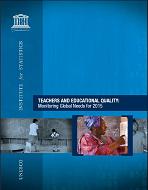
Read the full article from Reuters AlertNet (April 26. 20060.
"More than 18 million new teachers will be needed over the next nine years to meet a U.N. goal of providing primary education to all the world's children by 2015, a U.N. agency said on Tuesday.
"Developing nations have the greatest needs but are poorly equipped to fulfill them because of lack of money and qualified personnel, UNESCO's Montreal-based Institute for Statistics said in a report."
Tuesday, April 25, 2006
Mrs. Bush's Remarks at the UNESCO Education for All Week Luncheon
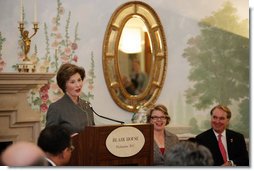
Read the transcript of the First Lady's remarks.
"Literacy is the foundation of personal freedom. Being able to read, and choosing what we read, is how we shape our beliefs, our minds, and our characters. Reading brings self-reliance and independence. For many women and their children, literacy can even mean the difference between life and death. A mother who can read can understand the label on a food container. She knows how to follow the instructions on a bottle of medicine. She's more likely to make wise decisions about her life that will keep her and her children healthy.
"Literacy is the foundation of economic freedom. Free markets require informed consumers, and that means consumers who can read. Wider literacy also increases economic participation, which leads to more stable and vibrant economies......
"Today, I'm delighted to announce that this September, during the opening of the 61st session of the U.N. General Assembly, we'll convene a Conference on Global Literacy in New York. Working in cooperation with the U.S. Department of Education, the U.S. State Department, the U.S. Agency for International Development, and UNESCO, the United Nations Scientific and Cultural Organization, we'll be looking at literacy programs that work, and connecting countries with the information they need to implement similar programs. The Conference will also encourage leaders from around the world to become involved in literacy in their own countries, and then to learn ways to support UNESCO's goal of Education for All by 2015."
Wednesday, April 19, 2006
World Book and Copyright Day - April 23, 2006
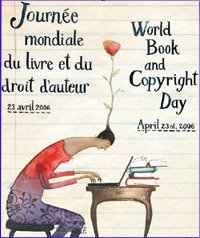
Go to the UNESCO website for the World Book and Copyright Day, 2006.
By celebrating this Day throughout the world, UNESCO seeks to promote reading, publishing and the protection of intellectual property through copyright.
23 April: a symbolic date for world literature for on this date and in the same year of 1616, Cervantes, Shakespeare and Inca Garcilaso de la Vega all died. It is also the date of birth or death of other prominent authors, and was a natural choice for UNESCO's General Conference to pay a world-wide tribute to books and authors. UNESCO encourages "everyone, and in particular young people, to discover the pleasure of reading and gain a renewed respect for the irreplaceable contributions of those who have furthered the social and cultural progress of humanity".
Tuesday, April 18, 2006
United Kingdom to give $15 billion to promote Education for All (EFA)
Read the full press release from UNESCO.
"The United Kingdom has pledged $15 billion in overseas aid for education in Africa and Asia over the next ten years."
"The United Kingdom has pledged $15 billion in overseas aid for education in Africa and Asia over the next ten years."
Saturday, April 15, 2006
Masterpieces of Intangible Heritage
UNESCO's Culture program includes a strong focus on the intangible heritage of mankind. Indeed, UNESCO is the managing U.N. agency for The Convention for the Safeguarding of the Intangible Cultural Heritage.
It has produced this webpage with an interactive map showing the entire List of Masterpieces of the Oral and Intangible Heritage of Humanity. Various lists down the left side of the webpage, plus a world map, allow visitors to the page to browse among the 47 proclaimed masterpieces and to consult detailed information, diaporamas, and videos on each of them.
It has produced this webpage with an interactive map showing the entire List of Masterpieces of the Oral and Intangible Heritage of Humanity. Various lists down the left side of the webpage, plus a world map, allow visitors to the page to browse among the 47 proclaimed masterpieces and to consult detailed information, diaporamas, and videos on each of them.
Friday, April 14, 2006
Unesco intends to put the magic back in Babylon
Read the full article by Jeffrey Gettleman in The New York Times/International Herald Tribune, FRIDAY, APRIL 14, 2006.
"Babylon, the city with the million- dollar name, has paid the price of war. It has been ransacked, looted, torn up, paved over, neglected and roughly occupied. Archaeologists said American soldiers had even used soil thick with priceless artifacts to stuff sandbags.
"But Iraqi leaders and UN officials are not giving up on it. They are working assiduously to restore Babylon, home to the Hanging Gardens, one of the Seven Wonders of the Ancient World.........
"The UN Educational, Scientific and Cultural Organization is pumping millions of dollars into Babylon and a handful of other sites. It has even printed a snazzy brochure to give to wealthy donors. "Cultural tourism could become Iraq's second biggest industry, after oil," explained Philippe Delanghe, a United Nations official helping with the project."
"Babylon, the city with the million- dollar name, has paid the price of war. It has been ransacked, looted, torn up, paved over, neglected and roughly occupied. Archaeologists said American soldiers had even used soil thick with priceless artifacts to stuff sandbags.
"But Iraqi leaders and UN officials are not giving up on it. They are working assiduously to restore Babylon, home to the Hanging Gardens, one of the Seven Wonders of the Ancient World.........
"The UN Educational, Scientific and Cultural Organization is pumping millions of dollars into Babylon and a handful of other sites. It has even printed a snazzy brochure to give to wealthy donors. "Cultural tourism could become Iraq's second biggest industry, after oil," explained Philippe Delanghe, a United Nations official helping with the project."
Sunday, April 09, 2006
Convention on Intangible Cultural Heritage Enteers into Force
Read the full UNESCO announcement.
As at 31 March 2006, forty-six States had ratified the Convention for the Safeguarding of the Intangible Cultural Heritage. The Convention was approved by the UNESCO General Conference in 2005. It will enter into force on 20 April 2006. The implementation of this Convention, which strongly emphasizes the role of communities and groups as bearers and transmitters of intangible cultural heritage, is hoped to contribute to the promotion of cultural diversity and human creativity. The convention was strongly opposed by the Bush administration.
As at 31 March 2006, forty-six States had ratified the Convention for the Safeguarding of the Intangible Cultural Heritage. The Convention was approved by the UNESCO General Conference in 2005. It will enter into force on 20 April 2006. The implementation of this Convention, which strongly emphasizes the role of communities and groups as bearers and transmitters of intangible cultural heritage, is hoped to contribute to the promotion of cultural diversity and human creativity. The convention was strongly opposed by the Bush administration.
Panographic Views of World Heritage Sites
World Heritage Tour provides an online experience of UNESCO World Heritage sites. Click on the link above, and then on the map, and you will have the chance to view the pyramids, or the empire state building almost as well as if you were there, never leaving your computer.
Friday, April 07, 2006
UNESCO’s Basic Texts on the Information Society
Article 1 of UNESCO's Constitution states that it will "collaborate in the work of advancing the mutual knowledge and understanding of peoples, through all means of mass communication and to that end recommend such international agreements as may be necessary to promote the free flow of ideas by word and image". Among UNESCO’s fundamental activities, then, is the drafting of charters, declarations and recommendations intended to present the essence of its proposals for action in the fields of education, science, culture and communication. UNESCO staff have attempted through this publication to select a number of quotations from the Organization’s many official texts, originating from all its program sectors, which contribute to defining what the information society ought to be, without reducing the debate to purely technical issues. It was prepared for the World Summit on the Information Society (WSIS). UNESCO, 2003. (PDF, 116 pages.)
Thursday, April 06, 2006
Towards Knowledge Societies
The UNESCO World Report on knowledge societies for all has been released at a crucial moment. After the achievements of the first phase of the World Summit on the Information Society, there is fresh international interest in the growth and development paradigm that bears within it the idea of “knowledge societies”. We are witnessing the emergence of a need for clarification of its aims as a project of society. This is the challenge that the UNESCO World Report intends to address on the eve of decisive international meetings.
Friday, March 17, 2006
UNESCO Projects on Slavery: St. Patrick' Day
Saint Patrick, the patron saint of Ireland, was sold into slavery in the 5th century. After his escape he returned to Ireland, where he had been a slave, and brought Christianity to the island. On this day, dedicated to St. Patrick, it seems appropriate to spotlight UNESCO's concern for slavery.
The Slave Route is UNESCO's portal for a long term project with three major objectives:
The Slave Trade Archives is a major project to break a silence and make universally known the issue of the transatlantic slave trade and slavery, its causes and dramatic results, by means of scientific work. Under this project historical records of the slave trade have been digitized and made available in new formats:
2004 was dedicated by the United Nations as Slavery Abolition Year. UNESCO's portal for the commeroration describes its activities.
Unfortunately, involuntary servitude is still with us 1600 years after St. Patrick, and in spite of the progress made in the 19th and 20 centuries. UNESCO's efforts, helping to keep the issue before the public and to further scientific understanding of slavery, are an arm in the international effort to promote and protect human rights!
Check out UNESCO's Lest We Forget: The Triumph Over Slavery Exhibit online.
The Slave Route is UNESCO's portal for a long term project with three major objectives:
* to break the silence surrounding the slave trade and slavery through the historical study of the causes and dynamics of the transatlantic slave tradeThe UNESCO Office in the Caribbean also emphasized its Slave Route Project.
* to clarify of the consequences and interactions resulting from the slave trade
* to contribute to the establishment of a culture of tolerance and peaceful coexistence between races and peoples.
The Slave Trade Archives is a major project to break a silence and make universally known the issue of the transatlantic slave trade and slavery, its causes and dramatic results, by means of scientific work. Under this project historical records of the slave trade have been digitized and made available in new formats:
* The National Library of Brazil's project is considered a model of excellence.
* Haiti, in the middle of civil war, under the threat of death, lack of electricity and political instability, was able to finish on schedule the first CD-ROM.
* Senegal prepared the documents of former French West Africa and inscribed them on the Memory of the World Register.
* Colombia digitised over 150.000 images.
* The Museum of Barbados created an archive for the 14 English-speaking countries of the Caribbean.
2004 was dedicated by the United Nations as Slavery Abolition Year. UNESCO's portal for the commeroration describes its activities.
Unfortunately, involuntary servitude is still with us 1600 years after St. Patrick, and in spite of the progress made in the 19th and 20 centuries. UNESCO's efforts, helping to keep the issue before the public and to further scientific understanding of slavery, are an arm in the international effort to promote and protect human rights!
Thursday, March 16, 2006
Water and Indigenous Peoples
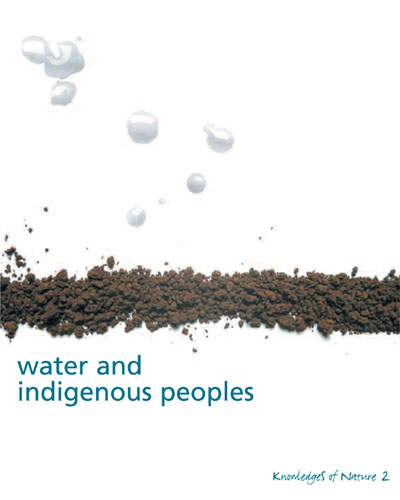
Edited by R. Boelens, M. Chiba and D. Nakashima. Knowledges of Nature 2, UNESCO: Paris, 177 pp., March 2006.
To request a copy, email - sc_links@unesco.org
This book has been launched by UNESCO during the Fourth World Water Forum in Mexico City (March 2006). It is based on the papers delivered atf the Second and Third World Water Forums (The Hague in 2000 and Kyoto in 2003). It brings to the fore some of the most incisive critics from indigenous communities of international debates on water access, use and management, as well as indigenous expressions of generosity that share community knowledge and insight in order to propose remedies for the global water crisis.
Water and Indigenous Peoples advocates a revision of international development efforts to fully embrace indigenous peoples' knowledge, values, land tenure, customary management, social arrangements and rights pertaining to water. Contributions cover a wide array of approaches and issues, ranging from 'worldviews' to 'rights-based struggles'.
Monday, March 13, 2006
"Education Makes News" training kit
UNESCO has launched a revised and improved the Education For All media training and resource kit titled “Education Makes News”. Education for All (EFA) is the international initiative to achieve education for all by 2015. The kit is to be used to encourage the communication media to highlight EFA goals locally, regionally and globally. The kit can be used to develop the interest, knowledge and skills of journalists and other media professionals in writing, reporting and investigating the EFA issues. It can help them to create stories from statistics and bring the EFA debate to the center stage. The revised kit has been updated with recent statistics, facts, and examples and newly organized contents. The technology used in the Computer Based Training (CBT) is simplified for easy use by learners/trainers.
Click here to downloaded the kit.
Click here to downloaded the kit.
Sunday, March 12, 2006
Philip Hall Coombs; Education Expert and Advocate
Read the obituary in the Washington Post, March 10, 2006.
Read the obituary in the New York Times, March 7, 2006.
Philip Hall Coombs, 90, the first assistant secretary of state for educational and cultural affairs, died Februar 15, 2006 in Chester, Conn.
Mr. Coombs worked for UNESCO's International Institute for Educational Planning in Paris. In 1970, he became vice chairman and then chairman of the International Council of Economic Development, focusing on improving education in developing countries.
His books include "The Fourth Dimension of Foreign Policy" (1964); "Education and Foreign Aid" (1965); "Attacking Rural Poverty: How Nonformal Education Can Help" (1974); and "The World Crisis in Education: The View From the Eighties" (1985).
Read the obituary in the New York Times, March 7, 2006.
Philip Hall Coombs, 90, the first assistant secretary of state for educational and cultural affairs, died Februar 15, 2006 in Chester, Conn.
Mr. Coombs worked for UNESCO's International Institute for Educational Planning in Paris. In 1970, he became vice chairman and then chairman of the International Council of Economic Development, focusing on improving education in developing countries.
His books include "The Fourth Dimension of Foreign Policy" (1964); "Education and Foreign Aid" (1965); "Attacking Rural Poverty: How Nonformal Education Can Help" (1974); and "The World Crisis in Education: The View From the Eighties" (1985).
"We praise education's virtues and count on it to help the new generation solve great problems which the older generation has failed to solve," Secretary Coombs told an international meeting in Washington in 1961. "But when it comes to spending more money for education, our deeds often fail to match our words."
Saturday, March 11, 2006
22 March - World Day for Water 2006: Water and Culture
Go to UNESCO's website for the World Day for Water 2006.
The United Nations General Assembly has declared that 22 March of each year is World Day for Water. States are invited to devote the Day, as appropriate in the national context, to concrete activities such as the promotion of public awareness through the publication and diffusion of documentaries and the organization of conferences, round tables, seminars and expositions related to the conservation and development of water resources and the implementation of the recommendations of Agenda 21.
World Water Day (WWD) 2006 will be guided by the theme 'Water and Culture' under the leadership of UNESCO.
The United Nations General Assembly has declared that 22 March of each year is World Day for Water. States are invited to devote the Day, as appropriate in the national context, to concrete activities such as the promotion of public awareness through the publication and diffusion of documentaries and the organization of conferences, round tables, seminars and expositions related to the conservation and development of water resources and the implementation of the recommendations of Agenda 21.
World Water Day (WWD) 2006 will be guided by the theme 'Water and Culture' under the leadership of UNESCO.
Wednesday, March 08, 2006
Laura Bush calls for promoting education with advanced teachers Training

Read the full article in the Pakistan Times.
"US First Lady Laura Bush on Saturday stressed the need for promotion of education in Pakistan, with special focus on advanced skill training for teachers.
"'Education is an issue of concern worldwide,...and we (United States) want Pakistan to shift from simple qualifications to advanced methodology in the educational field. This can help people to lead life with success,' she said in a roundtable talk with the representatives of UNESCO, Federal Directorate of Education, Children Resource International (CRI) and United States Agency for International Development (USAID) at US Embassy here."
"UNESCO: Sixty Years of Standard-Setting in Education, Science and Culture"
Go to the Conference website.
This Symposium is is to take place 9-10 March 2006 in Paris at the UNESCO Headquarters. It has been organized by UNESCO's Office of International Standards and Legal Affairs.
UNESCO has adopted over the last sixty years 35 conventions, 31 recommendations and 13 declarations in the fields of education, science and culture.
Two experts from U.S. universities are included among the distinguished participants:
This Symposium is is to take place 9-10 March 2006 in Paris at the UNESCO Headquarters. It has been organized by UNESCO's Office of International Standards and Legal Affairs.
UNESCO has adopted over the last sixty years 35 conventions, 31 recommendations and 13 declarations in the fields of education, science and culture.
* What has become of all these instruments ?This symposium on UNESCO’s standard-setting activities - the first of its kind - is organized in the context of the sixtieth anniversary of the Organization. It brings together eminent international legal scholars and practitioners to address the above issues, and to assess the impact of UNESCO’s standard setting-activities in the realization of the mandate of the Organization.
* Have they contributed to the realization of the principles and objectives of UNESCO as laid down in its Constitution ?
* What is their impact on national laws and policies of Member States ?
* Have they become part of international law ?
Two experts from U.S. universities are included among the distinguished participants:
* Prof. Ruth OKEDIJI from the University of Minnesota, and
* Prof. Jerome H. REICHMAN from Duke University.
International Women's Day 2006
Today is International Women's Day. Check out UNESCO's website describing the events taking place at UNESCO in honor of the occasion.
Every year on 8 March, both at and away from Headquarters, UNESCO celebrates International Women’s Day, a flagship event which highlights at the international level questions relating to the empowerment of women and the promotion of gender equality.
Every year on 8 March, both at and away from Headquarters, UNESCO celebrates International Women’s Day, a flagship event which highlights at the international level questions relating to the empowerment of women and the promotion of gender equality.
UNESCO Holds Conference on Arts in Human Development
UNESCO Holds Conference on Arts in Human Development
A conference on the role of arts in human development sponsored by the United Nations Educational, Scientific and Cultural Organization (UNESCO) began on Monday in the Portuguese capital.
The four-day meeting drew 750 experts from around the world including teachers, researchers and other experts in visual arts, dance, music, theatre, creative writing and poetry.
Portuguese President Jorge Sampaio opened the conference with UNESCO Director General Koichiro Matsuura.
A conference on the role of arts in human development sponsored by the United Nations Educational, Scientific and Cultural Organization (UNESCO) began on Monday in the Portuguese capital.
The four-day meeting drew 750 experts from around the world including teachers, researchers and other experts in visual arts, dance, music, theatre, creative writing and poetry.
Portuguese President Jorge Sampaio opened the conference with UNESCO Director General Koichiro Matsuura.
Strategies for Teacher Training in ICT
UNESCO Bangkok provides a page of links to several studies of pre- and in-service teacher development programs intended to effectively integrate information and communication technologies into school and university curricula. Examples include Singapore, Malaysia, Hong Kong, South Korea and Costa Rica. UNESCO also has a link to a Professional Development Model for Online Course Development.
Tuesday, March 07, 2006
Inter-Agency Peace Education Programg
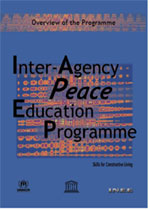 Read the booklet online.
This new UNESCO publication describes a program for the introduction of peace education and conflict minimization for refugee and returnee children. The program is designed to enable people to think constructively about living together and about solving problems that arise in their communities through peaceful means. It also allows the learners to practice these skills.
The program described is currently being implemented in eleven countries in Africa, and has been integrated into complementary programmes in Kosovo, Pakistan and Sri Lanka.
It is run by UNESCO in collaboration with the United Nations High Commissioner for Refugees (UNHCR).
U.S. Public Opinion on International Relations
"America's Place in the World 2005: An Investigation of the Attitudes of American Opinion Leaders and the American Public About International Affairs"
This is a study produced by the Pew Center for the People and the Press in association with the Council on Foreign Relations. It is the latest of a series. It is perceived by many to indicate a shift toward isolationism on the part of the American Public.
Peter Beinhart wrote last month, for example:
Public isolationism has jumped sharply since 2002. Even more striking is the change in elite opinion. According to a recent Pew study, the percentage of security experts who say the United States should be highly assertive around the world has dropped from 75 percent in 1993 to 53 percent today. Among leading scientists and engineers, it has dropped from 55 percent to 32 percent. Among top religious leaders, it has fallen from 57 percent to 36 percent.
Larry Seaquist, a member of the Board of Directors of Americans for UNESCO, provided a column by David Brooks of the New York Times, in which he takes an alternative view:
A polling analyst, Ruy Teixeira, has taken the closest look at the data over at his Web site, Donkey Rising. Teixeira argues that instead of seeing a turn to isolationism, what we are seeing in poll after poll is public opinion returning to normal post-World War II levels, after the unusual 9/11 blip.
Much of the isolationist talk started when a Pew survey found that 42 percent of Americans believe that the U.S. should mind its own business internationally, a 12-point rise over three years. But Teixeira points out that the 42 percent number puts Americans back where they were throughout the Clinton years, when Americans supported more foreign interventions than ever before.
Ruy Teixeira, on his website "Donkey Rising", in fact wrote:
Is the US public moving toward isolationism? Last week, I cited the John Mueller article on “The Iraq Syndrome” that suggested a trend among the public toward isolationism was likely in reaction to the Iraq debacle. Partial confirmation of this trend is provided by data from a new Pew Research Center/Council on Foreign Relations study, “American’s Place in the World, 2005". I say partial confirmation for two reasons: (1) There are counter-trends that suggest the public mood cannot easily by typecast as simply isolationist; and (2) The move away from internationalism, such as it is, is mostly relative to the post-September 11, 2001 surge in internationalism. Therefore, the public is mostly returning to the status quo ante–the post Vietnam era of qualified internationalism--rather than true isolationism.
Brooks seems clearly to have wrongly interpreted Teixeira, who thinks that the level of isolationism is returning to post Desert Storm levels, not post WWII levels. The key finding from the Pew study is shown in the graph below:

The report itself states:
Fully 42% of Americans say the United States should “mind its own business internationally and let other countries get along the best they can on their own.” This is on par with the percentage expressing that view during the mid-1970s, following the Vietnam War, and in the 1990s after the Cold War ended.Thus, on the basis of this one indicator, public opinion appears more isolationist not only than after WWII, when the failure of isolationism was fresh in the minds of the public, but than at any time other than right after Viet Nam and right after Desert Storm.
Teixeira also writes:
Data on the UN are somewhat contradictory. On the one hand, favorability toward the UN has nosedived, so it is now 29 points lower than it was just prior to September 11, 2001. And sentiment that the “The United States should cooperate fully with the United Nations” is now at just 54 percent, down 13 points from just before 9/11 and 6 points since 2002 (though this is still substantially higher than the previous low of 46 percent in 1976). But views on whether “strengthening the UN” should be a top priority (40 percent) are just about the same as they were before 9/11 and quite a bit higher than they were in 1997 (30 percent).
However, consider the results from "Americans on Addressing World Poverty of June 2005":
A large majority of Americans favors the US committing to the goal of devoting seven-tenths of one-percent of GDP to reducing world poverty, provided that other developed countries do so as well. An equally large majority favors the US committing up to $50 a year per taxpaying household to meet the Millennium Development Goals by the year 2015—once again, provided that other developed countries do so as well.
I suggest that public opinion polls show a reduction in support for the wars in Iraq and Afghanistan, and the related policies in the Middle East and West Asia. The changing views of the United Nations, especially if ascertained in the context of the wars, are probably also related to the conflict. Few opinion leaders and few in the public would distinguish the United Nations and its peace keeping functions, from the IAEA and its non-proliferation functions, from the decesntralized agencies such as UNESCO.
In fact I suppose there is great public support for some U.N. agencies. Thus the concern for a possible avian flu pandemic has required leadership on a global level from the World Health Organization, and I would guess that there is practically no isolationism expressed in terms of waiting for the pandemic to hit the United States, rather than working through multilateral channels to stop the disease where it breaks out in the human population.
I would suggest that UNESCO represents a special case. Opinion leaders and the public should be very supportive of its efforts toward Education for All. They should see international cooperation in science to be a public good, promoted effectively by UNESCO. But due to the long period that the United States was out of UNESCO, Americans know even less about it than about other U.N agencies. At a time when Americans for UNESCO is seeking to promote more linkages between UNESCO and its natural consitituencies in the United States, and to promote better understanding of UNESCO, those efforts might well be endangered by fall-out criticism of other international policies or of the United Nations.
UNESCO at the African Union Summit
The African Union held a Summit meeting in Khartoum, Sudan in January.
UNESCO provided a documentary exhibition describing the works of UNESCO in the service of culture, science and technology on the continent. Click here to see the exhibit.
Mr. Koichiro Matsuura, Director General of UNESCO addressed the heads of government and other attendees at the meeting. Click here to read his remarks.
Among other decisions, the Summit:
UNESCO provided a documentary exhibition describing the works of UNESCO in the service of culture, science and technology on the continent. Click here to see the exhibit.
Mr. Koichiro Matsuura, Director General of UNESCO addressed the heads of government and other attendees at the meeting. Click here to read his remarks.
Among other decisions, the Summit:
* Proclaimed the period 2006 – 2015, the Second Decade of Education for Africa;
* Endorsed the framework of the Plan of Action of the Second Decade of Education for Africa;
* Called upon Member States to devote sufficient resources for the implementation of the Plan of Action;
* Adopted the revised Charter for the Cultural Renaissance of Africa;
* Appealed to Member States for the speedy signing and ratification of the revised Charter;
* Adopted statutes for the establishment of the African Academy of Languages;
* Invited UNESCO and other relevant partners to provide support to both ministries of culture and education in their efforts to strengthen the interface between culture and education;
* Declared 2006 as the Year of African Languages; and
* Requested that the Commission (in cooperation with a Group of Experts) consider further the establishment of an African Educational, Scientific and Cultural Organization (AFESCO).
Tuesday, February 28, 2006
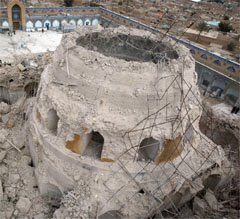
Rebuilding the Mosques in Iraq
 Askariya Before the Bombing
The bombing on February 22 of the Golden Mosque in Samarra, Iraq was a purposefully outrageous act, in the original sense that it deliberately provoked outrage.
CNN tells us this of the 1,200-year-old Askariya shrine:
# The Golden Mosque is one of the four major Shiite shrines in Iraq. The other major sites are in Najaf, Kerbala and the Baghdad district of Kadhimiya.The Golden Mosque was a beautiful building because a community of believers saw it as a symbol of their faith. It commemorated two men who were not only directly descended from the Prophet, but who were great leaders of their faith.
# Two of the 12 revered Shiite Imams are buried in the shrine. Imam Ali al-Hadi, who died in 868 AD and his son, the 11th Imam Hasan al-Askari, who died in 874 A.D.
Retaliation lead to retaliation, and the process included more purposefully outrageous acts, including the desecration of many other mosques. More and more people have been outraged.
According to Relief Web,
The Special Representative of the U.N. Secretary-General in Iraq Mr. Ashraf Qazi, confirmed on Monday, UN/UNESCO support to the Iraqi initiative to rebuild the Shrine of Imam Ali Al-Hadi and other damaged religious sites.He indicated that the UN, through its Iraq trust fund and UNESCO with its technical expertise, are ready to assist in rebuilding the damaged complex.
U.S. Ambassador to Iraq Zalmay Khalilzad and General George Casey, the commander of the coalition troops in Iraq, said,
Given the historic, cultural, and religious importance of this shrine, this attack is a crime against humanity. The Shrine should be rebuilt and the United States will contribute to its reconstruction.Michael Southwick, a member of the Americans for UNESCO Board of Directors, stated:
I think it would be great if some American would spearhead a widely publicized effort to collect contributions here from Muslim and non-Muslim American alike.I agree that it would be great if the American public were to raise money to rebuild the mosques that have been destroyed, Sunni and Shiite alike. Indeed, given the separation of church and state in this country, I think it would be better done through private philanthropy than through public funds. And I think Americans of all faiths would be willing to donate to show their support for the people of Iraq.
Thursday, February 23, 2006
Financing a UNESCO Chair or Participation in an UNITWIN Network
Since 1992, UNESCO has worked to strengthen higher education in the developing world through the UNITWIN and UNESCO Chairs programs. These programs encourage higher education systems in the industrial world to build relationships and share research and expertise with institutions in developing countries as well as regions in transition.
UNITWIN/UNESCO Chairs projects deal with training and research activities and cover all major fields of knowledge within UNESCO’s competence such as Education, Human Rights, Cultural Development, Environment, Basic and Engineering Sciences, Communication, etc. Thus far, 618 UNESCO Chairs and Networks have been established in 123 countries. A directory of existing projects is available online.
Each year, UNESCO designates approximately thirty new UNITWIN networks and UNESCO Chairs in total throughout the world; a majority is awarded to universities.
UNESCO Chairs
UNESCO Chairs are awarded each year to individual colleges, universities and research institutions to initiate programs that further research and training in one of UNESCO's fields of competence. A Chair may be established by reinforcing an existing teaching or research program and giving it an international dimension, or one may be established as a new teaching and research unit. More information on current Chairs can be found on the UNITWIN/UNESCO Chairs section of UNESCO's website.
UNITWIN Networks
Through the University Twinning and Network Scheme (UNITWIN), UNESCO matches colleges, universities and research institutions in industrialized countries with counterparts in the developing world to share information and knowledge in areas of need. Scholars who participate are often linked through web sites and portals, in addition to loaned faculty positions, trainings and conferences.
The Competitive Process
Selection of participants in this program is competitive, bases on project proposals, that are reviewed by UNESCO.
When the project proposal concerns the establishment of an inter-university network, it can be submitted either by the heads of all institutions involved, or by a single institution which takes the lead, acts as the focal point and ensures the development of the network.
UNESCO seeks the advice and endorsement of national commissions on these proposals, as part of its review process.
In the case of the U.S. National Commission for UNESCO, it will first screen applications, passing the successful ones to UNESCO itself. Its deadline for receipt of applications this year is March 27. Click here to go to the National Commission website for the program.
Scholars and institutions seeking to apply for a UNESCO Chair or to participate in the UNITWIN program should prepare application materials based on UNESCO's "Guidelines for the Submission of Project Proposals." More information can also be obtained in the UNESCO document "Procedures for the UNITWIN/UNESCO Chairs Programme: A Practical Guide."
The deadline for receipt of the applications at UNESCO (after their review in the National Commission) is April 30.
Sources of Funding
UNESCO has limited resources. It sees the universities in countries like the United States as financing their own participation using domestic resources. (UNESCO can make some seed money available to universities in developing nations.)
For a U.S. university, this raises the question of where to obtain the resources needed to create a chair or participate in a network. Several U.S. government sources of funding seem possible:
The U.S. Agency for International Development (USAID) funds the "Higher Education for Development (HED) Program" which promotes higher education's engagement in social and economic development through institutional and human capacity building in developing countries. Between 1998 and 2005, ALO awarded funding to more than 250 partnerships in more than 60 countries.
The National Science Foundation (NSF), and its Office of International Science and Engineering, have a number of programs that might provide the funds needed for a UNESCO chair. The Partnerships for International Research and Education was run as a one-time, pilot competition in 2005. If the NSF chooses to hold additional competitions, the PIRE program would be an exceptional source of support.
The Fogerty International Center of the National Institutes of Health is primarily a source of funding for biomedical research. (Note that there is a Special Focus program on HIV/AIDS, which includes a center at Johns Hopkins University.) Fogarty research areas include the Health, Environment, and Economic Development (HEED) Program, the International Cooperative Biodiversity Groups (ICBG) and International Studies on Health and Economic Development.
There are, in addition, thousands of foundations and other charitable organizations that might finance the efforts of a UNESCO Chair or network. The Foundation Center offers a searchable database of foundation programs, and your institution might well have subscribed to its online database. (Monthly subscriptions are not expensive, and you can search free of charge at the Center's offices in New York, Washington DC, Atlanta, Cleveland, or San Francisco. There are also cooperating collections in many states.
Check the Research Office of your university. They have information on sources of financing, and offer assistance in preparing proposals.
UNITWIN/UNESCO Chairs projects deal with training and research activities and cover all major fields of knowledge within UNESCO’s competence such as Education, Human Rights, Cultural Development, Environment, Basic and Engineering Sciences, Communication, etc. Thus far, 618 UNESCO Chairs and Networks have been established in 123 countries. A directory of existing projects is available online.
Each year, UNESCO designates approximately thirty new UNITWIN networks and UNESCO Chairs in total throughout the world; a majority is awarded to universities.
UNESCO Chairs
UNESCO Chairs are awarded each year to individual colleges, universities and research institutions to initiate programs that further research and training in one of UNESCO's fields of competence. A Chair may be established by reinforcing an existing teaching or research program and giving it an international dimension, or one may be established as a new teaching and research unit. More information on current Chairs can be found on the UNITWIN/UNESCO Chairs section of UNESCO's website.
UNITWIN Networks
Through the University Twinning and Network Scheme (UNITWIN), UNESCO matches colleges, universities and research institutions in industrialized countries with counterparts in the developing world to share information and knowledge in areas of need. Scholars who participate are often linked through web sites and portals, in addition to loaned faculty positions, trainings and conferences.
The Competitive Process
Selection of participants in this program is competitive, bases on project proposals, that are reviewed by UNESCO.
When the project proposal concerns the establishment of an inter-university network, it can be submitted either by the heads of all institutions involved, or by a single institution which takes the lead, acts as the focal point and ensures the development of the network.
UNESCO seeks the advice and endorsement of national commissions on these proposals, as part of its review process.
In the case of the U.S. National Commission for UNESCO, it will first screen applications, passing the successful ones to UNESCO itself. Its deadline for receipt of applications this year is March 27. Click here to go to the National Commission website for the program.
Scholars and institutions seeking to apply for a UNESCO Chair or to participate in the UNITWIN program should prepare application materials based on UNESCO's "Guidelines for the Submission of Project Proposals." More information can also be obtained in the UNESCO document "Procedures for the UNITWIN/UNESCO Chairs Programme: A Practical Guide."
The deadline for receipt of the applications at UNESCO (after their review in the National Commission) is April 30.
Sources of Funding
UNESCO has limited resources. It sees the universities in countries like the United States as financing their own participation using domestic resources. (UNESCO can make some seed money available to universities in developing nations.)
For a U.S. university, this raises the question of where to obtain the resources needed to create a chair or participate in a network. Several U.S. government sources of funding seem possible:
The U.S. Agency for International Development (USAID) funds the "Higher Education for Development (HED) Program" which promotes higher education's engagement in social and economic development through institutional and human capacity building in developing countries. Between 1998 and 2005, ALO awarded funding to more than 250 partnerships in more than 60 countries.
The National Science Foundation (NSF), and its Office of International Science and Engineering, have a number of programs that might provide the funds needed for a UNESCO chair. The Partnerships for International Research and Education was run as a one-time, pilot competition in 2005. If the NSF chooses to hold additional competitions, the PIRE program would be an exceptional source of support.
The Fogerty International Center of the National Institutes of Health is primarily a source of funding for biomedical research. (Note that there is a Special Focus program on HIV/AIDS, which includes a center at Johns Hopkins University.) Fogarty research areas include the Health, Environment, and Economic Development (HEED) Program, the International Cooperative Biodiversity Groups (ICBG) and International Studies on Health and Economic Development.
There are, in addition, thousands of foundations and other charitable organizations that might finance the efforts of a UNESCO Chair or network. The Foundation Center offers a searchable database of foundation programs, and your institution might well have subscribed to its online database. (Monthly subscriptions are not expensive, and you can search free of charge at the Center's offices in New York, Washington DC, Atlanta, Cleveland, or San Francisco. There are also cooperating collections in many states.
Check the Research Office of your university. They have information on sources of financing, and offer assistance in preparing proposals.
Wednesday, February 22, 2006
It is a good time for Yanks to seek UNESCO jobs.
UNESCO management, like that of other multilateral agencies, is concerned that the organization maintains a fair balance of staff from its member nations. It uses a formula to calculate the number of staff members it should have from each nation. In the case of the United States, it has estimated that there should be between 46 and 76 citizens on its staff. There are currently 32. Thus UNESCO might reasonably add another 30 Yanks to its staff!
Both UNESCO and the State Department are seeking qualified U.S. citizens for UNESCO jobs.
Both UNESCO and the State Department are seeking qualified U.S. citizens for UNESCO jobs.
World Culture Report 2000: Cultural diversity, conflict and pluralism

Go to the UNESCO website for the report.
Aware of the need to delve further into the multi-layered concepts of cultural diversity, conflict resolution and pluralism, UNESCO produced this second edition of the World Culture Report, in which experts, statisticians and artists provide information and analysis and propose new concepts, insights and policy recommendations. The report appears to be out of print, but the website has a number of tables online providing data up to the year 2000 about interesting cultural indicators.
Tuesday, February 21, 2006
A Visit to Cahokia Mounds, A World Heritage Site
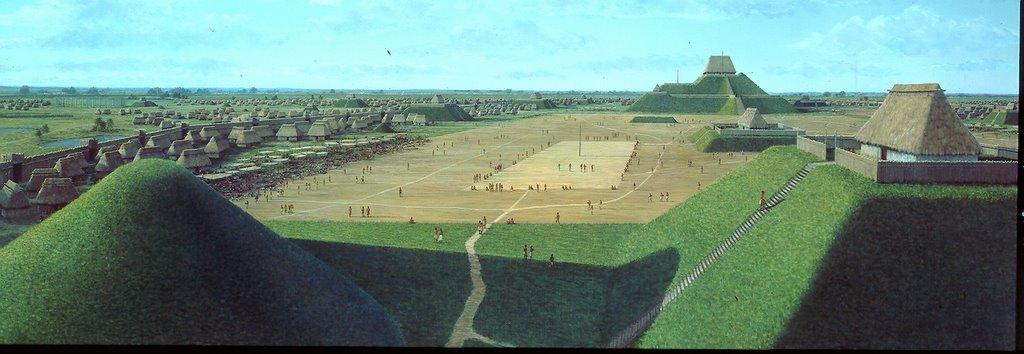
I was fortunate to visit the Cahokia Mounds State Historic Site in Illinois last weekend. It is a few miles away from St. Louis. The illustration above, based on the mural at the Interpretive Center, shows the largest pyramid and central plaza of the town, as it is imagined to have existed at its zenith about the year 1100. Notice the stockade, two miles long, that surrounded this central portion of the town.
Cahokia Mounds is one of only twenty (20) UNESCO World Heritage sites in the United States (including two sites jointly administered with Canada). (Click here for the National Parks Service website for the sites.) It proudly flies the UN flag, to indicate it is a UNESCO World Heritage Site.
According to TheSalmons.org, "Cahokia is the largest pre-Columbian settlement north of Mexico. It was occupied primarily during the Mississippian period (800-1400). It is an example of a complex agricultural chiefdom society, with many satellite mound centers and numerous outlying hamlets and villages."
The site includes the largest prehistoric earthwork in the Americas (shown above). This is a structure comparable in size to the great pyramid of Egypt and the Pyramid of the Sun in Teotihuacán, Mexico. Called "Monks Mound" (after the Trappist monks who settled the site in the 19th century) it covers 14 acres, rises 100 feet, and was originally topped by a massive 5,000 square-foot building another 50 feet high.
Monk's Mound was the largest of 120 earthen mounds built over an area of six square miles. (Only 80 survive today.) The builders of this city moved some 55 to 60 million cubic feet of earth, using only woven baskets, to create their network of mounds and community plazas.
Woodhenge, partially restored on its original site, was a circle of large wooden posts more than 400 feet in diameter. While its full significance is not understood, some of the posts appeared to mark the winter and summer salstices and the fall and spring equinoxes. The town was built in a diamond shape, marked out by large mounds at the corners, and suggesting surveying abilities even beyond those demonstrated by the central plaza and its edifices.
By AD 1050-1150, the Cahokia site was the regional center for the Mississippian culture with many satellite communities, villages and farmsteads for hundreds of miles around it. At is peak, it is estimated to have had some 20,000 inhabitants, making it larger at the time than Paris or London.
It was the center of a trading network that extended to Wisconsin in the north, Florida in the south-east, and Mexico in the south-west. It was a farming community, growing corn, squash, Jerusalem artichokes and other crops in the rich soil of the Mississippi river bottoms. The inhabitants added meat and fish to their diet by hunting and fishing.
The society that built this city was sophisticated, with a mastery of trade, agriculture, building and other technology, and indeed some scientific knowledge! It was a complex, stratified society.
After AD 1200, the population began to decline and the site was abandoned by AD 1400. It is not clear what happened to the descendents of the Mississippian culture, but it is believed that some still preserved traditions of their forefathers into historic times, allowing them to be recorded by early European explorers.
The Cahokia Mounds Interpretive Center is beautifully organized, in a fine building, and provides examples of the sophisticated pottery and stone artifacts found at the site, as well as exhibits eplaining the way the original inhabitants of the site lived.
I was amazed to learn that only a very small portion of the site has been explored by professional archaeologists, and much of the archaeology that has been done was rescue archaeology. Thus, major excavations were done when a highway was built through the site, and when the Interpretive Center was built.
We visited the site on a very cold day, and there were very few other visitors. Given the importance of this site, its extremely interesting "mounds", and its proximity to a large city (that was hosting the Annual Meeting of the American Association for the Advancement of Science at the time), I would have expected many more people on a clear, weekend morning.
This is not a national park nor a national monument. Much of the area of archaeological interest is not protected, and there is even an abandoned modern building on the site. This should be an important economic asset for the local community, drawing visitors not only from the United States, but from other countries. It does not seem to be adequately developed, nor adequately publicized for such a purpose. Indeed, I think all Americans should know of this site, but I suspect very few do.
Were it not for having been recognized by UNESCO in 1982 as an important part of the world's heritage, this site might be still less known and appreciated in the United States. That would be unfortunate, because it is a site that sheds significant light on our history and culture!
Thursday, February 16, 2006
Diplomacy helps Ethiopia regain its historical landmark
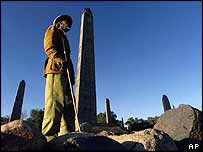
Read the full article in the Angola Press.
Italy has returned Ethiopia`s 1,700-year-old obelisk that was looted by dictator Benito Mussolini in 1937, and the Italian government is paying for restoring the 24-metre tall granite, weighing 150 tons, at its original site of Axum in the northern Ethiopian region of Tigray. According to BBC News, "The Axum obelisk is regarded as one of Ethiopia's national religious treasures."
The return and restauration of the obelisk "is a very difficult and unprecedented operation," said Francesco Bandarin, director of UNESCO World Heritage Centre, which is coordinating the restoration in collaboration with Ethiopia`s culture and tourism ministry. "The engineering process is based on the philosophy of `zero risk` for the obelisk to be reinstalled in its former place and intact. We have to make sure the site is not damaged," Bandarin told journalists in Addis Ababa.
The peaceful resolution of a half century old dispute between nations is a great example of UNESCO's role in international cultural affairs.
Wednesday, February 15, 2006
UNESCO at 60: 60 weeks 60 themes
This website provides a wonderful introduction to UNESCO. In celebration of the 60 years since its creation, UNESCO has chosen to highlight a major area of its activity on its website each week for 60 weeks. The website provides links to all of the highlights published to date in chronological order.
The New Courier: UNESCO at 60

This 60th anniversary issue marks a new format for the New Courier. Bridging the tranformation of the paper edition into a full fledged e-magazine, this special edition presents articles on ten key subjects, providing web links for each article to guide the user towards more information from the UNESCO portal.
The themes explored are as follows:
# Education For All
# Oceans
# Heritage
# Copyright
# Bioethics
# Environment
# Cultural diversity
# Water
# Digital Divide
# Crises and emergencies
The Sixth E-9 Ministerial Meeting on Education
Ministers from the nine countries with the largest populations are meeting in Mexico from February 13th to 15th to discuss Education for All. The nine countries (Bangladesh, Brazil, China, Egypt, India, Indonesia, Mexico, Nigeria, Pakistan) account for over half of the world’s school-age population, 45 percent of the 100 million children who are out-of-school and over 70 percent of the 771 million adult illiterates around the globe.
The meeting is part of the UNESCO Education for All program.
The E-9 Initiative was launched in 1993, In New Delhi, India, on the occasion of the EFA Summit of the Nine High-Population countries. Heads-of-state or government of the so called E-9 countries ('E' for education and 9 for nine countries) at the meeting pledged to universalize primary education and significantly reduce illiteracy in their respective countries.
At the close of the meeting today, the ministers are to adopt a joint communiqué. Concluding remarks are to be presented by the Minister of Education of Mexico, the Director-General of UNESCO, and a representative of Indonesia, where the next E-9 meeting will be held.
The Director-General of UNESCO and the ministers will give a press conference at 6 p.m. today, February 15.
The meeting is part of the UNESCO Education for All program.
The E-9 Initiative was launched in 1993, In New Delhi, India, on the occasion of the EFA Summit of the Nine High-Population countries. Heads-of-state or government of the so called E-9 countries ('E' for education and 9 for nine countries) at the meeting pledged to universalize primary education and significantly reduce illiteracy in their respective countries.
At the close of the meeting today, the ministers are to adopt a joint communiqué. Concluding remarks are to be presented by the Minister of Education of Mexico, the Director-General of UNESCO, and a representative of Indonesia, where the next E-9 meeting will be held.
The Director-General of UNESCO and the ministers will give a press conference at 6 p.m. today, February 15.
Sunday, February 12, 2006
"Impact of Free Primary Education on Early Childhood Development in Kenya"
Click here to read the full issue No. 30 of the UNESCO Policy Brief on Early Childhood series.
Introduction
"Free Primary Education (FPE), introduced in Kenya in 2003, has enabled 1.3 million poor children to benefit from primary education for the first time through the abolishment of fees and levies for tuition. The gross enrolment rate in primary education jumped from 86.8% in 2002 to 101.5% in 2004.
"Though intended to boost primary education, FPE has had consequences in other areas of education, including early childhood development (ECD). The purpose of the present brief is to discuss the impact of FPE on ECD in Kenya and to outline two major policy options that may mitigate possible negative impact."
Introduction
"Free Primary Education (FPE), introduced in Kenya in 2003, has enabled 1.3 million poor children to benefit from primary education for the first time through the abolishment of fees and levies for tuition. The gross enrolment rate in primary education jumped from 86.8% in 2002 to 101.5% in 2004.
"Though intended to boost primary education, FPE has had consequences in other areas of education, including early childhood development (ECD). The purpose of the present brief is to discuss the impact of FPE on ECD in Kenya and to outline two major policy options that may mitigate possible negative impact."
Ministers from nine high population countries meet in Mexico to review Education for All progress
Read the full UNESCO press release.
"The Sixth E-9 Ministerial Review Meeting on Education for All will take place in Monterrey (Mexico), 13–15 February. Organized by UNESCO in cooperation with the government of Mexico, the meeting will assess progress towards the goal of providing quality education for all in nine of the world’s high-population countries. The President of Mexico, Vicente Fox Quesada, and the Director-General of UNESCO, Koïchiro Matsuura, will open the meeting. The education ministers of Bangladesh, Brazil, China, Egypt, India, Indonesia, Mexico, Nigeria and Pakistan will then review the challenges facing their countries with a view to increasing bilateral and collective cooperation."
"The Sixth E-9 Ministerial Review Meeting on Education for All will take place in Monterrey (Mexico), 13–15 February. Organized by UNESCO in cooperation with the government of Mexico, the meeting will assess progress towards the goal of providing quality education for all in nine of the world’s high-population countries. The President of Mexico, Vicente Fox Quesada, and the Director-General of UNESCO, Koïchiro Matsuura, will open the meeting. The education ministers of Bangladesh, Brazil, China, Egypt, India, Indonesia, Mexico, Nigeria and Pakistan will then review the challenges facing their countries with a view to increasing bilateral and collective cooperation."
U.S. Polish Cooperation on World Heritage Site
"The United States helped preserve the Wieliczka Salt Mine, a UNESCO World Heritage site in Poland that has been mined since the 13th century. Its nine levels contain 300 kilometers of galleries where works of art, altars and statues are sculpted in the salt."
This is part of the announcment of a new Science Cooperation pact between the United States and Poland.
This is part of the announcment of a new Science Cooperation pact between the United States and Poland.
Saturday, February 11, 2006
UNESCO's Global Alliance for Cultural Diversity
UNESCO's Global Alliance supports cultural diversity by strengthening cultural industries, such as music, cinema, and publishing, in developing countries. It promotes respect for intellectual property rights and encourages public-private partnerships between its members.
Note the materials on the 21 Dec 2005" - "The World Summit on Arts and Culture.
Note the materials on the 21 Dec 2005" - "The World Summit on Arts and Culture.
"DEVELOPPING PANAFRICAN CULTURAL SYNERGIES"
Go to the Conference annoumcement.
February 22-23-24, 2006, Brazzaville, Congo - Organised by the UNESCO Office in Brazzaville in cooperation with Forum des jeunes entreprises, Congo in the framework of UNESCO’s Global Alliance for Cultural Diversity in partnership with the Danish Centre for Culture and Development
The Forum will bring together a number of African civil society institutions and cultural enterprises with a view to developing a strategy for cultural South-South cooperation between the multiple private stakeholders of the creative chain in the region that is based on transfer and sharing of knowledge, competences and know-how. It will be organised in the form of a workshop so as to give each participant time to analyse its own strengths and needs and to gain understanding on possible pooling of available non-financial resources.
February 22-23-24, 2006, Brazzaville, Congo - Organised by the UNESCO Office in Brazzaville in cooperation with Forum des jeunes entreprises, Congo in the framework of UNESCO’s Global Alliance for Cultural Diversity in partnership with the Danish Centre for Culture and Development
The Forum will bring together a number of African civil society institutions and cultural enterprises with a view to developing a strategy for cultural South-South cooperation between the multiple private stakeholders of the creative chain in the region that is based on transfer and sharing of knowledge, competences and know-how. It will be organised in the form of a workshop so as to give each participant time to analyse its own strengths and needs and to gain understanding on possible pooling of available non-financial resources.
Friday, February 10, 2006
Education for All Global Monitoring Report Database
Extensive data on Education for All in some 180 countries is now available in a click with the new search tool on the Global Monitoring Report website.
This tool, developed by the UNESCO Institute for Statistics in partnership with the EFA Global Monitoring Report team, is based on the data contained in the 2006 statistical annex tables. It enables you to search by table, theme, indicator, country and region, and to export results into an Excel format.
This tool, developed by the UNESCO Institute for Statistics in partnership with the EFA Global Monitoring Report team, is based on the data contained in the 2006 statistical annex tables. It enables you to search by table, theme, indicator, country and region, and to export results into an Excel format.
Getting a Job With UNESCO
International work is interesting and fulfilling. Work in the U.N. system offers decent salaries and benefits and significant career opportunities. UNESCO provides virtually a unique opportunity for those interested in education, science, culture and communications to do useful and important work in an international setting.
Now is an especially good time for U.S. citizens to get jobs in UNESCO. During the long period that the United States was not a member of UNESCO, the number of U.S. citizens working in UNESCO decreased substantially. Now that the United States is back, that number should increase.
UNESCO was created in large part to increase the understanding among peoples in order to promote and maintain peace. The understanding between the people of the United States and those of other nations seems more important than ever. U.S. citizens on the staff of UNESCO can play a key role in promoting involvement of their fellow citizens in UNESCO activities, and thus to facilitating constructive dialog between the United States and other nations.
Moreover, the United States is especially strong in many of the skills needed by UNESCO, and people from the United States are likely to be more effective than others in helping UNESCO tap the resources of the United States for its programs and activities. Not incidentally, U.S. citizens can also help make the benefits of UNESCO available to us at home.
Qualifications:
UNESCO's working languages in its headquarters are French and English, and its staff in the field is often required to speak other languages. Thus language skills are important for anyone thinking of a job in UNESCO. International experience is also a definite plus.
UNESCO is the United Nations Educational, Scientific and Cultural Organization, and employs people for its programs in education, the natural sciences, the social sciences, culture, and communications as well as the variety of professions needed to run a big, international organization (e.g. accounting, personnel, management, information technology management). The sectoral jobs tend to go to experienced professionals, both due to their content and to the competition for good positions in international organizations.
UNESCO jobs tend to require administrative and/or policy experience. Thus, while a teaching background is a definite plus for someone seeking a job in UNESCO's education sector, it is not the only qualification; experience in educational administration and educational policy are probably more relevant to most of UNESCO's work in the education sector.
The State Department is especially interested in helping highly qualified U.S. citizens to find policy making jobs in UNESCO. Those interested who feel themselves qualified for a senior position in UNESCO would be well advised to contact the U.S. Mission to UNESCO in Paris, or the U.S. National Commission. Their advice would be invaluable, and their support in obtaining such a position in UNESCO essential.
There are, however, entry level jobs at UNESCO, including fellowships. There is even a Fulbright Fellowship for U.S. citizens to help people with recent graduate degrees to work in UNESCO.
Some useful links.
UNESCO has an Employment Services Website.
The U.S. National Commission for UNESCO posts notices of fellowship and other employment opportunities on its website. It also provides timely information on UNESCO vacancies in its "updates" newsletter.
The U.S. Mission's website also provides employment information.
There is a very helpful document provided by the State Department for those interested in "Employment Opportunities With the United Nations and Other International Organizations". It is part of State's website on "Employment Information: U.N. and International Organizations".
Click here for more on jobs in multilateral development agencies.
Now is an especially good time for U.S. citizens to get jobs in UNESCO. During the long period that the United States was not a member of UNESCO, the number of U.S. citizens working in UNESCO decreased substantially. Now that the United States is back, that number should increase.
UNESCO was created in large part to increase the understanding among peoples in order to promote and maintain peace. The understanding between the people of the United States and those of other nations seems more important than ever. U.S. citizens on the staff of UNESCO can play a key role in promoting involvement of their fellow citizens in UNESCO activities, and thus to facilitating constructive dialog between the United States and other nations.
Moreover, the United States is especially strong in many of the skills needed by UNESCO, and people from the United States are likely to be more effective than others in helping UNESCO tap the resources of the United States for its programs and activities. Not incidentally, U.S. citizens can also help make the benefits of UNESCO available to us at home.
Qualifications:
UNESCO's working languages in its headquarters are French and English, and its staff in the field is often required to speak other languages. Thus language skills are important for anyone thinking of a job in UNESCO. International experience is also a definite plus.
UNESCO is the United Nations Educational, Scientific and Cultural Organization, and employs people for its programs in education, the natural sciences, the social sciences, culture, and communications as well as the variety of professions needed to run a big, international organization (e.g. accounting, personnel, management, information technology management). The sectoral jobs tend to go to experienced professionals, both due to their content and to the competition for good positions in international organizations.
UNESCO jobs tend to require administrative and/or policy experience. Thus, while a teaching background is a definite plus for someone seeking a job in UNESCO's education sector, it is not the only qualification; experience in educational administration and educational policy are probably more relevant to most of UNESCO's work in the education sector.
The State Department is especially interested in helping highly qualified U.S. citizens to find policy making jobs in UNESCO. Those interested who feel themselves qualified for a senior position in UNESCO would be well advised to contact the U.S. Mission to UNESCO in Paris, or the U.S. National Commission. Their advice would be invaluable, and their support in obtaining such a position in UNESCO essential.
There are, however, entry level jobs at UNESCO, including fellowships. There is even a Fulbright Fellowship for U.S. citizens to help people with recent graduate degrees to work in UNESCO.
Some useful links.
UNESCO has an Employment Services Website.
The U.S. National Commission for UNESCO posts notices of fellowship and other employment opportunities on its website. It also provides timely information on UNESCO vacancies in its "updates" newsletter.
The U.S. Mission's website also provides employment information.
There is a very helpful document provided by the State Department for those interested in "Employment Opportunities With the United Nations and Other International Organizations". It is part of State's website on "Employment Information: U.N. and International Organizations".
Click here for more on jobs in multilateral development agencies.
Saturday, February 04, 2006
Mobile Learning for Expanding Educational Opportunities

A new publication examines the potential of information and communication technologies (ICT) to expand educational opportunities and accelerate national socio-economic development in the Asia and Pacific Region. It looks closely at how devices such as Personal Digital Assistants (PDAs), laptops, Pocket PCs, and mobile phones can be utilized as mobile learning (m-learning) tools to provide interactive content in previously unreachable and remote locations.
Many nations have developed e-learning and m-learning strategies, and are rapidly expanding the use and knowledge of ICT in educational activities by incorporating ICT into lesson plans, teaching methodologies and curricula, and devoting funds to procuring ICT-related resources. However, successful implementation of e-learning and m-learning programmes involves careful planning, and also faces an array of challenges.
This publication draws from the International Workshop on Mobile Learning for Expanding Educational Opportunities, which took place on 16-20 May 2005 in Tokyo, Japan.
UNESCO and the World Summit on the Information Society
Koïchiro Matsuura, Director-General of UNESCO, gave this talk to the governmental Permanent Representatives and Observers to UNESCO on UNESCO's role in the WSIS and the effect of WSIS on UNESCO.
Excerpts:
"We proceeded to elaborate a strategy of engagement with the Summit that reflected a different approach, one that gave proper weight to the social dimension, ethical considerations and the claims of cultural and linguistic diversity. In a nutshell, our strategy focused not on connectivity but on content.
"In order to have an impact and influence on the Summit, we realized that we had to work out a coherent, well-developed position and to apply it consistently in different fora and processes. And this is precisely what we did through our elaboration of the concept of “knowledge societies”, featuring four key principles: freedom of expression; universal access to information and knowledge; respect for cultural and linguistic diversity; and quality education for all. By bringing these principles and concerns regularly into the frame of discussion and debate, UNESCO helped to show that the “digital divide” is not merely technological in character.
"The most tangible outcomes of the WSIS process are the four documents adopted in Geneva and in Tunis, including principles, action areas and instructions on implementation mechanisms. These are the Geneva Declaration of Principles, the Geneva Plan of Action, the Tunis Commitment and the Tunis Agenda for the Information Society.
"They all reflect, in varying degrees, UNESCO’s contribution to the WSIS process. Before examining that contribution in further detail, I would like to highlight three important outcomes of the Summit of a general nature.
"First, the Summit has helped to generate a high-level dialogue on such matters as Internet governance which simply had not been taking place before. Such dialogue is vital as new phases of the digital revolution unfold and as its impact becomes increasingly global in character.
"Second, the Summit has been a catalyst for partnership between a wide range of stakeholders. It served to bring together different constituencies of interest and provided opportunities for cooperation and exchange. The development of multistakeholder partnerships, I believe, will be one of the lasting benefits of the Summit.
"Third, WSIS has helped to show that ICT is not merely a tool or instrument that belongs to “technology” rather than “society” but is, in fact, deeply embedded in social processes, in knowledge, in culture, in science and in education. The new ICTs have fast become as integral to our lives as the old technologies of print, radio, TV and cinema. By helping us to create new knowledge and to live different kinds of lives, ICT clearly is not separate from us. The growing development of this integrated, holistic understanding is an important outcome of the Summit."
"UNESCO will also be participating in other parts of the international post-WSIS coordination machinery.
"One of the issues that the international community will continue to address is Internet Governance, which remains a core concern for UNESCO. Therefore, UNESCO will participate as an observer in the work of the Internet Governance Forum and will continue to advocate an open, transparent and inclusive approach to Internet Governance echoing its consistent advocacy of the principle of openness, which encompasses the free flow of information, freedom of expression and technical interoperability. The main areas of relevance to UNESCO are the concern for ethical
dimensions, the realization of multilingualism in the Internet development environment and capacity-building.
"With regard to the Task Force on Financial Mechanisms, led by UNDP, its report was integrated into the Tunis final document, which recognizes the importance of financial mechanisms for bridging the digital divide. The Task Force recommended the creation of a voluntary Digital Solidarity Fund and this was welcomed by the Summit as a complement to existing financing mechanisms which should continue to be fully utilized and improved.
"UNESCO will continue to participate in the work of the Partnership for Measuring ICT for Development ensuring, for example, that the set of core ICT indicators that are presently being developed include those related to the application of ICT and their impact, in particular in the areas of education, science and culture. The role of UIS is clearly important in this regard."
Excerpts:
"We proceeded to elaborate a strategy of engagement with the Summit that reflected a different approach, one that gave proper weight to the social dimension, ethical considerations and the claims of cultural and linguistic diversity. In a nutshell, our strategy focused not on connectivity but on content.
"In order to have an impact and influence on the Summit, we realized that we had to work out a coherent, well-developed position and to apply it consistently in different fora and processes. And this is precisely what we did through our elaboration of the concept of “knowledge societies”, featuring four key principles: freedom of expression; universal access to information and knowledge; respect for cultural and linguistic diversity; and quality education for all. By bringing these principles and concerns regularly into the frame of discussion and debate, UNESCO helped to show that the “digital divide” is not merely technological in character.
"The most tangible outcomes of the WSIS process are the four documents adopted in Geneva and in Tunis, including principles, action areas and instructions on implementation mechanisms. These are the Geneva Declaration of Principles, the Geneva Plan of Action, the Tunis Commitment and the Tunis Agenda for the Information Society.
"They all reflect, in varying degrees, UNESCO’s contribution to the WSIS process. Before examining that contribution in further detail, I would like to highlight three important outcomes of the Summit of a general nature.
"First, the Summit has helped to generate a high-level dialogue on such matters as Internet governance which simply had not been taking place before. Such dialogue is vital as new phases of the digital revolution unfold and as its impact becomes increasingly global in character.
"Second, the Summit has been a catalyst for partnership between a wide range of stakeholders. It served to bring together different constituencies of interest and provided opportunities for cooperation and exchange. The development of multistakeholder partnerships, I believe, will be one of the lasting benefits of the Summit.
"Third, WSIS has helped to show that ICT is not merely a tool or instrument that belongs to “technology” rather than “society” but is, in fact, deeply embedded in social processes, in knowledge, in culture, in science and in education. The new ICTs have fast become as integral to our lives as the old technologies of print, radio, TV and cinema. By helping us to create new knowledge and to live different kinds of lives, ICT clearly is not separate from us. The growing development of this integrated, holistic understanding is an important outcome of the Summit."
for each of the eleven Actions Lines that were adopted in the Geneva Plan of Action, one or several UN organizations or programmes will act as facilitators or moderators. UNESCO, alone or with other agencies, was assigned the role of a moderator or facilitator for the following seven Action Lines:• Access to information and knowledge
• E-learning
• E-science
• Cultural diversity and identity, linguistic diversity and local content
• Media
• Ethical dimensions of the Information Society
• International and regional cooperation
The role of facilitators/moderators should include, inter alia, information exchange, creation of knowledge, sharing of best practices, and assistance in developing multi-stakeholder and public/private partnerships.
"UNESCO will also be participating in other parts of the international post-WSIS coordination machinery.
"One of the issues that the international community will continue to address is Internet Governance, which remains a core concern for UNESCO. Therefore, UNESCO will participate as an observer in the work of the Internet Governance Forum and will continue to advocate an open, transparent and inclusive approach to Internet Governance echoing its consistent advocacy of the principle of openness, which encompasses the free flow of information, freedom of expression and technical interoperability. The main areas of relevance to UNESCO are the concern for ethical
dimensions, the realization of multilingualism in the Internet development environment and capacity-building.
"With regard to the Task Force on Financial Mechanisms, led by UNDP, its report was integrated into the Tunis final document, which recognizes the importance of financial mechanisms for bridging the digital divide. The Task Force recommended the creation of a voluntary Digital Solidarity Fund and this was welcomed by the Summit as a complement to existing financing mechanisms which should continue to be fully utilized and improved.
"UNESCO will continue to participate in the work of the Partnership for Measuring ICT for Development ensuring, for example, that the set of core ICT indicators that are presently being developed include those related to the application of ICT and their impact, in particular in the areas of education, science and culture. The role of UIS is clearly important in this regard."
In order for the Organization to maintain the momentum achieved over recent years, I have decided to prolong the mandate of the Task Force on the Information Society (TFIS) under my chairmanship. It will continue monitoring the implementation of the WSIS decisions as well as the recommendations put forward in the World Report "Towards Knowledge Societies".
I have requested the Communication and Information Sector to maintain a leading role in the coordination of WSIS activities within UNESCO, in close cooperation with BSP. The Sectors are asked to cooperate with CI as it carries out the coordination role.
I will see to it that each programme sector assumes the responsibility for Action Lines falling under its respective mandates. Those concerned in the central services, notably BPI and BSP, as well as the Institutes (notably UIS) and Field Offices, will also be involved in the post-WSIS phase.
UNESCO will actively participate in the implementation mechanisms on the international level. The CI Sector will ensure that UNESCO assumes a prominent role in this context, for example, in the work of the UN Group on the Information Society to be established within the CEB.
Friday, February 03, 2006
Study Abroad 2006-2007
Study Abroad 2006-2007 contains some 2,900 entries concerning post-secondary education and training in all academic and professional fields in countries throughout the world. Key features include information on:
- Study opportunities and financial assistance available to students wishing to study in a foreign country
- National systems of higher education
- Open and distance learning (ODL) opportunities
- Validation of foreign qualifications
- How to search for quality institutions of higher education including warnings about bogus institutions
UNESCO Reference Works series
22,00 €
Book, 688 pages, trilingual edition: French/English/Spanish, 33rd edition
Format: 27 x 19 cm
2005
Thursday, February 02, 2006
Cultural and Linguistic Diversity in Education
Go to the facet of the UNESCO Education Portal on cultural and linguistic diversity in education.
With a focus on promoting universally shared values and a culturally sensitive diversification of educational contents and methods, UNESCO is working to promote quality education as a fundamental right for all by addressing a broad range of themes, which include respect for cultural and linguistic diversity.
This facet of UNESCO's Education Portal provides a broad picture of approaches to education of children where multiple languages are spoken in the same community.
Note especially the position paper, "Education in a Multilingual World".
With a focus on promoting universally shared values and a culturally sensitive diversification of educational contents and methods, UNESCO is working to promote quality education as a fundamental right for all by addressing a broad range of themes, which include respect for cultural and linguistic diversity.
This facet of UNESCO's Education Portal provides a broad picture of approaches to education of children where multiple languages are spoken in the same community.
Note especially the position paper, "Education in a Multilingual World".
Wednesday, February 01, 2006
UNESCO at 60: Celebrating Secondary and Vocational Education
 John Yoon, physics student at Ward Melville High School in Setauket, NY (USA) / © Stony Brook University
Go to the Education Portal home page for this spread on UNESCO's celebration of Secondary and Vocational Education.
In many countries, progress towards universal primary education is sharply increasing the demand for secondary education. This is creating unprecedented challenges of transition from primary to secondary levels of education for about one billion adolescents worldwide. UNESCO is helping countries by approach focuses on strategies for increasing the primary to secondary transition and improving the quality and relevance of secondary education.
* How many children in Africa reach secondary education? (PDF)
* Secondary Education at UNESCO
* Secondary and Vocational Education Brief from UNESCO's Bureau of Public Information (PDF)
* Technical and vocational education under scrutiny
* Vocational Education: The Come-back?
Education specialists tend to prescribe technical and vocational education and training as a recipe for jobs for young people. But experiences around the world tend to show that this is not always the case, reports Education Today.
Tuesday, January 31, 2006
UNESCO: Technical and vocational education

Arts and crafts training for Ethiopian girls
Photographer: Niamh Burke
Technical and vocational education under scrutiny
Experts agree: skill training enhances productivity and sustains competitiveness in the global economy. But what are the progress made by countries in promoting technical and vocational education and training. Over 100 experts from around the world examined this issue during the meeting titled "Learning for Work, Citizenship and Sustainability". The meeting took place in Bonn, Germany, from 25 to 28 October 2004.
Americans for UNESCO Board Meeting
A meeting of the Board of Directors of Americans for UNESCO took place yesterday.
Andre Varchaver was elected to replace Dick Arndt as Chair. Arndt, after four years of arduous service, will move over to become Co-Chair of the Advisory Council.
The Treasurer reported that the recent fund raising campaign had proven reasonably successful, with donations received from the public as well as members of the Board and the Advisory Council. It was agreed that the organization would seek to account for in kind donations, which include large amounts of time donated to the organization's activity.
Progress on the renewal of the Americans for UNESCO website was reported. The UNESCO news blogs have received nearly 5,000 visits since December, 2004, and some 8,000 page views.
Andre Varchaver was elected to replace Dick Arndt as Chair. Arndt, after four years of arduous service, will move over to become Co-Chair of the Advisory Council.
The Treasurer reported that the recent fund raising campaign had proven reasonably successful, with donations received from the public as well as members of the Board and the Advisory Council. It was agreed that the organization would seek to account for in kind donations, which include large amounts of time donated to the organization's activity.
Progress on the renewal of the Americans for UNESCO website was reported. The UNESCO news blogs have received nearly 5,000 visits since December, 2004, and some 8,000 page views.
UNESCO Literacy Portal
Go to the Literacy Portal.
The Literacy Portal aims to provide a platform for information-sharing on literacy projects and activities undertaken around the world and enhance UNESCO’s capacity in coordinating the United Nation Literacy Decade (UNLD) in building partnership at all level.
This portal will be developed progressively through the contribution of all literacy actors; including UNESCO Field Offices, UN Agencies, bilateral and multilateral Organizations, Member States, Institutions, Non-governmental Organizations and Literacy workers. It will be a working tool to provide them more visibility and networking possibilities.
A major task for UNESCO is to support Member States in policy reforms, especially the design and implementation of EFA policies and action plans as well as of legal instruments for promoting universal access to basic education. One way of implementing the right to education is to work towards literacy.
Faced with an increasing gap between literates and illiterates in terms of social, civic and economic opportunities, UNESCO focus its efforts towards achieving literacy for all, targeting principally girls and women. On the other hand, emphasis is placed on an education that helps to meet the challenges of poverty and exclusion by promoting life skills and access to the world of work, in particular through technical and vocational education.
UNESCO recommends several strategies for literacy work at the country level with a view towards achieving education for all – recommendations also articulated in the International Plan of Action for the United Nations Literacy Decade. These are:
1. placing literacy at the centre of national education systems and development efforts;
2. giving equal importance to formal and non-formal education modalities;
3. promoting an environment supportive of literacy and a culture of reading in schools and communities;
4. ensuring community involvement in literacy programmes as well as their local ownership;
5. building partnerships particularly at the national level, but also at sub regional, regional and international levels, between government, civil society, the private sector and local communities;
6. developing at all levels systematic monitoring and assessment supported by research and data collection.
Fulbright Fellowship at UNESCO
The United Nations Foundation, a private organization, supports professional internships under the U.S. Fulbright program at UNESCO headquarters. I understand that there are currently nine Fellows in residence under the program, and that it is expected to appoint six more for the comming year.
The program is to allow selected grantees to contribute to the advancement of the work of the United Nations and UNESCO, learn from UNESCO staff, and gain valuable professional experience to cap off their Fulbright program abroad. While all degree levels are considered, recent graduates and master's degree applicants have been encouraged to apply.
INTERNSHIP AREAS: Include communications and the Media/Communications, Cultural & World Heritage, HIV/AIDS Education, Basic Education, Quality of Life Education, Sustainable Development and Global Tsunami Warning Systems. INTERNSHIP STIPEND: A travel and settling-in allowance and a monthly stipend to cover housing, meals, and incidental expenses will be provided.
The program is implemented by the International Institute for Education. This website provides information on the 2005 - 06 program.
The program is to allow selected grantees to contribute to the advancement of the work of the United Nations and UNESCO, learn from UNESCO staff, and gain valuable professional experience to cap off their Fulbright program abroad. While all degree levels are considered, recent graduates and master's degree applicants have been encouraged to apply.
INTERNSHIP AREAS: Include communications and the Media/Communications, Cultural & World Heritage, HIV/AIDS Education, Basic Education, Quality of Life Education, Sustainable Development and Global Tsunami Warning Systems. INTERNSHIP STIPEND: A travel and settling-in allowance and a monthly stipend to cover housing, meals, and incidental expenses will be provided.
The program is implemented by the International Institute for Education. This website provides information on the 2005 - 06 program.
Monday, January 30, 2006
Measuring Linguistic Diversity on the Internet

Read the report in English or French on its UNESCO website.
UNESCO has been emphasizing the concept of “knowledge societies”, which stresses plurality and diversity instead of a global uniformity in order to bridge the digital divide and to form an inclusive information society. An important theme of this concept is that of multilingualism for cultural diversity and participation for all the languages in cyberspace.
Friday, January 27, 2006
"'African UNESCO' gets go-ahead"
Read the full atricle by Wagdy Sawahel in SciDev.Net. (27 January 2006)
"The African Union (AU) has backed plans to create a scientific and cultural branch modelled on the UN Educational, Scientific and Cultural Organization (UNESCO).
"The AU council gave the proposal, from Sudan, the green light at its summit last week (21 January) in the Sudanese capital Khartoum.
"Among its aims, the proposed African Educational, Scientific and Cultural Organization (AFESCO) intends to boost the continent's scientific capacity, promote international cooperation and protect African cultures."
"The African Union (AU) has backed plans to create a scientific and cultural branch modelled on the UN Educational, Scientific and Cultural Organization (UNESCO).
"The AU council gave the proposal, from Sudan, the green light at its summit last week (21 January) in the Sudanese capital Khartoum.
"Among its aims, the proposed African Educational, Scientific and Cultural Organization (AFESCO) intends to boost the continent's scientific capacity, promote international cooperation and protect African cultures."
Thursday, January 26, 2006
Thanks to Seabreeze Travel!
The folks at Seabreeze Travel have donated three desktop computers to Americans for UNESCO, filling a real need as we work to get the organization back online. Many thanks!
Tuesday, January 17, 2006
UNESCO, big business join forces against AIDS
Read the full article in AFP via Yahoo!News.
UNESCO and The Global Business Coalition (GBC) on HIV/AIDS signed the agreement on Monday, January 15. The Global Business Alliance invludes 200 companies that have committed themselves to fighting AIDS. Many of the coalition's members, including DaimlerChrysler, GlaxoSmithKline, Total, L'Oreal, Volkswagen, Johnson and Johnson, and Unilever have already implemented anti-AIDS strategies, mostly in Africa. UNESCO Director-General Koichiro Matsuura stressed the need for cooperation between institutions and the private sector to fight the "scourge" of HIV/AIDS.
UNESCO and The Global Business Coalition (GBC) on HIV/AIDS signed the agreement on Monday, January 15. The Global Business Alliance invludes 200 companies that have committed themselves to fighting AIDS. Many of the coalition's members, including DaimlerChrysler, GlaxoSmithKline, Total, L'Oreal, Volkswagen, Johnson and Johnson, and Unilever have already implemented anti-AIDS strategies, mostly in Africa. UNESCO Director-General Koichiro Matsuura stressed the need for cooperation between institutions and the private sector to fight the "scourge" of HIV/AIDS.
Monday, January 16, 2006
"Preservation: Sure, It's a Good Thing, but.."
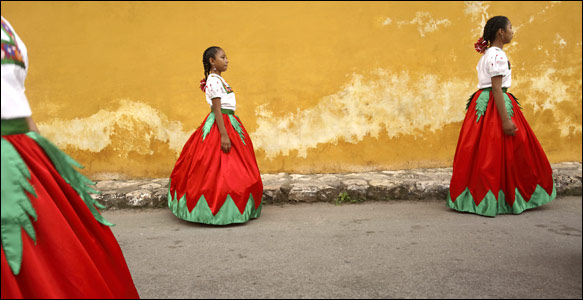
Janet Jarman; The New York Times
Go to the multimedia piece by Seth Kugel for the New York Times. (January 15, 2006)
"The phrase Unesco World Heritage site has been crossing from the lips of travel agents and popping up more and more on travel Web sites. That's no coincidence: the list has grown steadily from the first 12 in 1978 to 812 today, and includes everything from the Statue of Liberty, the Taj Mahal and Angkor Wat to the Wooden Churches of Southern Little Poland and the Orkhon Valley Cultural Landscape in Mongolia.
"But as the list expands each year, many, including Unesco staff members, are left wondering: is this rapid growth watering down the list's meaning? And by drawing both tourism and development that's often left unchecked, can the honor do as much harm as good to those places so anointed?"
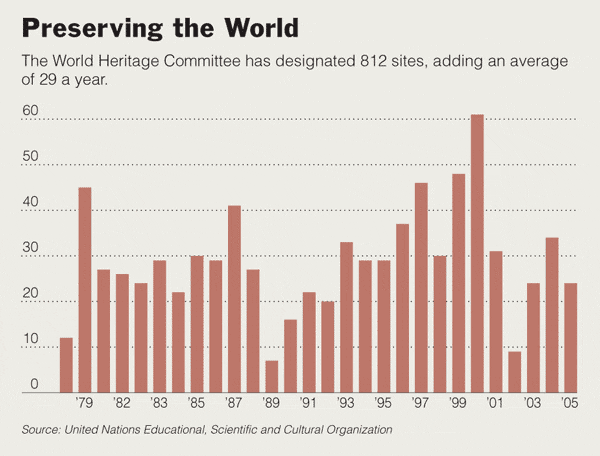
Seth Kugel has produced this thoughtful piece for the New York Times, questioning UNESCO's World Heritage Site list, and indirectly the process by which sites are added and deleted from that list.
Today was marked in Washington by a story in the Washington Post on the destruction of a historic astronomical observatory. Two 1890 telescope buildings designed by one of the fathers of American architecture, Richard Morris Hunt, are being torn down. According to the Post, "precise, astronomical measurements -- celestial and equatorial readings that gave Naval warships their bearings and the world's clocks their precision -- had been made inside these buildings for much of the 175-year history of the U.S. Naval Observatory."
"No ship sailed, no missile fired, no mission to outer space was ever launched without help from the star positions marked by the telescope observations made in these buildings," said Gail S. Cleere, a Washington historian who wrote a book about the observatory.
My point is that the 812 sites on the UNESCO list are far from exhausing the number of natural and man made sites that constitute the heritage of man. UNESCO, with its very limited budget and staff can not preserve man's heritage, but it can and does serve as a venue for the nations of the world to discuss that preservation. UNESCO's World Heritage Center draws attention to sites that are clearly very important, and that attention encourages communities and nations to protect their local heritage for us all.
The multimedia show on this website, documenting the Times visit to Chichén Ítza and Campeche in Mexico's Yucatán peninsula, are well worth visiting!
Monday, January 09, 2006
Whither UNESCO? Science, Poverty, and Peace
There has been a change in the speaker lineup for this symposium on UNESCO to be held as part of the AAAS Annual Meeting in St. Louis. The correct information follows:
DATE: Friday, February 17, 2006
TIME: 8:30 AM - 10:00 AM
ORGANIZER: Irving Lerch, Americans for UNESCO
PARTICIPANTS:
Laurel Baldwin-Ragaven (Moderator), Trinity College
Marcio Barbosa* (Speaker), United Nations Educational, Scientific, and Cultural Organization (UNESCO), Paris
The View from UNESCO
Walter Erdelen* (Speaker), UNESCO
The Impact of the UNESCO Science Program
Marguerite Sullivan (Speaker), U.S. Department of State
The View from the U.S. Government
Bruce Alberts (Speaker), University of California, San Francisco
The Role and Viewpoint of the National Academies
Rita Colwell (Speaker), University of Maryland and Canon U.S. Life Sciences Inc.
The Role and Expectation of the Learned and Professional Societies
Laurel Baldwin-Ragaven is the Henry R. Luce Professor of Health and Human Rights in Trinity College, and current Chair of the AAAS Committee on Scientific Freedom and Responsibility.
* Please note that UNESCO Deputy Director General Barbosa and UNESCO Assistant Director General Erdelen are listed as unconfirmed speakers. This is due to the fact that hard commitments cannot be made long before the event. However, the organizers have been assured of their desire to attend and participate in this discussion.
DATE: Friday, February 17, 2006
TIME: 8:30 AM - 10:00 AM
ORGANIZER: Irving Lerch, Americans for UNESCO
PARTICIPANTS:
Laurel Baldwin-Ragaven (Moderator), Trinity College
Marcio Barbosa* (Speaker), United Nations Educational, Scientific, and Cultural Organization (UNESCO), Paris
The View from UNESCO
Walter Erdelen* (Speaker), UNESCO
The Impact of the UNESCO Science Program
Marguerite Sullivan (Speaker), U.S. Department of State
The View from the U.S. Government
Bruce Alberts (Speaker), University of California, San Francisco
The Role and Viewpoint of the National Academies
Rita Colwell (Speaker), University of Maryland and Canon U.S. Life Sciences Inc.
The Role and Expectation of the Learned and Professional Societies
Laurel Baldwin-Ragaven is the Henry R. Luce Professor of Health and Human Rights in Trinity College, and current Chair of the AAAS Committee on Scientific Freedom and Responsibility.
* Please note that UNESCO Deputy Director General Barbosa and UNESCO Assistant Director General Erdelen are listed as unconfirmed speakers. This is due to the fact that hard commitments cannot be made long before the event. However, the organizers have been assured of their desire to attend and participate in this discussion.
Sunday, January 08, 2006
Robinson Miller Upton: 1916-2005

Read the obituary in The Chicago Tribune.
Miller Upton, who served for 21 years as president of Beloit College, died December 19, 2005, at his home in Fontana, Wis. He was 88. Mr. Upton was president of many organizations, including the Council of Protestant Colleges and Universities, the Wisconsin Association of Independent Colleges and Universities, the Wisconsin Association on Higher Education and the American Finance Association. Mr. Upton also served on the board of directors for various companies, including what is now M&I Bank in Beloit, Snap-On Tools Corp., American General Series Portfolio Co., Affiliate Artists Inc., Sears Roebuck Foundation and Household International Inc.
Mr. Upton had a passion for working with international organizations on how to advance education. He was chairman of the U.S. National Commission for UNESCO from 1971 to 1974.
Emily Vargas-Baron provided the following comments on Miller Upton:
He and his wife June have been dear friends. I first met him when, as the director of the U. S. National Commission to UNESCO, he gave a marvelous speech at a General Conference. He received a standing ovation, and at first he did not realize how unusual this was...
Miller was a dynamic, gentle and highly effective leader. He fully supported Jack Fobes, and for years contributed in many ways to AAU. I am glad he lived to see the United States return to UNESCO.
Through the U.S. National Commission, he helped ensure the broad participation of civil society in UNESCO and its programmes. As President of Beloit College, he orchestrated the provision of an excellent liberal arts programme. Both activities were a reflection of his deep commitment to ideals of peace, democracy, the rule of law, and education for all. I am sure many of you will join me in missing Miller greatly.
For your information, Beloit College has established the Miller and June Upton Scholarship Fund.
Friday, January 06, 2006
"UNESCO grants $125,000 for Shalamar Gardens’ restoration"

Read the full article by Shoaib Ahmed in The Daily Times (Pakistan), January 06, 2006.
"The United Nations Educational, Scientific and Cultural Organisation (UNESCO) and Getty Foundation have given US$ 125,000 fund for the restoration and conservation of the Shalamar Gardens, which will be closed for about a month for heavy restoration work, Punjab Archaeology Department (PAD) sources told Daily Times on Thursday.
"Sources said the UNESCO released US$ 50,000 as emergency assistance for the gardens’ restoration whereas the Getty Foundation released US$ 75,000 for the first phase of the documentation and master plan. Amidst the restoration work being carried out at the Shalamar Gardens under the PAD, sources said the department would soon issue an order with the consultation of senior officials to close the garden for a month........Sources said the next grant expected from the Getty Foundation was US$ 250,000."
Wednesday, January 04, 2006
Why the United States Rejoined UNESCO
Read the full Fact Sheet on the website of the U.S. Embassy in Paris.
“As a symbol of our commitment to human dignity, the United States will return to UNESCO. This organization has been reformed and America will participate fully in its mission to advance human rights and tolerance and learning.”
George W. Bush
57th UN General Assembly, September 12, 2002
Why the United States is Rejoining UNESCO
“Since wars begin in the minds of men, it is in the minds of men that the defenses of peace must be constructed.”
American poet Archibald MacLeish
Preamble of the UNESCO Constitution
“As a symbol of our commitment to human dignity, the United States will return to UNESCO. This organization has been reformed and America will participate fully in its mission to advance human rights and tolerance and learning.”
George W. Bush
57th UN General Assembly, September 12, 2002
Why the United States is Rejoining UNESCO
• UNESCO’s mission and programming reflect and advance a wide range of U.S. interests. For example, UNESCO manages the “Education for All” program, which promotes universal basic education and literacy. This initiative advances U.S. educational goals worldwide and closely parallels the U.S. “No Child Left Behind” program.
• UNESCO advocates education that promotes tolerance and civic responsibility. This is a key to building democracy and combating terrorism.
• UNESCO helps countries protect their natural and cultural heritage. It promotes adoption of sound scientific standards. These efforts are important in maintaining a healthy balance between continuity and imperatives for change.
• UNESCO promotes press freedom and independent media, essential foundations of democracy.
• UNESCO brings countries together to address issues that have significant implications for the future, such as bioethics and cultural diversity. The United States intends to be a full and active participant in these deliberations.
“Since wars begin in the minds of men, it is in the minds of men that the defenses of peace must be constructed.”
American poet Archibald MacLeish
Preamble of the UNESCO Constitution
Subscribe to:
Posts (Atom)