Friday, November 10, 2006
Decisions adopted by the Executive Board at its 175th session, Paris, 26 September-12 October 2006
Read the full 77 page report online. (PDF format.)


More than 15 States ratify the Convention on the Protection and Promotion of the Diversity of Cultural Expressions
Read the full UNESCO news release online.
As of 8 November, 16 nations have ratified the Convention on the Protection and Promotion of the Diversity of Cultural Expressions. The Convention was adopted by UNESCO’s General Conference in October 2005. It will enter into force three months after the the 30th nation has ratified. According to Director-General of UNESCO, Koïchiro Matsuura" “No other UNESCO Convention concerning culture has been ratified by so many States in such a short time.”
UNESCO now administers of a range of standard setting instruments in the field of culture including three Conventions – concerning world heritage (1972), intangible heritage (2003), and the diversity of cultural expressions (2005).
As of 8 November, 16 nations have ratified the Convention on the Protection and Promotion of the Diversity of Cultural Expressions. The Convention was adopted by UNESCO’s General Conference in October 2005. It will enter into force three months after the the 30th nation has ratified. According to Director-General of UNESCO, Koïchiro Matsuura" “No other UNESCO Convention concerning culture has been ratified by so many States in such a short time.”
UNESCO now administers of a range of standard setting instruments in the field of culture including three Conventions – concerning world heritage (1972), intangible heritage (2003), and the diversity of cultural expressions (2005).
Thursday, November 09, 2006
Job Opening: Senior Programme Specialist for Literacy Assessment and Monitoring
Go the UNESCO Institute for Statistics job posting for full details.
Our U.S. Mission to UNESCO would like to be able to propose several Americans of stature who can firmly oversee the monitoring of the UNESCO literacy program. The LAMP program was recently awarded an additional $1 million by the First Lady during the September White House Conference on Global Literacy.
Senior Program Specialist (LAMP)
Literacy Assessment and Monitoring Program
The UNESCO Institute for Statistics (UIS) is seeking a qualified candidate for the post of Senior Program Specialist, LAMP, based in Montreal. Under the authority of the Director of UIS, the incumbent as a senior team member will be responsible to develop, manage and implement the UIS strategy for measuring education quality and outcomes, including the following responsibilities:
Requirements: An advanced university degree with a specialization in statistics, education planning or direct related field. At least 10 years of progressively responsible relevant national and field experience
in educational policies and planning, of which at least 5 years in a management position. Experience in international cooperation is required; UNESCO experience desirable. Excellent verbal and written communication skills in English or French, and good knowledge of the other language is required.
The annual remuneration (including post adjustment) is at the current exchange rate 126 000 USD (116 900 USD without dependents) exempt from income tax and prior to deductions for social security.
Candidates should submit electronically a completed UNESCO CV (available on our website under 'jobs') with a letter of introduction by 30 November 2006, to:
Our U.S. Mission to UNESCO would like to be able to propose several Americans of stature who can firmly oversee the monitoring of the UNESCO literacy program. The LAMP program was recently awarded an additional $1 million by the First Lady during the September White House Conference on Global Literacy.
Literacy Assessment and Monitoring Program
The UNESCO Institute for Statistics (UIS) is seeking a qualified candidate for the post of Senior Program Specialist, LAMP, based in Montreal. Under the authority of the Director of UIS, the incumbent as a senior team member will be responsible to develop, manage and implement the UIS strategy for measuring education quality and outcomes, including the following responsibilities:
* Establishing the long term strategy for literacy assessment to be managed by the UIS including a financial strategy;Closing Date: 2006-11-30 12:00 pm
* Leading the development of the literacy assessment tests to be used in LAMP as well as background questionnaires, survey methodologies and estimation procedures;
* Raising funds and assisting countries to raise funds for their activities under the LAMP program. Liaising with pilot countries and assuring the quality of their work.
* Working closely with users of literacy data (UNDP, World Bank, Global Monitoring report team, Millennium Development Goals (MDG) to ensure that the implementation of LAMP is managed in a statistically and politically appropriate manner.
* Collaborating with the Quality Division of the Education Sector to develop and implement the measurement of global student assessments; taking responsibility for liaison with the various regional and international student assessment studies across the world.
* Managing the UIS LAMP team and cooperating with other UIS sections to ensure that the UIS involvement in Literacy Initiative For Empowerment (LIFE) and the development of regular literacy estimates and projections is integrated with LAMP developments; analysing International Adult Literacy Survey (IALS) data and contributing to the Education for All, EFA, Global Monitoring report.
Requirements: An advanced university degree with a specialization in statistics, education planning or direct related field. At least 10 years of progressively responsible relevant national and field experience
in educational policies and planning, of which at least 5 years in a management position. Experience in international cooperation is required; UNESCO experience desirable. Excellent verbal and written communication skills in English or French, and good knowledge of the other language is required.
The annual remuneration (including post adjustment) is at the current exchange rate 126 000 USD (116 900 USD without dependents) exempt from income tax and prior to deductions for social security.
Candidates should submit electronically a completed UNESCO CV (available on our website under 'jobs') with a letter of introduction by 30 November 2006, to:
recruitment@uis.unesco.orgU.S. citizens interesting in this position should also alert the U.S. Mission to UNESCO to their candidacy:
2, avenue Gabriel
75382 Paris, Cedex 08
T: 33(0)1.45.24.74.56
F: 33(0)1.45.24.74.58
E: ParisUNESCO@state.gov
Wednesday, November 08, 2006
Nobel Committee Broadens Definiton of Peace

©Banker to The Poor, Autobiography of Prof. Muhammad Yunus
Michael Renner, a Senior Researcher at the Worldwatch Institute, comments on the 2006 Nobel Peace Prize award. >>Full article
Alfred Nobel stated that the Prize be given to “the person who shall have done the most or the best work for fraternity between nations, for the abolition or reduction of standing armies and for the holding and promotion of peace congresses ”. Though the Norwegian Nobel Committee’s latest decision is grounded on a more modern principle; that “peace can not be achieved unless large population groups find ways in which to break out of poverty. Micro-credit is one such means. Development from below also serves to advance democracy and human rights.”
The 2006 Peace Prize, -awarded to micro-credit pioneer Muhammad Yunus and the Grameen Bank he founded-, may indeed draw criticism from traditional security analysts.
Working towards a conception of peace that is more than the mere absence of war demands a commitment to sustainable development, equity, and participatory democracy. We need to enhance our comprehension of the ways in which a multitude of social, economic, environmental, and demographic pressures interact, and how these dynamics play out in light of ethnic and political fault lines.
Tuesday, November 07, 2006
The USA-Iran Team wins special recognition at the Mondialogo School Contest Award Ceremony
The awaited winners list of the 2006 Mondialogo School Contest initiated by UNESCO and DaimlerChrysler to promote intercultural learning among young people was announced Monday evening in Rome. This year 35,000 students from 138 nations took part in the competition.
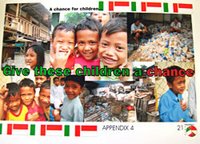
The winner team is one that brought together students from schools in Indonesia and Italy for raising money to provide free schooling to Indonesian children living off garbage dumps.
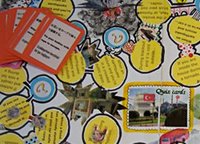 Second prize was awarded to a team from Japan and Turkey for a game they designed about cultural heritage protection and on how to respond to natural disasters.
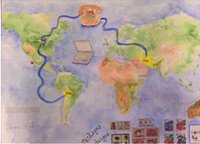 Special recognition for commitment to dialogue was given to a team from Iran and the U.S.A., for their project on water supply. Because direct communication between the two countries proved difficult, the partner team used intermediaries in Bolivia and Pakistan to complete their project.
Further special recognition went to a Romania-Yemen partner team for outstanding creativity. Team members set up a model intercultural community whose architecture unites Christian and Muslim elements in a single city.
A partner team from South Africa and Australia also received special recognition for a project on HIV-AIDS education.
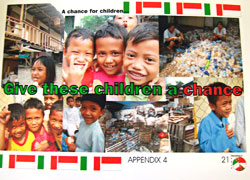
The winner team is one that brought together students from schools in Indonesia and Italy for raising money to provide free schooling to Indonesian children living off garbage dumps.
 Second prize was awarded to a team from Japan and Turkey for a game they designed about cultural heritage protection and on how to respond to natural disasters.
 The third place in the contest was shared between partner teams from Congo-Poland and a team from the Czech Republic and Argentina. The Congo-Poland team published a magazine dedicated to the life of children in these countries, while the Czech Republic-Argentina team produced an inspiring video report highlighting similarities in their everyday lives.
 Special recognition for commitment to dialogue was given to a team from Iran and the U.S.A., for their project on water supply. Because direct communication between the two countries proved difficult, the partner team used intermediaries in Bolivia and Pakistan to complete their project.
Further special recognition went to a Romania-Yemen partner team for outstanding creativity. Team members set up a model intercultural community whose architecture unites Christian and Muslim elements in a single city.
A partner team from South Africa and Australia also received special recognition for a project on HIV-AIDS education.
Visit the Mondialogo School Contest Website
Read our previous related postings
*The Mondialogo School Contest
*Call for Applications: The Mondialogo Engineering Award 2006-2007
© Mondialogo
Monday, November 06, 2006
Alice Ilchman; Advisor to Americans for UNESCO
Alice Stone Ilchman was a member of the Advisory Council of Americans for UNESCO, sharing her great knowledge and experience in education and international affairs. She died in August at her Bronxville home from complications of pancreatic cancer. She was 71. We mourn her loss.
Dr. Ilchman was dean at Wellesley College for five years and president of Sarah Lawrence College in Bronxville, N.Y., for 17. She was appointed dean of the college and professor of economics and education at Wellesley in 1973. Dr. Ilchman was instrumental in establishing Wellesley's Center for Research on Women. Her accomplishments while she was at the helm of Sarah Lawrence from 1981 to 1998 were many. Her legacy includes two new buildings, 10 faculty chairs, three overseas programs, and stronger fiscal health.
During her tenure at Sarah Lawrence, Dr. Ilchman received an Honorary Doctorate from Mt. Holyoke College (1982), the Maternity Association Carola Warburg Rothschild Award (1991), the Maxwell "Spirit of Public Service Award" (1994), The Wellesley College Distinguished Service Award (1995), a Fulbright Honor (1996), and the Alice Ilchman Award for Public Service (1998).
She served as assistant secretary of state for educational and cultural affairs during the Carter administration for two years, with responsibility for the newly created United States Information Agency, the Fulbright program, US libraries abroad, and the international visitor program.
For 13 years, she was a member of the board of the Rockefeller Foundation. At the time of her death, she was director of the Jeannette K. Watson Fellows program, which creates paid summer internships for first-generation college students in New York City.
She had a long interest in and association with India. In 1962 and 1963, she and her husband lived in Delhi and Rajasthan, while she worked on her dissertation on rural development in India for the London School of Economics. She lived in Delhi again in 1968 and 1969. While at the University of California at Berkeley, she directed three Peace Corps training projects for India and co-taught the school's first interdisciplinary South Asian studies course.
Dr. Ilchman graduated from Mount Holyoke College in 1957 and was a member of its board of trustees for 10 years. She earned her master's degree from the Maxwell School of Citizenship and Public Affairs at Syracuse University and her doctorate from the London School of Economics and Politics in 1965.
In addition to her husband and son, Dr. Ilchman leaves a daughter, Sarah, of New York City; two sisters, Nancy Dickinson of Indianapolis and Elizabeth Stone of Los Angeles; and a brother, Donald C. Stone Jr. of Oakland, Calif.
Read obituaries from:
* The Boston Globe
* Sarah Lawrence College
* The New York Times
* The Washington Post
Saturday, November 04, 2006
"National Geographic rates best and worst"

Read the full article in The Seattle Times of November 3, 2006.
"The (National Geographic) magazine's November-December issue had 94 World Heritage sites evaluated by experts in ecology, sustainable tourism, preservation and other fields, to determine which sites were at risk from development or environmental pressures and which ones were being preserved and promoted appropriately.
"The magazine's "best-rated" World Heritage sites were Norway's West Fjords, followed by Vezelay in France, which is known for its abbey and medieval architecture; Mexico's Guanajuato, which dates to the 16th century; and Alhambra, Granada and Cordoba in Spain.......
""Destinations in trouble" were identified as Stonehenge, England; China's Great Wall; Machu Picchu, Peru; Acropolis, Greece; Egypt's pyramids; and Ha Long Bay, Vietnam."
From an earlier National Geographic article* in National Geographic:
UNESCO officials do not see the list as a mere trophy case of superlative places. World Heritage status commits the home nation to protect the designated location. And if a site—through natural disaster, war, pollution, or lack of funds—begins to lose its value, nations that have signed the treaty must assist, if possible, in emergency aid campaigns. To date 172 of the world’s 192 nations have signed the treaty.*"They need a world of support, and they’ve got it. Today 730 World Heritage sites find salvation in the United Nations," feature by Tom O’Neil, National Geographic Magazine, October 2002.
The World Heritage program has scored high-profile successes. It exerted pressure to halt a highway near Egypt’s Giza Pyramids, block a salt mine at a gray whale nursery in Mexico, and cancel a dam proposal above Africa’s Victoria Falls. Its funds, provided by dues from the treaty’s signers, have hired park rangers, bought parkland, built visitor centers, and restored temples.
It relies on persuasive powers more than legal threats, but at age 30 the World Heritage initiative has quietly become a force for appreciating and safeguarding the world’s special places.
"In the Holy Caves of India"

Image by Sam Hollenshead/Polaris for The New York Times
Read the full article by SIMON WINCHESTER in The New York Times of November 5, 2006.
"The monument comprises a series of 29 caves that have been carved deep into this sheer face of a horseshoe-shaped cliff a few miles from the old walled town of Ajanta, hidden away in the deep gorge gouged in the high Deccan plains by the Waghora River about 300 miles inland from Mumbai. It is a UNESCO World Heritage Site, designated as such back in 1983 as one of India’s first, along with the Taj Mahal. And though Shah Jahan’s famous memorial in Agra is far better known, the Ajanta Caves are hugely popular, particularly with Indians, who see them as eloquent testimony to their country’s immense and unbroken history. The caves can in consequence become insufferably crowded. But I went in March, the lowest of the low seasons — the schools hadn’t closed for spring break and the weather, though warm, wasn’t as hot as most Indian travelers prefer. There were so few people around that it sometimes seemed as though the tourists were outnumbered by the monkeys, who gathered in troops up in the neem trees, gazing down at the scattering of humans who wandered, in rapt attention, in and out of great gaping holes in the high walls of the cliff."
Tuesday, October 31, 2006
Knowledge Societies

The world is moving towards knowledge societies. Today, a nation’s wealth depends more on the production, exchange and transformation of knowledge than on natural wealth or industry.
* Towards Knowledge Societies (The First UNESCO World Report)
* "Communication: from information society to knowledge societies" (The UNESCO Courier, Oct. 2003)
* Knowledge Societies and Culture
* Infosheet (PDF Format)
Providing Access to Preventive Commodities at UNESCO Headquarters

While attending the 28th Meeting of the Committee of Cosponsoring Organisations (CCO) of UNAIDS in New York, UNESCO’s Director-General Mr. Koïchiro Matsuura announced his decision to accept a recommendation of UNESCO’s Workplace Committee on HIV and AIDS to install preventive commodity dispensers in the premises of UNESCO Headquarters.
The announcement comes as part of UNESCO’s commitment to strengthen knowledge on HIV and AIDS among all of its employees, ensure staff is familiar with the United Nation’s HIV and AIDS workplace policies, and implement a policy of zero tolerance for stigma and discrimination in the workplace.
The Director-General also reported at the CCO meeting on progress made to date on training staff in order to give them knowledge and skills for responding to HIV and AIDS in their professional and private lives. Since the launch of the campaign to sensitize UNESCO personnel on HIV and AIDS, eleven percent of HQ staff have attended the orientation sessions.
UNESCO has an explicit program against HIV/AIDS.
Comment: Like the search for peace, the battle against this epidemic must begin in the minds of men and women. It is important that members of UNESCO's focus sectors -- education, science, culture and communications -- be sensitized to the magnitude of the problem and their role in its solution. Thus it is important that UNESCO itself begin by sensitizing its own staff. JAD
World Program of Human Rights Education - Plan of Action -
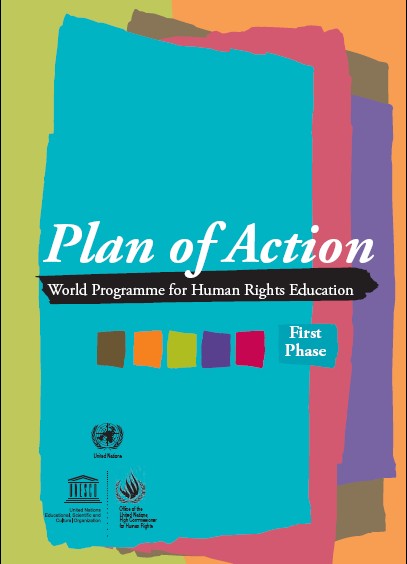 "The World Program for Human Rights Education (from 2005 onwards) aims at encouraging the development of sustainable national strategies and programs in human rights education.
This international trend highlights a consensus that the education system plays a vital role in fostering respect, participation, equality and non-discrimination in our societies.
It is important to bear in mind, however, that international programs can only support – and not substitute for – committed, vigorous and concerted national action. United Nations programs acquire real value only if national and local actors take responsibility for implementing them in their communities, and use them as mobilization and advocacy tools.
The U.S. Announces Two New International Exchange Programs
 ©Permament Delegation of the U.S. to UNESCO
At the Closing Plenary Session of the Fulbright New Century Scholar (NCS) Symposium at UNESCO in Paris, Assistant Secretary of State for Educational and Cultural Affairs, Dina Habib Powell announced the creation of two new U.S. initiatives: an International Fulbright Science and Technology Award, and an International Fusion Arts Exchange Program. Both programs will enable young people from different countries to come together for academic exchange at American universities.
The closing plenary session was hosted by the U.S. Department of State's Bureau of Educational and Cultural Affairs and the U.S. Permanent Mission to UNESCO. The Fulbright New Century Scholars program is sponsored by the Bureau of Educational and Cultural Affairs of the United States Department of State.
Dina Powell reminded her audience that:
“The U.S. recently worked within UNESCO and the OECD to develop guidelines for quality provision in cross border higher education, helping to share information and build capacity to promote international educational exchanges”,
before announcing:
“So we decided to create a new International Fulbright Science and Technology Award, which will bring outstanding international students to our country to study for Ph.D.'s in science and technology. "
She added:
“The arts create common understanding that transcends language and borders. Music is especially effective in this role and speaks very powerfully to young people. Since one of our primary goals is to reach young people internationally, what better way to do this, we thought, than through an exchange in music?
So I am absolutely delighted today to announce, here at UNESCO, the creation of a new international exchange, the Fusion Arts Exchange, that will allow young people from different countries to learn about, compose and perform popular music together. We will bring university students from countries with especially rich musical traditions-such India, South Africa, Mali, Brazil, and Ireland just to name a few-with American students, to study and work together at a U.S. university with a world-renowned music study program and facilities. They will look at international and U.S. musical traditions and composition, learn about careers and economic development opportunities for their societies in music-related fields, and have the chance to compose and perform together and develop on-going collaborations.”
Report by the Director-General on the Implementation of the Program and Budget (32 C/5) and on Results Achieved in the Biennium 2004-2005

"This Report on the implementation of the program and budget during the 2004-2005 biennium represents an important milestone in the ongoing reform of the Organization. Firstly, it is the first biennial report after my re-election as Director-General, and I see it as setting a baseline for reporting during my second term. Secondly, the report provides answers to several issues concerning reporting raised by the Executive Board in the last few years."
Results Achieved for the Individual Main Lines of Action (MLA) of the Education Sector
Results Acheived for the Individual Main Lines of Action (MLA) of the Culture Sector
Monday, October 30, 2006
Learning through UNESCO Education Newsletters, Briefs and Journals
Check out the series of UNESCO thematic publication on education! The objective of these newsletters, briefs, journals, and bulletins is to provide a forum for disseminating newsworthy information on Education activities, experiences, best practices, etc… to facilitate the work of practitioners and education advocates. Reports marked by (*) are also available in selected languages.
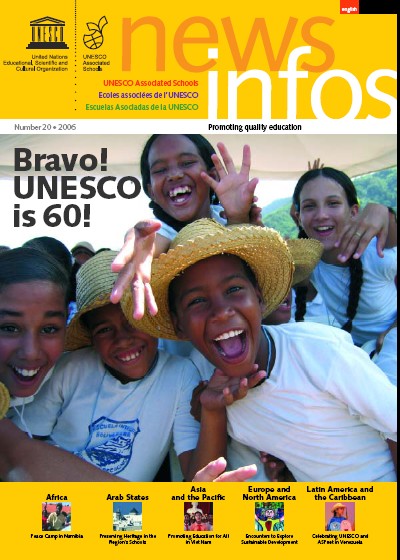
Associated School Project Network Newsletter

Adolescence Education Newsletter
Highlights country (Thailand) and regional news on Adolescent Reproductive and Sexual Health (ARSH) resources.

 International Review of Education
International journal on the comparative theory and practice of formal and non-formal education.
 Information and Communication Technologies in Education Newsletter:
Infoshare
Bulletin providing the latest trends and developments on the application of information and communication technologies in UNESCO programs and projects in the Asia-Pacific region.

International Institute for Education Planning (IIEP) Newsletter
(* also in French, and Spanish )
(* also in French, and Spanish )
Provides the latest information on educational planning and management.

Education for All (EFA) Newsletter
Disseminates information on Education for All (EFA) activities, experiences and events as well as e-mail alert about new developments related to Education for All, new resources in the website and new additions to the growing list of network of experts and practitioners.
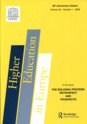
A scholarly publication dealing with major problems and trends in contemporary higher education.
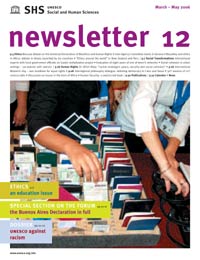
Provides information on the work of UNESCO in the field of social and human sciences. It is available both in printed and electronic form.
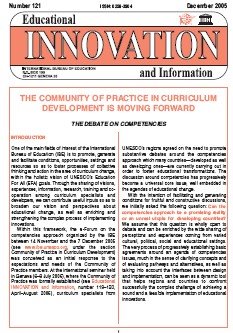
Provides short articles on current educational research and activities being conducted at the IBE and news from the field of comparative education.

Listening to Africa (*also in French)

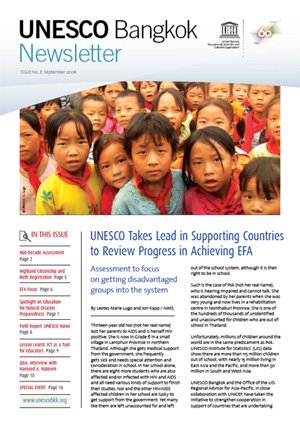

Informative newsletter of the UNESCO Office for Education in Latin America and the Caribbean.
PRELAC Journal
(*also in Spanish)
A journal detailing the challenges of PRELAC (El Proyecto Regional de Educacion para América Latina y el Caribe/Regional Education Project of Latin America and the Caribbean) and its contributions to the objectives of the global movement of Education for All (EFA).
Want to know more?
*Newsletter on EDUCAIDS
*Policy Briefs on Early Childhood
*UNESCO Institute for Education - Nexus (*also in German)
*The UNESCO Courier (*also in French, Arabic, Spanish, Chinese, and Russian)
*Education Today (* also in French) - Newsletter on trends and innovations in education, on worldwide efforts towards Education for All and on UNESCO's own education activities.
*Connect - UNESCO International Science, Technology and Environmental Education Newsletter.
*Asia-Pacific Program of Education for All (APPEAL) - Reports on progress of on-going projects and activities of APPEAL.
Sunday, October 29, 2006
Remembering Jack Fobes
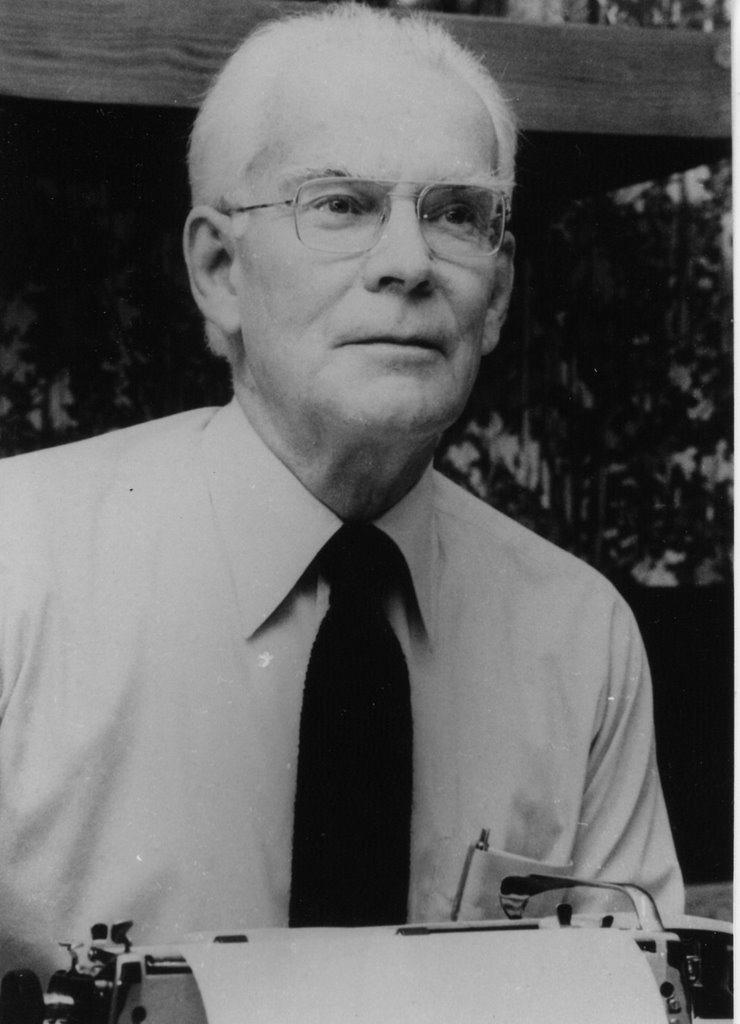
John Edwin Fobes died at his home at the age of 86 on Jan. 20, 2005. A distinguished diplomat, he served as Deputy Director-General of UNESCO from 1971 to 1977 -- the organization's chief operating officer. He served as Chair of the U.S. National Commission for UNESCO on his return from Paris. When the United States withdrew from UNESCO, Jack Fobes immediately founded Americans for the Universality of UNESCO (which subsequently became Americans for UNESCO). From 1985-2002, he headed AUU; through the organization's network and its Newsletter, he virtually single-handedly kept the idea of UNESCO alive in the American mind. In 2002, he assumed the Chair of the Advisory Council of Americans for UNESCO.
We have posted the following the following on the Internet in his honor:
* Remembering Jack Fobes
* Tributes to John Fobes by Koïchiro Matsuura and Paul Schafer
* Jack Fobes: Lien-Link Memorial Articles
Friday, October 27, 2006
Challenging Multiculturalism and the Prospects of Environmental Education and Technology Integration
January 13, 2007
Nicosia – Cyprus
The aim of this conference is to provide a venue for discussing issues relating to sustainable development, environmental education, technology integration, and peace education. Internationally speakers and local experts will present their ideas and engage in discussion with the audience. The conference will be held in English.
The conference is organized by the Center for the Advancement of Research and Development in Educational Technology (CARDET) and the UNESCO Chair on Cultural Diversity and Intercultural Dialogue for a Culture of Peace at Intercollege.
Keynote Speakers
* Dr. Zvi Bekerman, Truman Institute and Melton Center, Hebrew UniversityComment: This event, organized by a UNESCO chair, illustrates how UNESCO can catalyze action to promote peace with very little expense drawn from its own budget.
Some things on integration and its pedagogies: Research findings in the Palestinian Jewish bilingual integrated schools in Israel
* Dr. Gabriel Salomon, Center for Research on Peace Education, University of Haifa
The challenge facing environmental and peace education: Sustaining the change
Cyprus is a good location for discussing peace in the Middle East, since Israelis and Arabs can meet there in a neutral environment. JAD
Thursday, October 26, 2006
UNESCO: Peace in the Minds of Men
The Governments of the States Parties to this Constitution on behalf of their peoples declare:
That since wars begin in the minds of men, it is in the minds of men that the defenses of peace must be constructed;
That ignorance of each other's ways and lives has been a common cause, throughout the history of mankind, of that suspicion and mistrust between the peoples of the world through which their differences have all too often broken into war;UNESCO Constitution
UNESCO mainstreams the Culture of Peace as a theme that runs through everything it does.
Check out UNESCO activities in the field of the culture of peace.
The International Congress on Peace in the Minds of Men was held on the initiative of UNESCO in Yamoussoukro in the heart of Africa. Its final declaration included this statement:
* Peace is reverence for life.
* Peace is the most precious possession of humanity.
* Peace is more than the end of armed conflict.
* Peace is a mode of behaviour.
* Peace is a deep-rooted commitment to the principles of liberty, justice, equality and solidarity among all human beings.
* Peace is also a harmonious partnership of humankind with the environment.
* Today, on the eve of the twenty-first century, peace is within our reach.
The first book ever published on the organization, UNESCO: Peace in the Minds of Men by Theodore Besterman, is now available on line. It provides a great look at the early history of the organization, and emphasizes the importance of the search for peace in the minds of men.
Sunday, October 22, 2006
"Work on UNESCO’s ICT Competency Standards for Teachers enters final phase"

Read the full UNESCO news story.
"A groundbreaking international standard for integrating ICTs in teaching, will soon be available as the extensive work on the “ICT Competency Standards for Teachers” that UNESCO is preparing together with several partners from academia and the private sector including Microsoft, Intel and Cisco, enters its final phase.
"'The new standard is designed to contribute to the professional development of teachers, mainly on primary and secondary levels, and we expect that it will considerably improve teachers’ practice' says UNESCO’s project manager Tarek G. Shawki. 'The standard combines methods for improving ICT skills with emergent views in pedagogy, curriculum and school organization', he says."
Thursday, October 19, 2006
2006 UNITWIN Directory Now Online
 The 2006 UNIVERSITY TWINNING and networking scheme “UNITWIN” directory is now available online. It is an important networking tool for one of UNESCO’s major education networks.
Over the last fourteen years the UNITWIN Program has developed into a truly worldwide, inter-university co-operation scheme based on interdisciplinarity, intersectoriality and networking. It has since become one of the major intersectorial Programs and an integral part of activities developed by UNESCO various Sectors, services and Field Offices.
Today 584 UNESCO Chairs and 66 UNITWIN Networks have been in the Program involving over 700 institutions in 124 countries. It contains full information on each of reporting Chairs and Networks covering 70 disciplines and identifies the contact persons, partners, events and publications for each one.
Download
UNITWIN/UNESCO Chairs Program, Ten Years of Action: Case studies (2005)
Procedures for the UNITWIN/UNESCO Chairs Program
Guidelines for Submission of Project Proposals
UNESCO: A Partner in the 5th World Forum on Sport, Education and Culture
 The International Convention against Doping in Sport; safeguarding traditional sports and games; boosting physical education and sport at school; and sport and human values are among topics that UNESCO will present at the 5th World Forum on Sport, Education and Culture, 22 to 24 October at the International Conference Centre in Beijing. Organized by the International Olympic Committee (IOC) and the Beijing Organizing Committee for the Games (BOCOG) in partnership with UNESCO, the Forum will elaborate on the theme of “Sport and a World of Harmony.” About 800 participants coming from every continent are expected to attend.
Serhiy Bubka, UNESCO Champion for Sport, will address the first plenary session on “Cultural and educational perspectives of the Olympic Games.”
Olympism and multiculturalism, sport and social harmony and the future of the Olympic movement are some of the issues that participants will debate during the sessions. They will also review the preparation of the Beijing 2008 Olympic Games and visit Olympic sites.
The conference is open to representatives of organizations, both governmental and non-governmental, concerned with sport, education and culture, representatives of the United Nations system and universities as well as of the Olympic family, particularly National Olympic Committees, International Sports Federations, Olympic Games Organizing Committees, Applicant Cities and Olympic sponsors. Cultural organizations and the media are also invited.
This Forum follows on the one held in June 2004 in Barcelona (Spain) as part of the 2004 Universal Forum of Cultures.
Subscribe to:
Posts (Atom)