The 8th Annual UN Student Conference on Human Rights, will take place on Thursday, December 1 and Friday, December 2.
This year's theme is "Water as a Human Right."
On Dec. 1, 2005, student delegates will meet at the United Nations
International School (UNIS) for presentations by speakers and to begin
drafting a Plan of Action. The meeting will be webcast from the UNIS web site at the following times:
10:00 to 12:30 (Eastern Standard Time)
15:45 to 17:00 (Eastern Standard Time)
On Dec. 2, 2005, the conference moves to UN Headquarters. The webcast
of this event will be available on the UN Cyberschoolbus web site from:
9:15am-12:15pm (Eastern Standard Time)
1:45pm-4:15pm (Eastern Standard Time)
Wednesday, November 30, 2005


The Poetry Archive
Go to the website of the Poetry Archive.
The Poetry Archive provides audio streaming of poets reading their work. It already has over seventy-five recorded readings. Its organizers plan to commission new, high-quality recordings from both established and emerging contemporary poets. The website also contains some hard-to-find, older recordings, some up to a century old, and there is a hope of obtaining others.
Seamus Heany, winner of the Nobel Prize for Literature, is the President. Andrew Motion, U.K. Poet Laureate, and Richard Carrington, audio producer, are its Directors.
The Poetry Archive seems to be limited to poets writing in English, but the idea is worthy of extension to poetry in other languages. As UNESCO seeks to protect cultural diversity, it might well consider supporting and expanding this initiative!
The Poetry Archive provides audio streaming of poets reading their work. It already has over seventy-five recorded readings. Its organizers plan to commission new, high-quality recordings from both established and emerging contemporary poets. The website also contains some hard-to-find, older recordings, some up to a century old, and there is a hope of obtaining others.
Seamus Heany, winner of the Nobel Prize for Literature, is the President. Andrew Motion, U.K. Poet Laureate, and Richard Carrington, audio producer, are its Directors.
The Poetry Archive seems to be limited to poets writing in English, but the idea is worthy of extension to poetry in other languages. As UNESCO seeks to protect cultural diversity, it might well consider supporting and expanding this initiative!
Tuesday, November 29, 2005
"More masterpieces of Oral and Intangible Heritage of Humanity listed by UNESCO"
Read the full article on XINHUA online.:
"The Chinese government received certificates for two masterpieces of Oral and Intangible Heritage of Humanity nominated by the United Nations Educational, Scientific and Cultural Organization (UNESCO), here Monday.
"The two masterpieces are the Art of Chinese Xinjiang Uyghur Muqam and the Pastoral Song of the Mongolian ethnic group.
"The list of masterpieces of Oral and Intangible Heritage of Humanity now counts 90 entries honoring oral expressions and traditions, music and dance, ritual and mythology, knowledge and practices about nature and the universe and traditional crafts."
"The Chinese government received certificates for two masterpieces of Oral and Intangible Heritage of Humanity nominated by the United Nations Educational, Scientific and Cultural Organization (UNESCO), here Monday.
"The two masterpieces are the Art of Chinese Xinjiang Uyghur Muqam and the Pastoral Song of the Mongolian ethnic group.
"The list of masterpieces of Oral and Intangible Heritage of Humanity now counts 90 entries honoring oral expressions and traditions, music and dance, ritual and mythology, knowledge and practices about nature and the universe and traditional crafts."
Girls, Educational Equity and Mother Tongue-based Teaching
Read the publication on UNESCO's website.
"This new UNESCO publication argues that language, specifically the language used in schools, is one of the principal mechanisms through which inequality in education is reproduced. It shows how the learner’s mother tongue holds the key to making schooling more inclusive for all disadvantaged groups, especially for girls and women."
"This new UNESCO publication argues that language, specifically the language used in schools, is one of the principal mechanisms through which inequality in education is reproduced. It shows how the learner’s mother tongue holds the key to making schooling more inclusive for all disadvantaged groups, especially for girls and women."
Tuesday, November 22, 2005
"World Digital Library Planned: Library of Congress Envisions Collection To Bridge Cultures"
Read the article by David A. Vise in today's Washington Post.
"The Library of Congress is launching a campaign today to create the World Digital Library, an online collection of rare books, manuscripts, maps, posters, stamps and other materials from its holdings and those of other national libraries that would be freely accessible for viewing by anyone, anywhere with Internet access.
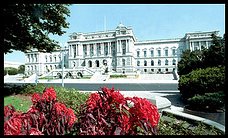
Main Building Library of Congress
"This is the most ambitious international effort ever undertaken to put precious items of artistic, historical, and literary significance on the Internet so that people can learn about other cultures without traveling further than the nearest computer, according to James H. Billington, head of the Library of Congress......
"Google co-founder and President Sergey Brin said in an interview that he and Billington began discussions roughly one year ago about ways for the Library of Congress and Google to team up. Brin said he became intrigued after seeing a range of "beautiful" items in the Library of Congress collection during private meetings with Billington.......
"Brin and Billington said Google would only digitize materials from the Library of Congress that are in the public domain and therefore not subject to copyright protection.
"Brin said he will help raise additional private funds to finance the World Digital Library. Billington said the $3 million gift from Google will be used over the next few years to develop the details of the project and pay for global outreach.
"'Working with UNESCO, we want to encourage other countries to make use of our experiences in developing their own digitization projects,' Billington said."
"The Library of Congress is launching a campaign today to create the World Digital Library, an online collection of rare books, manuscripts, maps, posters, stamps and other materials from its holdings and those of other national libraries that would be freely accessible for viewing by anyone, anywhere with Internet access.
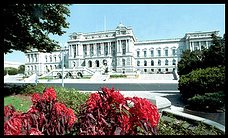
"This is the most ambitious international effort ever undertaken to put precious items of artistic, historical, and literary significance on the Internet so that people can learn about other cultures without traveling further than the nearest computer, according to James H. Billington, head of the Library of Congress......
"Google co-founder and President Sergey Brin said in an interview that he and Billington began discussions roughly one year ago about ways for the Library of Congress and Google to team up. Brin said he became intrigued after seeing a range of "beautiful" items in the Library of Congress collection during private meetings with Billington.......
"Brin and Billington said Google would only digitize materials from the Library of Congress that are in the public domain and therefore not subject to copyright protection.
"Brin said he will help raise additional private funds to finance the World Digital Library. Billington said the $3 million gift from Google will be used over the next few years to develop the details of the project and pay for global outreach.
"'Working with UNESCO, we want to encourage other countries to make use of our experiences in developing their own digitization projects,' Billington said."
Monday, November 21, 2005
The New Courier: Special UNESCO 60th anniversary issue
Read the issue online.
This issue examines UNESCO at 60 years of age. It contains focus sections discussing many of UNESCO's most important programs, including those dealing with:
Some interesting tidbits from UNESCO's history (found in the issue):
This issue examines UNESCO at 60 years of age. It contains focus sections discussing many of UNESCO's most important programs, including those dealing with:
* Education For All
* Oceans
* Heritage
* Copyright
* Bioethics
* Environment
* Cultural diversity
* Water
* Digital Divide
* Crises and emergencies
Some interesting tidbits from UNESCO's history (found in the issue):
* Céline Dion, the popular Canadian singer, was the first UNESCO Artist for Peace, appointed in 1999. The latest is French sculptor and poet Gérard Voisin in 2005.
* UNESCO issued its first commemorative medals, a set of three, in 1961 to celebrate its 20th anniversary. The newest medal was issued in October and commemorates UNESCO’s 60th anniversary.
* The diplomat and businessman Sheikh Ghassan I. Shaker was first UNESCO Good Will Ambassador to be appointed in 1990. Nelson Mandela, the former South African president, is the latest to join the ranks in 2005.
* In 1945, 37 countries signed the UNESCO Constitution, which came into force a year later after ratification by 20 signatories. They became the first founders of the Organization. With the entry of Brunei Darussalam in March 2005, the Organization now comprises 191 Member States and 6 Associate Members.
* The nomination of the Galápagos Islands in Ecuador was the first World Heritage site nomination to reach UNESCO in 1978, followed by 11 others in seven countries. Twentyfour new sites were inscribed in 2005, the latest being the Urban Historic Centre of Cienfuegos in Cuba. Today, the list comprises 812 sites from 137 States Parties to the World Heritage Convention.
* Alva Myrdal (1902-1986) directed UNESCO’s Department of Social Sciences from 1951 to 1955.
* People representing their countries at UNESCO governance meetings included Maria Montessori, Taha Hussain, Pablo Neruda, and Indira Ghandi.
* in 1953 UNESCO established the World Braille Uniformity Programme, which standardized literary codes, enabling blind people around the world to read the same Braille books, learn foreign languages, exchange ideas and experiences. This expanded later to include science, mathematics and music notations. UNESCO also launched the World Braille Council, thus providing an international venue for Braille matters to be discussed. Again in 1953, UNESCO published World Braille Usage, as well as the Braille Courier in English, French, Spanish and Korean.
* If not for UNESCO’s international campaign, the Aswan High Dam would have flooded the Nile valley, site of the most important Nubian temples. This was but one of 26 campaigns. In addition, operational projects have been launched protecting monuments and sites such as those in Angkor, Mostar and Ethiopia.
Sunday, November 20, 2005
World Heritage Forum
Go to Matthias Ripp's World Heritage Forum
This website is run by Matthias Ripp "to support the exchange of information on UNESCO World Heritage topics and UNESCO World Heritage Sites" and to serve as a starting point for people who are interested in these issues. The associated Weblog contains Ripp's reports about new developments, conferences, etc. in the field of UNESCO World Heritage.
This website is run by Matthias Ripp "to support the exchange of information on UNESCO World Heritage topics and UNESCO World Heritage Sites" and to serve as a starting point for people who are interested in these issues. The associated Weblog contains Ripp's reports about new developments, conferences, etc. in the field of UNESCO World Heritage.
Wikipedia: World Heritage Site
 World Heritage Site #307
Go to the Wikipedia entry for World Heritage Sites.
Wikipedia provides a brief introduction to the World Heritage program of UNESCO, together with some photos of World Heritage sites, and links to a number of resources on the World Heritage program.
World Heritage Information Network
Go to the World Heritage Information Network website.
WHIN is a clearing-house for information about the natural and cultural sites identified as being of "outstanding universal value" and inscribed on the World Heritage List by the Intergovernmental World Heritage Committee. This list is established as part of the international implementation of the World Heritage Convention.
WHIN is a clearing-house for information about the natural and cultural sites identified as being of "outstanding universal value" and inscribed on the World Heritage List by the Intergovernmental World Heritage Committee. This list is established as part of the international implementation of the World Heritage Convention.
U.S. World Heritage Sites
Go to the National Park Service "World Heritage Sites"home page.
There are twenty (20) World Heritage sites in the United States (including two sites jointly administered with Canada). The U.S. Department of the Interior, in cooperation with the Federal Interagency Panel for World Heritage has identified many more sites (cultural and natural) as likely to meet the criteria for future nomination to the World Heritage List. This tentative list is available for viewing.
This website is a joint effort between the U.S. National Park Service (NPS) and the United States Committee of the International Council on Monuments and Sites (US/ICOMOS). Throughout the world, national ICOMOS committees work to support the World Heritage Convention.
In the United States, the NPS serves as chief steward of the nation's natural and cultural patrimony. The Secretary of the Interior, through the National Park Service, is responsible for identifying and nominating U.S. sites to the list. The Service's Office of International Affairs provides staff support for U.S. participation in the World Heritage Convention.
There are twenty (20) World Heritage sites in the United States (including two sites jointly administered with Canada). The U.S. Department of the Interior, in cooperation with the Federal Interagency Panel for World Heritage has identified many more sites (cultural and natural) as likely to meet the criteria for future nomination to the World Heritage List. This tentative list is available for viewing.
This website is a joint effort between the U.S. National Park Service (NPS) and the United States Committee of the International Council on Monuments and Sites (US/ICOMOS). Throughout the world, national ICOMOS committees work to support the World Heritage Convention.
In the United States, the NPS serves as chief steward of the nation's natural and cultural patrimony. The Secretary of the Interior, through the National Park Service, is responsible for identifying and nominating U.S. sites to the list. The Service's Office of International Affairs provides staff support for U.S. participation in the World Heritage Convention.
The Organization of World Heritage Cities
Go to the OWHC website.
The Organization of World Heritage Cities (OWHC) is made up of 208 cities in which are located sites included on the UNESCO World Heritage List. Of the member cities, 7 are located in Africa, 36 in Latin America, 20 in Asia and the Pacific, 123 in Europe and North America and 22 in the Arab States. At the moment there are also 4 Observer-members. These 208 World Heritage Cities have a combined population of 125 million. The OWHC’s headquarters are located in Québec City, Canada. The OWHC’s initiatives, which are geared to the implementation of the World Heritage Convention, include informing and the training municipal managers. The OWHC organizes symposia and seminars dealing with management and strategies pertaining to the development and preservation of historic sites. The OWHC also strives to heighten awareness among United Nations, UNESCO, World Bank and Council of Europe officials of the importance of better protecting historic cities in the event of armed conflicts. In the coming years, the Organization is to focus on the establishment of an electronic communications network linking member cities through the Internet and the creation of a data bank on historic cities.
The Organization of World Heritage Cities (OWHC) is made up of 208 cities in which are located sites included on the UNESCO World Heritage List. Of the member cities, 7 are located in Africa, 36 in Latin America, 20 in Asia and the Pacific, 123 in Europe and North America and 22 in the Arab States. At the moment there are also 4 Observer-members. These 208 World Heritage Cities have a combined population of 125 million. The OWHC’s headquarters are located in Québec City, Canada. The OWHC’s initiatives, which are geared to the implementation of the World Heritage Convention, include informing and the training municipal managers. The OWHC organizes symposia and seminars dealing with management and strategies pertaining to the development and preservation of historic sites. The OWHC also strives to heighten awareness among United Nations, UNESCO, World Bank and Council of Europe officials of the importance of better protecting historic cities in the event of armed conflicts. In the coming years, the Organization is to focus on the establishment of an electronic communications network linking member cities through the Internet and the creation of a data bank on historic cities.
World Heritage Site
Go to Els Slots World Heritage Site.
Els Slots, a Dutch woman, has provided this website (in English) with many excellent photos of the 194 World Heritage sites she has visited. The website has existed since 1997, and includes more than 1,000 comments from visitors. A newsletter is published by the webmaster.
Els Slots, a Dutch woman, has provided this website (in English) with many excellent photos of the 194 World Heritage sites she has visited. The website has existed since 1997, and includes more than 1,000 comments from visitors. A newsletter is published by the webmaster.
The World Heritage Tour
Go to the World Heritage Tour website.
The WHTour website presents an image bank of printable panographies and online virtual tours for registered UNESCO World Heritage sites. Panographies are shot, assembled and uploaded on this website by Tito Dupret and Bijuan Chen. So far, the WHTour provides materials on World Heritage sites in: Afghanistan, Bangladesh, Eastern Canada, China, Cambodia, Egypt, India, Indonesia, Iran, Kazakhstan, Korea, Laos, Malaysia, Nepal, Pakistan, Sri Lanka, Thailand, Turkmenistan, The Philippines, Uzbekistan and Vietnam.
The WHTour website presents an image bank of printable panographies and online virtual tours for registered UNESCO World Heritage sites. Panographies are shot, assembled and uploaded on this website by Tito Dupret and Bijuan Chen. So far, the WHTour provides materials on World Heritage sites in: Afghanistan, Bangladesh, Eastern Canada, China, Cambodia, Egypt, India, Indonesia, Iran, Kazakhstan, Korea, Laos, Malaysia, Nepal, Pakistan, Sri Lanka, Thailand, Turkmenistan, The Philippines, Uzbekistan and Vietnam.
UNESCO Welcomes Cultural Diversity Endorsement
Read the full article in artdaily.com
"The Director-General of UNESCO, Ko�chiro Matsuura, today welcomed the endorsement by 176 States attending the World Summit on the Information Society (Tunis, November 16-18) of UNESCO?s vision of 'knowledge societies'. This vision is based on the four principles of freedom of expression, quality education for all, universal access to information and knowledge and respect for cultural and linguistic diversity. These principles are included in the Tunis Commitment and the Tunis Agenda for the Information Society adopted at WSIS today."
"The Director-General of UNESCO, Ko�chiro Matsuura, today welcomed the endorsement by 176 States attending the World Summit on the Information Society (Tunis, November 16-18) of UNESCO?s vision of 'knowledge societies'. This vision is based on the four principles of freedom of expression, quality education for all, universal access to information and knowledge and respect for cultural and linguistic diversity. These principles are included in the Tunis Commitment and the Tunis Agenda for the Information Society adopted at WSIS today."
Saturday, November 19, 2005
Editorial: WSIS
The World Summit on the Information Society is finally over. Another good thing is that it has engendered public discussion on information and communications technology for development. Unfortunately, most of that discussion seems to have centered on the role of ICANN in the governance of the Internet, and on “A Laptop for Every Child”. Unfortunately, the key issues that should have been and sometimes were discussed at the Summit have been largely overlooked by the media.
The industrial revolution, which still has not reached all of the world’s population, transformed society by substituting power from engines for animal power, and by mechanizing tasks that previously had been done by hand. It marked the emergence of manufacturing industries over extractive industries as the drivers of development. It profoundly changed the nature of society.
The information revolution, which is just beginning to affect most of the world, transforms society by enabling affordable communication at a distance, and by automating tasks previously done in the minds of men – calculation, storage and retrieval of information, etc. It marks the emergence of service industries over manufacturing industries as the drivers of development. It will profoundly change the nature of society.
The age of the printing press, beginning in the 1450’s, was advanced by the industrial revolution allowing printed material to be produced in greater and greater amounts, more and more cheaply, and distributed more widely and economically. The age of the microchip, beginning five centuries later, is extending all of these benefits. The growth of knowledge in the age of the printing press has been exponential, and it seems likely that the age of the microchip will allow that exponential growth to continue. Knowledge is now the driving force not only of the economies of rich countries, but increasingly of social and political development.
100 years from now, WSIS might be seen as a benchmark, as the first time the global community met to formally recognize the information revolution and information society. Of course, we barely recognize that we are at the beginning of such a transition, and we can not begin to predict its eventual ramifications. No wonder the participants at WSIS focused on small steps for men, rather than the giant step for mankind.
ICT and Poverty
The information society, as seen today by poor people in poor countries, is more a matter of radio and mobile phones than of computers and the Internet, although you would not appreciate the fact from the media coverage of WSIS. I do not belittle radio and telephones; they are a huge advance!
The unseen action of ICT on poverty is still more important. The extractive industries, agriculture, forestry, fishing, mining, become more efficient as ICT is applied. Indeed, extractive industries benefit that we hardly consider as such, such as the “water industry”. Manufacturing too is transformed, albeit not at the level of the micro-enterprise in poor countries, by the application of ICT, from the design of plant and equipment, to the management of the process, to the marketing of goods. Transportation too becomes more efficient, as ICT is applied to the design and manufacture of vehicles of all kinds, to their operation, and to their management. Services, including governance, financial, health and educational services are perhaps even more able to achieve efficiency and coverage gains than the extractive and manufacturing industries. The transformation of economies by ICT is not accomplished by giving every poor person a computer, but rather by appropriate investments in technology where they will have the highest benefit-to-cost ratio. In societies with pro-poor policies, the rising tide of economic growth does in fact raise all boats including those of the poor. And indeed, I suggest, proper applications of ICT for development make those pro-poor policies more likely and more effective.
A $100 laptop
MIT’s media genius has grabbed the headlines, but in spite of the slogan “one laptop for every child”, MIT will be lucky to sell a million laptops in the next few years. MIT’s proposal is not only to revolutionize the market for educational computers in poor countries, but also to revolutionize educational software, and – perhaps more importantly – to revolutionize the pedagogy that surrounds the use of ICT in education and, still more generally, pedagogy itself. MIT will be lucky to produce any significant advances in e-learning in the next few years, much less to convince large numbers of teachers to utilize them.
But what happens if a million $100 laptops are put into place that would not otherwise be there? They would probably go to places with some economic possibilities, and would probably go to train kids who would eventually join an intellectual elite. They would probably go to places with educational administrators more adventurous than most, and indeed to classrooms with teachers more adventurous than most. The introduction of exciting new equipment and exciting new teaching methods and aids would be likely to improve the learning environment immeasurably. Getting a million kids into such an environment, and enabling them to join an intellectual elite in their nations after such an experience seems a great accomplishment to me.
John Daly
The industrial revolution, which still has not reached all of the world’s population, transformed society by substituting power from engines for animal power, and by mechanizing tasks that previously had been done by hand. It marked the emergence of manufacturing industries over extractive industries as the drivers of development. It profoundly changed the nature of society.
The information revolution, which is just beginning to affect most of the world, transforms society by enabling affordable communication at a distance, and by automating tasks previously done in the minds of men – calculation, storage and retrieval of information, etc. It marks the emergence of service industries over manufacturing industries as the drivers of development. It will profoundly change the nature of society.
The age of the printing press, beginning in the 1450’s, was advanced by the industrial revolution allowing printed material to be produced in greater and greater amounts, more and more cheaply, and distributed more widely and economically. The age of the microchip, beginning five centuries later, is extending all of these benefits. The growth of knowledge in the age of the printing press has been exponential, and it seems likely that the age of the microchip will allow that exponential growth to continue. Knowledge is now the driving force not only of the economies of rich countries, but increasingly of social and political development.
100 years from now, WSIS might be seen as a benchmark, as the first time the global community met to formally recognize the information revolution and information society. Of course, we barely recognize that we are at the beginning of such a transition, and we can not begin to predict its eventual ramifications. No wonder the participants at WSIS focused on small steps for men, rather than the giant step for mankind.
ICT and Poverty
The information society, as seen today by poor people in poor countries, is more a matter of radio and mobile phones than of computers and the Internet, although you would not appreciate the fact from the media coverage of WSIS. I do not belittle radio and telephones; they are a huge advance!
The unseen action of ICT on poverty is still more important. The extractive industries, agriculture, forestry, fishing, mining, become more efficient as ICT is applied. Indeed, extractive industries benefit that we hardly consider as such, such as the “water industry”. Manufacturing too is transformed, albeit not at the level of the micro-enterprise in poor countries, by the application of ICT, from the design of plant and equipment, to the management of the process, to the marketing of goods. Transportation too becomes more efficient, as ICT is applied to the design and manufacture of vehicles of all kinds, to their operation, and to their management. Services, including governance, financial, health and educational services are perhaps even more able to achieve efficiency and coverage gains than the extractive and manufacturing industries. The transformation of economies by ICT is not accomplished by giving every poor person a computer, but rather by appropriate investments in technology where they will have the highest benefit-to-cost ratio. In societies with pro-poor policies, the rising tide of economic growth does in fact raise all boats including those of the poor. And indeed, I suggest, proper applications of ICT for development make those pro-poor policies more likely and more effective.
A $100 laptop
MIT’s media genius has grabbed the headlines, but in spite of the slogan “one laptop for every child”, MIT will be lucky to sell a million laptops in the next few years. MIT’s proposal is not only to revolutionize the market for educational computers in poor countries, but also to revolutionize educational software, and – perhaps more importantly – to revolutionize the pedagogy that surrounds the use of ICT in education and, still more generally, pedagogy itself. MIT will be lucky to produce any significant advances in e-learning in the next few years, much less to convince large numbers of teachers to utilize them.
But what happens if a million $100 laptops are put into place that would not otherwise be there? They would probably go to places with some economic possibilities, and would probably go to train kids who would eventually join an intellectual elite. They would probably go to places with educational administrators more adventurous than most, and indeed to classrooms with teachers more adventurous than most. The introduction of exciting new equipment and exciting new teaching methods and aids would be likely to improve the learning environment immeasurably. Getting a million kids into such an environment, and enabling them to join an intellectual elite in their nations after such an experience seems a great accomplishment to me.
John Daly
Wednesday, November 16, 2005
"A low-cost laptop for every child"

Read the full article by Christa Case in the Christian Science Monitor.
"Effort to link the world's rural poor to the Internet with a $100 computer gets a boost from the United Nations.
"In Cambridge, Mass., Nicholas Negroponte and his team at the Massachusetts Institute of Technology have been chipping away at a long-held dream: producing a laptop so cheap that governments could afford to link every child in the world to the Internet.....
"Mr. Negroponte, chairman of MIT's Media Lab, will unveil his brainchild with United Nations Secretary-General Kofi Annan at a technology meeting in Tunisia. The meeting of the UN's World Summit on the Information Society is aimed at beginning to put into effect its stated goals where "everyone, everywhere should have the opportunity to participate" in the benefits of information technology."
Tuesday, November 15, 2005
Measuring Linguistic Diversity
Read the UNESCO book online.
Subtitle: "A collection of papers by: John Paolillo, Daniel Pimienta, Daniel Prado, et al."
Introduction
"UNESCO has been emphasizing the concept of “knowledge societies”, which stresses plurality and diversity instead of a global uniformity in order to bridge the digital divide and to form an inclusive information society. An important theme of this concept is that of multilingualism for cultural diversity and participation for all the languages in cyberspace. There is a growing concern that in the efforts to bridge the digital divide, hundreds of local languages may be side-stepped, albeit unintentionally. Hence, the importance attached to linguistic diversity and local content as part of an Action Line of the WSIS Action Plan for which UNESCO has the responsibility of coordination.
"The issue of language diversity on the Internet proves to be central to the debate on the Information Society in a number of unexpected ways. At first glance the question seems to revolve around the communities using the Internet – allowing communities to talk to each other in their own mother tongues, but other questions quickly follow.
"Through what channels does communication happen across the Internet? The World Wide Web is a series of information sources which provide little interactivity. Discussion fora and email provide more direct interchange. However there is insuffi cient information about the languages used in email or discussion fora (see some discussion of this by Paolillo’s paper below Chapter 3 , including the work of Sue Wright). For most language analysis researchers therefore turn to Web pages. Here, as in all communication, we must consider the character of the audience. A Web page is only read by people who have Internet access. Thus while linguistic diversity might be served by having Web pages in the ‘vanishing’ language of a very remote tribe, few people would read them as it is unlikely that tribal members have Internet access. Pages about the language of the tribe in a more international language would however serve an important role in drawing attention to the cultural value of the language concerned, and perhaps attract support for the linguistic group concerned. It is in addition, a contribution to the preservation of endangered languages.
"The papers in this volume demonstrate that there are many technical problems in calculating language diversity on the Internet. We can easily produce a random count of Internet pages by using any number of commercial search engines, but we cannot judge how often Web pages are read or whether the reading of a page helped the reader in any way. Care has to be taken to ensure that the items searched for in different languages are equivalent in their value, meaning and usage (See Pimienta).
Subtitle: "A collection of papers by: John Paolillo, Daniel Pimienta, Daniel Prado, et al."
Introduction
"UNESCO has been emphasizing the concept of “knowledge societies”, which stresses plurality and diversity instead of a global uniformity in order to bridge the digital divide and to form an inclusive information society. An important theme of this concept is that of multilingualism for cultural diversity and participation for all the languages in cyberspace. There is a growing concern that in the efforts to bridge the digital divide, hundreds of local languages may be side-stepped, albeit unintentionally. Hence, the importance attached to linguistic diversity and local content as part of an Action Line of the WSIS Action Plan for which UNESCO has the responsibility of coordination.
"The issue of language diversity on the Internet proves to be central to the debate on the Information Society in a number of unexpected ways. At first glance the question seems to revolve around the communities using the Internet – allowing communities to talk to each other in their own mother tongues, but other questions quickly follow.
"Through what channels does communication happen across the Internet? The World Wide Web is a series of information sources which provide little interactivity. Discussion fora and email provide more direct interchange. However there is insuffi cient information about the languages used in email or discussion fora (see some discussion of this by Paolillo’s paper below Chapter 3 , including the work of Sue Wright). For most language analysis researchers therefore turn to Web pages. Here, as in all communication, we must consider the character of the audience. A Web page is only read by people who have Internet access. Thus while linguistic diversity might be served by having Web pages in the ‘vanishing’ language of a very remote tribe, few people would read them as it is unlikely that tribal members have Internet access. Pages about the language of the tribe in a more international language would however serve an important role in drawing attention to the cultural value of the language concerned, and perhaps attract support for the linguistic group concerned. It is in addition, a contribution to the preservation of endangered languages.
"The papers in this volume demonstrate that there are many technical problems in calculating language diversity on the Internet. We can easily produce a random count of Internet pages by using any number of commercial search engines, but we cannot judge how often Web pages are read or whether the reading of a page helped the reader in any way. Care has to be taken to ensure that the items searched for in different languages are equivalent in their value, meaning and usage (See Pimienta).
Monday, November 14, 2005
Celebration of UNESCO’s 60th Anniversary
Read the full UNESCO media announcement of the event.
Claude Levi-Strauss, one of the founders of contemporary anthropology, Federico Mayor and Amadou-Mahtar M’Bow, former Director-Generals of UNESCO, several Heads of State and Government and numerous other personalities will participate in a ceremony on November 16, 2005 (9.30 – 12.30) marking the 60th anniversary of the adoption of the Organization’s Constitution. The ceremony will take place in the UNESCO heaquarters in Paris. It will be followed by an international symposium which will bring together some 60 historians, anthropologists and philosophers.
"On November 16, 1945, representatives from 37 countries gathered in London decided to create an organization dedicated to building peace through education, science and culture. Sixty years later, the Organization is undertaking a critical review of its past directions, activities and results in order to respond to the new challenges of the 21st century."
Claude Levi-Strauss, one of the founders of contemporary anthropology, Federico Mayor and Amadou-Mahtar M’Bow, former Director-Generals of UNESCO, several Heads of State and Government and numerous other personalities will participate in a ceremony on November 16, 2005 (9.30 – 12.30) marking the 60th anniversary of the adoption of the Organization’s Constitution. The ceremony will take place in the UNESCO heaquarters in Paris. It will be followed by an international symposium which will bring together some 60 historians, anthropologists and philosophers.
"On November 16, 1945, representatives from 37 countries gathered in London decided to create an organization dedicated to building peace through education, science and culture. Sixty years later, the Organization is undertaking a critical review of its past directions, activities and results in order to respond to the new challenges of the 21st century."
"African heritage sites to go digital"
Read the full article from xinhuanet via Africast.
"Scientists in South Africa are digitizing Africa's rich cultural heritage sites to provide a virtual tour to those who cannot visit in person, while benefiting preservation of the sites.
"Using the latest laser-scan and computer technology, they are creating 3D models and virtual landscapes of the sites in Sub-Saharan Africa, including a coral-stone fortress in Tanzania, an ancient mosque in Timbuktu, Mali, and Great Zimbabwe, Sunday Times reported.
"These digital models and historical resources will be stored in an African cultural heritage and landscapes database that African scholars, libraries and universities will be able to use free of charge......
"The team has already finished models for four World Heritage sites, including Kilwa Great Mosque, dated about 1200 AD, and Kilwa Kisiwani Fortress (1503) in Tanzania; St Giyorgis, a rock-hewn church at Lalibela (dating back to the 11th to 13th century) in Ethiopia; and the Grand Mosques of Djenne and Djingereiber in Timbuktu in Mali (14th and 20th centuries).
"UNESCO convened the 29 session of the World Heritage Committee July in Durban, South Africa, finding that 16 of 33 endangered World Heritage sites are in Africa due to conflicts, lack of fund and protection."
"Scientists in South Africa are digitizing Africa's rich cultural heritage sites to provide a virtual tour to those who cannot visit in person, while benefiting preservation of the sites.
"Using the latest laser-scan and computer technology, they are creating 3D models and virtual landscapes of the sites in Sub-Saharan Africa, including a coral-stone fortress in Tanzania, an ancient mosque in Timbuktu, Mali, and Great Zimbabwe, Sunday Times reported.
"These digital models and historical resources will be stored in an African cultural heritage and landscapes database that African scholars, libraries and universities will be able to use free of charge......
"The team has already finished models for four World Heritage sites, including Kilwa Great Mosque, dated about 1200 AD, and Kilwa Kisiwani Fortress (1503) in Tanzania; St Giyorgis, a rock-hewn church at Lalibela (dating back to the 11th to 13th century) in Ethiopia; and the Grand Mosques of Djenne and Djingereiber in Timbuktu in Mali (14th and 20th centuries).
"UNESCO convened the 29 session of the World Heritage Committee July in Durban, South Africa, finding that 16 of 33 endangered World Heritage sites are in Africa due to conflicts, lack of fund and protection."
Sunday, November 13, 2005
The History Channel: The World's Most Endangered Sites
Go to the History Channel's Most Endangered Sites website.
"Save Our History is The History Channel's global campaign dedicated to historical preservation and history education. The History Channel has partnered with UNESCO's World Heritage Center to help preserve some of the world's most endangered sites."
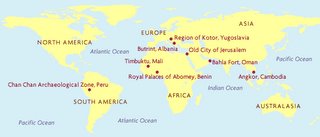
"Save Our History is The History Channel's global campaign dedicated to historical preservation and history education. The History Channel has partnered with UNESCO's World Heritage Center to help preserve some of the world's most endangered sites."

The History Channel's map of the sites.
Subscribe to:
Posts (Atom)