Saturday, September 17, 2005

The Economist: Survey of Higher Education

Read the full survey. (Subscription required.)

"Bigger is Worse"
Kingsley Amis

“Better brain drain than brain in the drain."
Rajiv Gandhi

The Economist has a very good survey of higher education, reflecting of course its conservative economic views. Some excerpts are included below:

"Mass higher education is forcing universities to become more diverse, more global and much more competitive." The Brains Business

"America's system of higher education is the best in the world. That is because there is no system." Secrets of Success Competition rules, institutions are diverse, and all use diverse sources of finance. The model stresses knowledge creation, education, and service.

"The Institute of Higher Education at Shanghai's Jiao Tong University ranks the world's universities on a series of objective criteria such as the number of Nobel prizes and articles in prestigious journals. Seventeen of the top 20 universities in that list are American (see table in article); indeed, so are 35 of the top 50. American universities currently employ 70% of the world's Nobel prize-winners. They produce about 30% of the world's output of articles on science and engineering, according to a survey conducted in 2001, and 44% of the most frequently cited articles."

"Europe hopes to become the world's pre-eminent knowledge-based economy. Not likely!" (Head in the Clouds) The hand of government is too heavy for The Economist's taste.
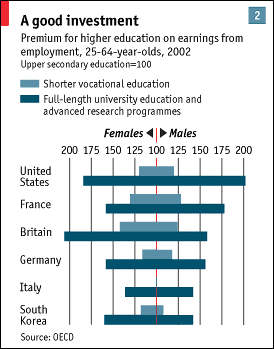


Developing countries see the point of higher education. (A World of Opportunity)

"Public spending on universities in developing countries is highly regressive. In Latin America the professional classes, who account for 15% of the population, take up nearly half of all university places. In Rwanda, 15% of the total education budget is spent on the 0.2% of students who attend universities. Most universities in the developing world are also hopelessly badly managed. But there are a few bright spots on the horizon."

"India has two valuable things going for it. One is its collection of elite institutions. For decades, India has been pouring resources into the All India Institute of Medical Sciences, the Indian Institute of Science in Bangalore and, above all, the Indian Institutes of Technology. These institutions take their pick from an army of candidates every year, with 180,000 hopefuls taking the screening test for around 3,500 places in the seven IITs. They provide a highly intensive education, with all students and often professors too living on campus. And they produce a stream of highly educated people who help to set professional standards. “They are a class apart, like Oxford and Cambridge,” says P.V. Indiresan, an expert on universities. These elite institutions help to keep India plugged into the global knowledge economy.........India's other big advantage is a more recent development: a booming private sector."

"In higher education, as in so much else, China is visibly pulling ahead of India. The Chinese are engaged in the biggest university expansion in history. In the 1980s, only 2-3% of school-leavers went to university. In 2003, the figure was 17%. The watershed year was 1999, when the number of students enrolled jumped by almost half. The expansion at the doctoral level is even faster than for undergraduates: in 1999-2003, nearly 12 times as many doctorates were awarded as in 1982-89 (see chart 4). And there is more to come: the number of new doctoral students jumped from 14,500 in 1998 to 48,700 in 2003. The Chinese are determined to create a super-league of universities to rival the best in the world."

For students, higher education is becoming a borderless world. (Wandering Scholars)

"For the past 50 years America has effortlessly dominated the market for international students, who have brought both direct and indirect benefits. Not only are they contributing some $13 billion a year to America's GDP, they are also supplying brainpower for its research machine and energy for its entrepreneurial economy. But now America's leadership is under challenge. The Institute of International Education reports that the number of foreign students on American campuses declined by 2.4% in 2003-04, the first time the number has gone down in 30 years. Foreign applications to American graduate schools fell by 28% last year, and actual enrolment dropped by 6%." While the demand for international education is growing, the competition for students from other developed nations is increasing, and the Bush Administration's policies have made it more difficult to foreign students to get into the United States.

Universities have become much more businesslike, but they are still doing the same old things. (Higher Ed Inc)

"The University of Phoenix is America's largest for-profit university (and indeed America's largest university, full stop), with 280,000 students, 239 campuses and various offshoots around the world, including some in China and India.....The University of Phoenix is designed to cater for the needs of working adults, who make up 95% of its students. The emphasis is on practical subjects, such as business and technology, that will help them with their careers, and on fitting in with busy schedules......in designing a university for working adults, Mr Sperling also introduced two other far-reaching innovations. The first was to concentrate power in the organisation. In traditional universities academics are semi-independent contractors who devote as much time as possible to their own research. In Phoenix they are simply employees. It is the university, not the teachers, that owns the curriculum. Todd Nelson, the company's boss, claims that this has allowed the university to become a “learning organisation”: it is constantly improving its ability to teach by measuring performance and disseminating successful techniques. The only research it cares about is the sort that improves teaching. The second innovation is to turn higher education into a business." The University also emphasizes distance education.

There is an audio streaming interview with the author.

And a nice set of links for sources.

Sunday, September 04, 2005

UNESCO: Education in Emergency, Crisis and Reconstruction

UNESCO Dossier on Education in Emergency, Crisis and Reconstruction:

"Armed conflicts, natural disasters (such as earthquakes, floods and cyclones), ecological and man-made disasters (desertification, drought, deforestation, and so forth) and deterioration of living conditions (poverty, unemployment, famine, and other afflictions) results in large scale fatalities and injuries to the population. It often creates massive displacement and migration of population and devastating physical destruction.

Since 1945 we have seen 150 conflicts erupt throughout the five continents, resulting in 20 million deaths and 60 million casualties."

This page may be of use to U.S. Educators in the wake of Katrina.

Thursday, September 01, 2005

The Global Heritage Fund

Global Heritage Fund website

The Global Heritage Fund's mission, according to its website, "is to enable successful long-term preservation of mankind's most important Global Heritage cultural sites in developing countries with acute pressures and without resources for preservation and planned development." It is a private, California non-profit organization.

Friday, August 26, 2005

"Sex Traffickers Prey on Eastern Europeans"

seeurope.net :: View Story:

"UNESCO, the UN's cultural organization, has proclaimed August 23 as International Day for the Remembrance of the Slave Trade and its Abolition. But despite laws against slavery in all of the world's countries, modern-day slavery continues to thrive in illegal underground forms. In the second of a two-part series, RFE/RL correspondent Ron Synovitz examines how the latest wave of sex-slave trafficking preys upon Eastern European women to fuel the global sex trade. "

Sunday, August 21, 2005

Games people play - for peace

Israel21c full article

"Working toward intercultural understanding and world peace may seem like serious business, but to Tamar Meshulam, it's a game.

"Not just any game, however, - a large, beautifully designed prize-winning game.

"A unique project that Meshulam designed and built, entitled 'Master Peace' won first place at the recent UNESCO Design contest in Japan, which has been held annually every five years in order to encourage young designers to develop creations that contribute to society and help to change the world for the better.

"The contest, which carried a $10,000 prize, included more than 700 entrants from around the world, with a different theme each year. This year's theme was interpersonal communication, with the title 'Love/Why?'"

Saturday, August 13, 2005

4th UNESCO Youth Forum

"The 4th edition of the UNESCO Youth Forum of the 33rd UNESCO General Conference, will be highly visible and is an opportunity for young people to express and exchange their ideas, make their voice heard and ensure their views are integrated in to UNESCO's programmes and policies.

"This year's theme will be 'Young People and the Dialogue among Civilisations, Cultures and Peoples - Ideas for action in education, the sciences, culture and communication'. In the field of science, dialogue-oriented initiatives focus on the link to sustainable development, the promotion of the natural and social sciences as a means for social transformation and increased networking and cooperation."

Friday, August 12, 2005

UNESCO Draft program's and Budget, 2006-2007

The 33rd session of the General Conference will take place from 3 to 21 October at the UNESCO Headquarters in Paris (France). The General Conference takes place every other year, and is the top governance body for UNESCO. The full budget is published and available for review now. It is a PDF file, and is 3.55 MB in length (448 pages.)

Wednesday, August 10, 2005

Scotsman.com News - Entertainment - Arts - Lasers to recreate statues destroyed by Taleban


Scotsman.com full News story

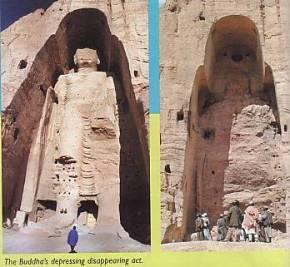
"AFGHANISTAN'S famous Bamiyan Buddhas are due to be recreated by multicoloured laser images projected on to the cliffs where they once stood. The 1,600-year-old statues were destroyed by the Taleban in 2001.

"Artist Hiro Yamagata will use solar and wind power to drive fourteen laser systems and project 140 faceless images, standing up to 175ft (52.5m) tall, onto the cliff-face for four hours every Sunday night.

"Afghan government officials, who approached the Japanese artist in 2003, are awaiting approval from United Nations cultural organisation, UNESCO, who must assess whether the laser beams could damage the cliffs."

UNESCO Kicks Off 40th Youth Camp

The Korea Times full article.:

"One hundred thirty youths from 30 countries tomorrow will kick off the International Youth Camp (IYC) hosted by the Korean National Commission for UNESCO.

"The 40th annual camp will continue through Aug. 22 at the Korea UNESCO Culture Center in Ichon, Kyonggi Province, and seven other local venues. "

Tuesday, August 09, 2005

International Day of the World's Indigenous People - August 9

The Dag Hammarskjold Library website commemorating the day:

"By resolution 49/214 of 23 December 1994, the General Assembly decided to celebrate the International Day of the World's Indigenous People on 9 August every year during the International Decade of the World's Indigenous People. In 2004 the Assembly proclaimed a Second International Decade by resolution 59/174. The goal of this Decade is to further strengthen international cooperation for the solution of problems faced by indigenous people in such areas as culture, education, health, human rights, the environment, and social and economic development. "

Monday, August 08, 2005

Canadian software firm to help in the automation of central Iraq Museum in Baghdad

albawaba.com full article:

"The Iraq National Museum supported by the United Nations Educational, Scientific and Cultural Organization, (UNESCO-Paris) has launched an initiative to automate their collections for documentation, research, preservation and the sharing of information. Through this project, the Iraq Museum will ensure that the important and unique antiquities of the Iraqi People will be available in electronic format to promote and protect the culture and heritage of Iraq. The project is funded by a generous contribution to UNESCO from the Swiss Government."

World conference for the UNESCO Clubs movement

The Times & The Sunday Times (Malta) full article

About 300 representatives from 120 countries participated in a recent conference of the World Federation of UNESCO Clubs Associations. The UNESCO Clubs movement has developed hand-in-hand with UNESCO since the establishment of the first club in Sendai, Japan, on July 19, 1947.

"According to the results of the survey recently conducted by UNESCO, there are more than 3,600 UNESCO clubs, which are engaged in a range of activities in the fields of its competence in 89 member states. Over 1,400 clubs are to be found in the Asia-Pacific Region, 1,200 in Africa, over 600 in Europe and North American, 250 in Latin America and the Caribbean, and over 70 in the Arab States."

The Director General of UNESCO, Mr Koichiro Matsuura, addressed the meeting. He is quoted as saying, "The UNESCO Clubs movement must be seen........as one of UNESCO's most important partners in civil society, the UNESCO Clubs are a distinctive, indeed unique, asset within the UN system. This reflects the fact that, at meetings of our governing bodies over the years, member states have reaffirmed their interest in and support for this movement........I see potential roles of UNESCO clubs, complementary to those of governments, non-governmental organisations and other civil society organisations at national, regional and international levels, as crucial in achieving the goals of the decade, and this is just one example."

In 2004, UNESCO's formal associate relations with the world Federation of UNESCO clubs was suspended, on an interim basis, due to a number of reasons. Since that time, an Ad Hoc Committee for the renewal of WFUCA, has been working to re-examine WFUCA's rationale and to identify its best way forward. The article states that a possible solution was reached that the World Federation of UNESCO Clubs might again resume to function within the scope of its creation.

Friday, August 05, 2005

U.S. National Commission for UNESCO, Newsletter published

U.S. National Commission for UNESCO, Volume 1, Issue 5, June/July 2005:

The contents are:

- Highlights
- U.S. National Commission Annual Meeting
- U.S. Candidacy for World Heritage Committee
- Francesco Bandarin Visit
- International Oceanographic Committee
- NASA and UNESCO
- Creative Cities -- Santa Fe, New Mexico
- Young Professionals Program
- UNESCO External Relations and Cooperation
- Job Vacancies

Wednesday, August 03, 2005

IAAF Withdraws Proposal for Lifetime Bans

AP story via Yahoo! News:

"USA Track & Field withdrew its proposal Wednesday for lifetime bans for first-time steroid violations after the sport's world governing body promised to push for an increase of suspensions from two years to four years for all serious doping offenses.

"USATF wanted life bans for a first steroid infraction as part of its zero-tolerance policy on doping. But it withdrew the measure after the International Association of Athletics Federations said it would lobby for a return to four-year suspensions for all sports in 2007.

"The IAAF switched from four-year bans to two-year suspensions in 1997 to avoid costly litigation.

"The IAAF fears that life bans would lead to drawn-out court cases and undermine the World Anti-Doping Code, which calls for two-year suspensions. The code has already been adopted by major international sports federations, while national governments are scheduled to sign a UNESCO convention accepting the treaty this fall."

Monday, August 01, 2005

UNESCO, International Law and Internet Governance

The UN Working Group on Internet Governance (WGIG) has completed its Report for the World Summit on the Information Society (WSIS).

UNESCO in turn has issued a Position Statement on Internet Governance. The preamble to that Statement reads:

The Internet is a major opportunity to improve free flow of information and ideas throughout the world. Internet governance mechanisms should be based on the principle of “openness”, encompassing interoperability, freedom of expression in Knowledge Societies and measures to resist any attempt to censor content. There should be no changes in Internet governance mechanisms that impede the free flow of information and ideas on the Internet. The effect of these mechanisms should be to enable greater use of the Internet by citizens with diverse linguistic and cultural backgrounds.

The WGIG report makes a number of recommendations to address Internet-related issues. Among these are three that I believe to be of special relevance to UNESCO:

23. Intellectual property rights (IPR)

Application of intellectual property rights to cyberspace.

• While there is agreement on the need for balance between the rights of holders and the rights of users, there are different views on the precise nature of the balance that will be most beneficial to all stakeholders, and whether the current IPR system is adequate to address the new issues posed by cyberspace. On the one hand, intellectual property rights holders are concerned about the high number of infringements, such as digital piracy, and the technologies developed to circumvent protective measures to prevent such infringements; on the other hand, users are concerned about market oligopolies, the impediments to access and use of digital content and the perceived unbalanced nature of current IPR rules.

81. Freedom of expression

• Ensure that all measures taken in relation to the Internet, in particular those on grounds of security or to fight crime, do not lead to violations of human rights principles.


85. Multilingualism

(a) Domain names:

• Ensuring bottom-up and inclusive development of a transparent policy for the introduction of multilingual domain names.

• Strengthening the participation and coordination of all Governments and all stakeholders in the governance process. This is required to push forward the development and implementation of multilingual domain name solutions, including multilingual e-mail addresses and key word lookup.

• Strengthening cooperation between IETF and IDN registries,[15] thus creating a sound international environment for the further development of technical standards and action plan for global deployment.

(b) Content:

• More effort should be put into developing content development tools to facilitate the creation of multilingual content.

• Governments, the private sector and civil society are encouraged to promote and create more content in local languages to be posted on the Internet.


Intellectual Property Rights

UNESCO has a lead role among UN agencies in the field of copyrights, and would seem to be a logical entity to take an expanded role in copyright aspects of Internet governance.

UNESCO’s set of copyright tools includes its Network of Copyright Chairs in universities in a number of developing countries and countries in transition, UNESCO publications, including the e-Copyright Bulletin, now in five languages, the Collection of national copyright laws, the studies of copyright issues carried out in the framework of the administration of the Universal Copyright Convention and the Guide to the Collective Administration of Authors’ Rights, a useful tool for the development of collecting societies.

A number of Conventions administered by UNESCO set the current international legal framework for copyright issues:
- Multilateral Convention for the Avoidance of Double Taxation of Copyright Royalties, with model bilateral agreement and additional Protocol.
Madrid, 13 December 1979
- Convention relating to the Distribution of Programme-Carrying Signals Transmitted by Satellite
Brussels, 21 May 1974
- Convention for the Protection of Producers of Phonograms against Unauthorized Duplication of their Phonograms
Geneva, 29 October 1971
- Universal Copyright Convention as revised at Paris on 24 July 1971, with Appendix Declaration relating to Article XVII and Resolution concerning Article XI
Paris, 24 July 1971
- International Convention for the Protection of Performers, Producers of Phonograms and Broadcasting Organizations
Rome, 26 October 1961
- Convention concerning the Exchange of Official Publications and Government Documents between States
Paris, 3 December 1958
- Convention concerning the International Exchange of Publications
Paris, 3 December 1958
- Universal Copyright Convention, with Appendix Declaration relating to Articles XVII and Resolution concerning Article XI
Geneva, 6 September 1952
- Agreement on the Importation of Educational, Scientific and Cultural Materials, with Annexes A to E and Protocol annexed
Florence, 17 June 1950
- Agreement For Facilitating the International Circulation of Visual and Auditory Materials of an Educational, Scientific and Cultural character with Protocol of Signature and model form of certificate provided for in Article IV of the above-mentioned Agreement
Beirut, 10 December 1948

Within the framework of the Global Alliance for Cultural Diversity, UNESCO is working on the theme of Copyright, Piracy and Cultural Industries, and is currently developing new initiatives and projects in order to fight against piracy.

Freedom of Expression and UNESCO

UNESCO has a long standing program on Freedom of Expression. Indeed, UNESCO held a conference on Freedom of Expression in Cyberspace in 2002, in its headquarters, as part of the preparation for WSIS. The report of that meeting is now online.

Important international understandings form the basis for this program. Article 19 of the Univesal Declaration of Human Rights states:

Everyone has the right to freedom of opinion and expression; this right includes freedom to hold opinions without interference and to seek, receive and impart information and ideas through any media and regardless of frontiers.

The Constitution of UNESCO also designates its functions with regard to Freedom of Expression. UNESCO's first given purpose is:

Collaborate in the work of advancing the mutual knowledge and understanding of peoples, through all means of mass communication and to that end recommend such international agreements as may be necessary to promote the free flow of ideas by word and image.

The UNESCO website affirms that "Since the adoption of the New Communication Strategy by the General Conference in 1989, UNESCO has contributed to a wider recognition and public awareness of the importance of freedom of expression and freedom of information as a fundamental human right......The Organization has also continuously provided assistance to media organizations in setting up legal statutes to ensure independent flow of information, editorial independence, financial autonomy and safety of media professionals."

Multilingualism and UNESCO

UNESCO held two meetings directly pertinent to this topic in preparation for WSIS:

- Multilingualism for Cultural Diversity and Participation of All in Cyberspace(6-7 May 2005, Bamako, Mali)

- Cultural Diversity in Knowledge Societies
(17-19 May 2005, St. Petersburg, Russian Federation)

The reports of these meetings are available online.

The concern for multilingualism relates to UNESCO's larger interest in Cultural Diversity, as expressed in the UNESCO Universal Declaration on Cultural Diversity. UNESCO is currently working towards a Convention on the Protection of the Diversity of Cultural Contents and Artistic Expressions.

UNESCO also is responsible for international cultural conventions that help establish an international legal framework for some of the broader aspects of Internet governance including multilingualism and endangered languages:
- Convention For the Safeguarding of the Intangible Cultural Heritage
Paris, 17 October 2003
- Convention on the Means of Prohibiting and Preventing the Illicit Import, Export and Transfer of Ownership of Cultural Property
Paris, 14 November 1970


UNESCO, Participation and Capacity Building

The WGIG report also calls for efforts to promote "meaningful participation in global policy development" by and "capacity-building" for developing nations. UNESCO is well placed to assist in these efforts. This is especially true since the United States representative presented a draft decision for the Creation of a Cross-Sectoral Program in Technical Capacity Building which was accepted by the last meeting of UNESCO's Executive Board, and is likely to be accepted by UNESCO's General Conference later this year. Capacity building for Internet governance, as well as for the larger issues in entry into the Information Society might well form an important part of this new initiative.

UNESCO: Action in favour of Indigenous Peoples

UNESCO website on its relevant actions:

"The International Decade of the World's Indigenous People was officially launched on 10 December 1994 by the United Nations General Assembly. It is in this framework that International Day of the World's Indigenous Peoples is celebrated every year on 9 August, being the anniversary of the opening of the first session of the Working Group on Indigenous Populations in 1982.

"In partnership with the United Nations and its agencies, UNESCO plays a key role in the Decade which is intended to 'strengthen international cooperation for the solution of problems faced by indigenous people in such areas as human rights, the environment, development, education and health'. In this respect the programme of activities of the International Decade of the World's Indigenous People recognizes the value and diversity of the cultures of indigenous communities and of their specific forms of social organization, and attaches value to the contributions that they can make to humanity."

Tuesday, July 26, 2005

Kristen Silverberg Nominated to be Assistant Secretary of State

University of Texas announcement

"Silverberg currently serves as Deputy Assistant to the President and Advisor to the Chief of Staff in the White House, where she helps coordinate the development of Administration policy. She previously served as Deputy Assistant to the President for Domestic Policy. Until October 2003, she served as Senior Advisor to Ambassador L. Paul Bremer in Baghdad, Iraq. Before her service in Iraq, she served as Special Assistant to the President in the Office of the Chief of Staff.

"Before joining the Bush administration, Silverberg was a policy advisor on the 2000 presidential campaign in Austin. She earlier practiced law at Williams & Connolly in Washington, D.C. She also served as a law clerk to U.S. Supreme Court Justice Clarence Thomas and U.S. Court of Appeals for the District of Columbia Judge David Sentelle. Silverberg received her bachelor’s degree from Harvard."

U.S. Seeks Membership on UNESCO Committees and Councils

US Mission to UNESCO

The United States was recently elected to the Executive Council of the Intergovernmental Oceanographic Commission (IOC) of UNESCO.

It is currently a candidate for the following UNESCO council and committee:

The Intergovernmental Council of the International Hydrological Programme (IHP),
elections to be held during the 33rd session of the General Conference of UNESCO in October 2005; and,
The World Heritage Committee (WHC),
elections to be held during the General Assembly of States Parties to the Convention in October 2005.

Editorial by UNESCO's new Assistant Director-General for Education Peter Smith

Education Today newsletter, July - September, 2003:

"'I will develop a leadership framework and programme management model, which will emphasize decentralization and results through collaboration and teamwork,' Mr Smith says."

Science and society: Bombs, books, and bucks

Daily Times (Pakistan) article (By David Bloom and Joel E Cohen, Tuesday, July 26, 2005.)

"The $82 billion 'emergency supplemental' bill to finance American military operations in Iraq and Afghanistan leaves the United States spending more money on military power than is needed on a yearly basis to permit every child in the world to receive, within one decade, both primary and secondary education. Clearly, the question is not whether universal education is affordable, but whether America and the world can afford to neglect the political, economic, social, and health benefits of educating the roughly 380 million children around the globe who currently do not attend school.............

"The World Bank, UNICEF, and UNESCO have estimated that achieving UPE by 2015 will entail annual expenditures of between $6.5 billion and $35 billion, on top of the approximately $82 billion that developing countries spend each year on primary education. These funds will be needed for schools, teachers, teacher training, materials and equipment, administration, and assessments.

"Based on a five-year project that we led at the American Academy of Arts and Sciences, we believe that the UPE goal is not ambitious enough: the world should aim for, and can achieve, high-quality, universal secondary education, as well as universal primary education. Developing countries spend approximately $93 billion per year on secondary education. If a gradual approach is taken between now and 2015, the annual additional cost of extending secondary education to every child will likely be between $27 billion and $34 billion."

Monday, July 25, 2005

“Academics Across Borders”

The United Nations Educational, Scientific and Cultural Organization (UNESCO) has announced the anticipated launch of its new “Academics Across Borders” program in November 2005. This project is aimed at reducing the high-level training and research gap between industrial and developing countries. The program will seek to identify volunteer academics from industrially developed nations and match them with targeted higher education needs in developing and transitional nations. Expatriate academics, in particular, are encouraged to return to their countries of origin to assist in strengthening universities and research institutions. UNESCO is currently developing a database of distinguished academics and researchers from developing countries in the fields of medicine, engineering and natural sciences, and computer sciences who may be willing to return to their home countries to participate in the program. US-based individuals interested in volunteering should email the Department of State, while potential volunteers based in other countries should contact Winsome Gordon.

Public Diplomacy Chief-Designate Seeks Dialogue and Advocacy

FindLaw.com report:

"In reaching out to publics around the world, the United States is seeking both a dialogue with other cultures and faiths and the opportunity to create “the connections and conditions that allow people to make up their own minds,” says Karen Hughes, President Bush’s choice for under secretary of state for public diplomacy."

Friday, July 22, 2005

"China, UNESCO jointly protect endangered languages"

People's Daily Online article:

"Bouchenaki Mounir, assistant director-general of the United Nations Educational, Scientific and Cultural Organization (UNESCO), said in Beijing on July 21 that China and UNESCO are now jointly protecting the endangered languages in China.

"At the on-going World Chinese Conference, which opened here on July 20, Mounir said more and more languages in the world were endangered, including Shui Shu, a Chinese language specially used by the local women in south China's Hunan Province. Some languages have a large population of speakers while some have few, therefore the native speakers for the less-spoken languages are no longer willing to use them."

Sunday, July 17, 2005

UN to investigate climate threat

Green Consumer Guide.Com article:

"The UNESCO World Heritage Committee (WHC) is to set up a dedicated working group to assess the threat posed by climate change to sensitive locations around the world, it has been announced. The expert team will look at the global warming effects on World Heritage Sites and devise strategic response programmes to combat the issue. The first reports from the group will be in 2006."

Biblical remains, Macau added to U.N. heritage list

RedNova News article:

"Biblical-era archaeological remains, the Chinese island of Macau and a war-ravaged Bosnian bridge were among 17 cultural sites added to the U.N.'s World Heritage list this week.

"UNESCO, the U.N. environmental and cultural body, also added a Belgian renaissance printing house, archaeological findings in Bahrain dating from 2300 BC, the Albanian Ottoman town of Gjirokastra, and Greek and Roman era tombs in Italy."

Friday, July 15, 2005

UNESCO Partnerships

Partnerships: UNESCO website:

"UNESCO cooperates with numerous partners from the private sector: big multinationals or small and medium enterprises, private foundations, professional, administrative or economics associations, philanthropist organisms and individuals. The field of cooperation with the private sector is at present very wide."

Click here to read about various examples of cooperation between the private sector and UNESCO."

Thursday, July 14, 2005

Norwegian Fjords and Japan's Shiretoko peninsula are among the seven natural sites added to UNESCO's World Heritage List

UNESCO press release:

"The World Heritage Committee chaired by Themba Wakashe, South Africa's Deputy Director-General for Heritage and National Archives, today inscribed seven natural sites on UNESCO's World Heritage List. The Committee also decided to extend two natural sites already on the List. The one is extended in size while the extension of the other makes it both a natural and cultural site. With today's inscriptions, UNESCO World Heritage List numbers 160 natural sites and 24 mixed sites (i.e. both natural and cultural) of outstanding universal value around the world."

Wednesday, July 13, 2005

The Ninth Edition of the Pirelli Internetional Award: UNESCO

UNESCO's Venice Office's Announcement of the Awards:

"After having evaluated more than 1,000 entries, coming from over 50 countries, particularly (around 70%) from universities and educational institutions, the international Jury has assigned the awards, subdivided into the categories: Multimedia Education, the Environment, Information and Communication Technologies (ICT) and Alice Generation Award.

"The 25,000 Euro-worth Top Pirelli Prize has been awarded to Patrick J. Lynch, Director of the “MedMedia Group” of the School of Medicine of the University of Yale for the project “'NTRODUCTION TO CARDIOTHORACIC IMAGING': it is a broad virtual voyage into the human heart and lungs through anatomy, the pathologies and the techniques for analysis and treatment of illnesses and discomforts that strike these important organs of the human body. The work has also been awarded as the best entry coming from the world of education in the category Multimedia Education.

"Within the same Multimedia Education category, the 15,000 Euro award for the best multimedia product oriented toward the world of education, the project 'MicroArrays MediaBook', that describes the principles of genomics and the technological and scientific effects of these new studies. The work has been produced by 'Media Group' of the University of North Carolina, a team comprised of researchers, programmers and graphic artists coordinated by Walter 'Skip' E. Bollenbacher, who received the award.

"The Environment category has been won by the American company 'EarthTalk Studios', specialized in the production of multimedia tools for schools and education, with “Environmental Science in Practice”, a project commissioned by the renown publishing group, Prentice Hall and dedicated to environmental safekeeping, won an award of 15,000 Euro.

"The ICT Award (20,000 Euro offered by Telecom Italia) was granted to William Sarnaki of the Department of Health of the State of New York for a video-presentation of an innovative technology, the 'Brain-Computer Interfaces For Communication and Control', that uses thecomputer to improve the communication options of people with grave disabilities.

"For the Alice Generation Award, offered by Telecom Italia and reserved to projects by Italian authors, the winners: in the Senior category the 'BANCA DATI AMBIENTALE SULLA LAGUNA DI VENEZIA', a project of the Istituto Veneto di Scienze, Lettere ed Arti; in the Junior category, reserved for candidates under the age of 21, the elementary school “Don Milani” of Altamura in Bari, Italy for the multimedia work 'THE ENGLISH VOWELSOUNDS FOR KIDS', for the study of the English phonetic language. The two projects have been awarded 15.000 and 10.000 Euro respectively.

"The next event with the Pirelli Award is scheduled for next autumn, featuring the awarding ceremony for the Pirelli Relativity Challenge, the contest dedicated to Albert Einstein that the Pirelli Group has organized for the International Year of Physics and that challenges participants to explain the theory of relativity using multimedia tools in less than five minutes."

UNESCO Chairs/UNITWIN Networks

UNESCO Chairs/UNITWIN Networks website

UNITWIN/UNESCO Chairs projects deal with training and research activities and cover all major fields of knowledge within UNESCO’s competence, including Education, Human Rights, Cultural Development, Environment, Basic and Engineering Sciences, and Communication. UNITWIN is the abbreviation for the UNIVERSITY TWINNING and networking scheme. The program includes projects located at over 600 institutions in some 121 countries and involving thousands of academics, scholars and graduate students, as well as key partners from civil society and the economic sector. Over the last five years these partners have brought some $30 million US dollars towards UNITWIN projects, a sum six times greater than UNESCO’s own funding.

The principal beneficiaries of this programme are institutions of higher learning in developing countries and countries in transition. The program began in 1992, and an external evaluation took place in 2000. The evaluation appears to be based on a questionnaire answered by UNESCO staff, and another answered by 24 national commissions for UNESCO. Ths success of the program is varied, with developing countries limited by financial problems. Generally, programs appeared to have high relevance and efficiency, and acceptable inpact.

A complete list of the Chairs and Networks is available on the UNESCO website.

UNESCO has published "Procedures for the UNITWIN/UNESCO Chairs Programme: A Practical Guide (2002)".

Tuesday, July 12, 2005

Education Makes News! workshop in Zimbabwe

noticias.info news story:

"Journalists from Botswana, Malawi, Mozambique, Zambia and the host Zimbabwe attended recently a workshop entitled 'Education Makes News!'. The workshop that run concurrently with Zimbabwe�s celebration of the Education for All (EFA) Week familiarized journalists with EFA�s Goals and objectives.

"The workshop also studied the linkages of the concepts of communication and education using the UNESCO produced Education for All media training resource kit, which comes in resource-packed CD-Rom and print versions, the works reporting on education and encouraging wider media coverage of EFA issues and goals."

Nelson Mandela joins the ranks of UNESCO Goodwill Ambassadors

UNESCO Media services release:

"Nelson Mandela, former President of South Africa, has been designated UNESCO Goodwill Ambassador by Director-General Koichiro Matsuura, in a ceremony today at the Nelson Mandela Foundation in Johannesburg, South Africa. Mr Mandela has been awarded the title 'in recognition of his outstanding leadership in the fight against apartheid and racial discrimination, in his country and worldwide; for his dedication to reconciliation between different communities; his unfailing commitment to democracy, equality and learning; his support for all the oppressed of the Earth; and his exemplary contribution to international peace and understanding.'"

Monday, July 11, 2005

Heritage is much more than mere monuments

NZZ Online (Switzerland) article:

"The World Heritage Committee, which approves new sites, believes Europe is generally over-represented among the 788 listed objects worldwide, particularly when it comes to monuments.

"To correct this imbalance, it has begun to implement a new strategy that takes into account regions with little or no heritage sites, and considers objects of industrial or architectural interest."

Sunday, July 10, 2005

ICT and Creativity

Address by UNESCO Director-General Koïchiro Matsuura on the occasion of the opening of the WSIS Contributory Conference on “ICT and Creativity” in June 2005.

"In the shift from the idea of a global information society to the notion of diverse knowledge societies, the role of applications is central. With the added ingredient of creativity, one moves toward the re-imagining of society itself. Through the digitization of personal experience, views and information, ICT and the digital revolution are bringing opportunities for the democratization of creativity, often in minor ways but sometimes, especially in the aggregate, in significant forms. It is important, however, that the very openness and profusion of the Internet do not lead to an undermining of the rightful claims of expertise. A balance is needed and this, I believe, can only be achieved through education and the spread of information literacy."

New Sites to be inscribed on UNESCO World Heritage List

UNESCO Media Services release:

"Forty-two new sites will be proposed for inscription on the UNESCO World Heritage List during the 29th session of the World Heritage Committee scheduled for July 10-17 at the International Convention Centre (ICC) in Durban, South Africa. Extensions will be proposed for nine already inscribed sites." To date, the 1972 Convention on the Protection of the World Cultural and Natural Heritage protects 788 sites “of outstanding universal value” located in 134 States Parties and includes 611 cultural sites, 154 natural and 23 mixed sites.

UNESCO's World Heritage website provides a list of all the sites now approved, as well as an interactive map of their locations.

The twenty World Heritage Sites in the United States are listed below. (click on the name for UNESCO's description of the site.)
Mesa Verde (1978 )
Yellowstone (1978 )
Kluane/Wrangell-St Elias/Glacier Bay/Tatshenshini-Alsek (1979 , 1992, 1994 ) *
Grand Canyon National Park (1979 )
Everglades National Park (1979 )
Independence Hall(1979 )
Redwood National Park (1980 )
Mammoth Cave National Park (1981 )
Olympic National Park (1981 )
Cahokia Mounds State Historic Site (1982 )
Great Smoky Mountains National Park (1983 )
La Fortaleza and San Juan Historic Site in Puerto Rico (1983 )
Statue of Liberty (1984 )
Yosemite National Park (1984 )
Chaco Culture National Historical Park (1987 )
Hawaii Volcanoes National Park (1987 )
Monticello and the University of Virginia in Charlottesville (1987 )
Pueblo de Taos (1992 )
Waterton Glacier International Peace Park (1995 ) *
Carlsbad Caverns National Park (1995 )

The website devoted to the United States World Heritage sites lists eight cultural and 12 natural sites. The low level of respresentation of the United States in the list is further indicated by the fact that no U.S. site has been included in the last decade.

The low representation in the list of cultural sites may contribute to the impression so common in other nations that the United States is lacking in culture. I would suggest Broadway and the Manhattan skyline, the Washington Mall, the French Quarter of New Orleans, and the historic district of Santa Fe are worthy of inclusion. Even the list of natural heritage sites fails to include such places as the Big Sur coastline, Sequoia, Grand Tetons, Arches, Bryce Canyon and Zion National Parks.

Saturday, July 09, 2005

Santa Fe named a UNESCO Creative City

New Mexico Business Weekly article, 2005-07-08:

"The city of Santa Fe was designated a UNESCO Creative City today in a ceremony at City Hall. It is the first such city to be designated in the U.S. by UNESCO."

Friday, July 08, 2005

UNESCO's changing partnership with the private sector

UNESCO New Courier article:

"Once limited to sponsoring, partnerships between the private sector and UNESCO are now becoming more numerous and ambitious. Information and communications technology (ICT) are providing a special opportunity to experiment with a new form of cooperation with business........

"The new cooperation is also key to meeting the Education For All goals. As Mr Abhimanyu Singh, Director of UNESCO’s Division of International Coordination and Monitoring of EFA points out: 'If we are to have a better chance of achieving the EFA goals, then it cannot be done without broadening the partnership to the private sector, globally and in-country.'

"Elizabeth Longworth, Director of UNESCO’s Information Society Division, agrees. 'The digital divide is one of the greatest obstacles to the fulfilment of UNESCO’s key mandate to help create, share, disseminate and preserve knowledge,' she said.

"UNESCO’s growing list of partnerships with ICT companies include Hewlett-Packard, Intel, Microsoft, Alcatel and Hitachi, and range from teacher syllabus programmes to community access centres, science networks and recording cultural heritage. .......

"In recent months, much attention has been focused on two particularly high profile partnerships between UNESCO and the private sector: a Memorandum of Understanding with Intel and a Cooperation Agreement with Microsoft. These represent a new level of strategic engagement with the private sector, taking partnerships beyond the more traditional idea of funding and sponsorship to defining how to meet the needs of developing countries. While these new partnerships have attracted much media attention, not all reactions have been positive. In December 2004, the French newspaper Le Monde cited fears that such agreements were diluting UNESCO’s strong support for Free and Open Source Software (FOSS)."

30 teachers to graduate Columbia University Online Course Saturday in Tobago

Tobago News article:

"Thirty Tobago teachers who did the Columbia University Teachers College online certificate programme in special education will graduate tomorrow.........The program was mounted in collaboration with the United Nations Educational, Scientific and Cultural Organisation (UNESCO)."

Thursday, July 07, 2005

Cultural Property: its Illicit Trafficking and Restitution

UNESCO website dealing with Cultural Property: its Illicit Trafficking and Restitution

This year celebrates the tenth anniversary of the UNIDROIT Convention on Stolen or Illegally Exported Cultural Objects.

UNESCO General Conference to Discuss Protection and Renovation of Historical Sites in Jerusalem

INTERNATIONAL PRESS CENTER report:

"The permanent representative of Palestine at the United Nations Educational, Scientific and Cultural Organization (UNESCO), Ahmad Abdul Razeq, announced on Wednesday that the organization's General Conference will discuss a plan to protect and renovate the historical sites in the occupied East Jerusalem."

Wednesday, July 06, 2005

"International project seeks speakers of Native languages: Goal is to create online database"

Native American Times report:

"Voices of the World aims to build international popular awareness of the diversity of mankind through a worldwide documentary film and media project.........

"Voices of the World is an international non-profit initiative of UNESCO’s Goodwill Ambassador for Languages Mrs. Vigdis Finnbogadottír, based on an original idea by the internationally acclaimed filmmaker Janus Billeskov. Jansen is supported by the Danish Government, the UN and by leading linguists from all over the world.

"Our first task is to create a media event in connection with the UN's 60th anniversary in October 2005."

Remarks of UNESCO's Director General opening the UNU/UNESCO International Conference: “Sustaining the Future – Globalization and Education for Sustain

Read the address presented in Nagoya, Japan, 28 June 2005.

Remarks of the Director General to the Parlamentary Assemblee of the Francophonie

Read the remarks in French (not available in English)

The speech is notable for the Director General's support for the proposed Convention on the Protection of the Diversity of Cultural Contents and Artistic Expressions.

Australian Marine Park Authority and Mexican Ecologist Receive 2005 Sultan Qaboos Prize for Environmental Protection

UNESCO press release:

This year's Sultan Qaboos Prize for Environmental Protection has been awarded "jointly to the Great Barrier Reef Marine Park Authority (Australia) and to Dr Ernesto C. Enkerlin-Hoeflich (Mexico). The Bureau of the International Co-ordinating Council of UNESCO's Man and the Biosphere (MAB) Programme chose them at its meeting on June 29, during which it also selected ten young researchers to receive the 2006 MAB Young Scientist Awards. The Great Barrier Reef Marine Park Authority (GBRMPA), principal adviser to the Australian Government on managing the Great Barrier Reef Marine Park, received the prize for its crucial contributions to the conservation of the Great Barrier Reef, a critical global resource. Guided by the principle of balancing conservation and sustainable use, the GBRMPA has created an innovative framework that, whilst allowing for reasonable human use, will still ensure the healthy survival of the coastal and marine ecosystems.

"The Bureau also recommended that the prize be given to Dr Ernesto C. Enkerlin-Hoeflich (Mexico), President of the National Commission on Natural Protected Areas of Mexico (CONANP), for his outstanding contributions to nature and wildlife conservation, ecological research and environmental education. Born in 1958 in Monterrey, Mexico, and an expert on the ecology of parrots, Mr Enkerlin-Hoeflich is active in a number of research areas. During his four-year tenure at CONANP, which is charged with the conservation of all protected areas in Mexico, five new sites have been incorporated in the World Network of Biosphere Reserves."

Destruction of Cultural Heritage in Iraq: A Report from the Istanbul Initiative

www.uruknet.info article

In this article (in English, published on an Italian website devoted to the war in Iraq), Gül Pulhan of the World Tribunal on Iraq reports on the destruction of (and effort to preserve) the cultural heritage of Iraq.

Tuesday, July 05, 2005

SUMMARY OF THE HIGH-LEVEL SEGMENT OF THE ECONOMIC AND SOCIAL COUNCIL

Millennium Review Meeting Bulletin:

"The High-level Segment of the UN Economic and Social Council (ECOSOC) substantive session of 2005 took place from 29 June to 1 July 2005, at UN Headquarters in New York."

At the meeting:

"The UN Educational, Scientific and Cultural Organization (UNESCO) urged more investment in education to develop human capital" and

"Peter Smith, UNESCO, called for innovative approaches to education."

Sunday, July 03, 2005

Underwater Heritage Convention Ratified by Five Nations

Artdaily.com article:

"Five States (Panama, Bulgaria, Croatia, Spain, Libyan Arab Jamahiriya) have now ratified the Convention on the Protection of Underwater Cultural Heritage, adopted by UNESCO�s General Conference in october 2001."

UNESCO General Conference - 33rd session

UNESCO General Conference - 33rd session website:

"The 33rd session of the General Conference will take place from 3 to 21 October at the UNESCO Headquarters in Paris (France). The proposed timetable of work of the session will soon be available on-line. The provisional agenda will be finalized on 25 June 2005 and available before 4 July 2005 "

Thursday, June 30, 2005

President Bush Makes Major Policy Speach on Progress in Africa

Read the speech here

President Bush today made a major policy speech, focusing on the upcoming G8 meeting in Scotland. Some key passages are quoted below:

"We seek progress in Africa and throughout the developing world because our interests are directly at stake. September the 11th, 2001, Americans found that instability and lawlessness in a distant country can bring danger to our own. In this new century, we are less threatened by fleets and armies than by small cells of men who operate in the shadows and exploit weakness and despair. The ultimate answer to those threats is to encourage prosperous, democratic and lawful societies that join us in overcoming the forces of terror -- allies that we're finding across the continent of Africa. We fight the war on terror with our power; we will win the war on terror with freedom and justice and hope."

--------

"Economic aid that expects little will achieve little. Economic aid that expects much can help to change the world. Through the Millennium Challenge Corporation, established a year-and-a-half ago, America has begun awarding generous financial aid to countries that fight corruption, embrace democratic government, encourage free markets, and invest in the health and education of their people.

"Eight nations in Africa are now moving toward grants. In April, Madagascar became the first country to sign a compact that begins aid to vital development projects. In the last six weeks, the MCC board has approved three compacts, one with an African nation -- and I expect the MCC to move quickly in the future. Governments making the hard choices deserve our strong support. I call upon the United States Congress to fully support this initiative for new hope and progress across the developing world."

--------

"The best way to help nations develop while limiting pollution and improving public health is to promote technologies for generating energy that are clean, affordable and secure. Some have suggested the best solution to environmental challenges and climate change is to oppose development and put the world on an energy diet. But at this moment, about two billion people have no access to any form of modern energy. Blocking that access would condemn them to permanent poverty, disease, high infant mortality, polluted water and polluted air.

"We're taking a better approach. In the last three years, the United States has launched a series of initiatives to help developing countries adopt new energy sources, from cleaner use of coal to hydrogen vehicles, to solar and wind power, to the production of clean-burning methane, to less-polluting power plants. And we continue to look for more opportunities to deepen our partnerships with developing nations. The whole world benefits when developing nations have the best and latest energy technologies."

----------

"In 2001, I challenged the World Bank to give 50 percent of its aid to poor countries in grants instead of loans. And the bank has moved steadily closer to that goal. With the leadership of Great Britain and the United States, the G8 countries are urging cancellation of $40 billion in debt owed by 18 of the world's poorest nations, including 14 nations in Africa. (Applause.) Twenty more countries can qualify for this debt forgiveness in the future with good government and sound economic policies. We're determined not only to relieve debt, but to erase it, so nations in need can face the future with a clean slate."

-----------

"Overcoming extreme poverty will require greater trade. While aid and debt relief can create better conditions for development, it is trade that provides the engine for development................Under the African Growth and Opportunity Act, which has reduced barriers to trade, U.S. exports to sub-Sahara Africa increased 25 percent last year. And America's imports from AGOA countries rose 88 percent. Now we must take the next large step: expanding the entire global trading system through the Doha negotiations. The World Bank estimates that completing these negotiations could add $350 billion annually to developing countries' incomes, and lift 140 million people out of poverty. The Doha negotiations are the most practical and important anti-poverty initiative in the world, and we must bring them to a prompt and successful conclusion.

-----------

"Overcoming extreme poverty will require an atmosphere of peace, achieved in some cases by effective active military forces that can end terrible conflicts..........Over the next five years, America will provide training for more than 40,000 African peacekeepers as part of a broader initiative by the G8 countries. We will help African forces to preserve justice and order on the African continent.

"We're strongly committed to peace for all the peoples of Sudan. American mediation was critical to ending a 20-year civil war between north and south, and we're working to fully implement the comprehensive peace agreement signed last January. Yet the violence in Darfur region is clearly genocide. The human cost is beyond calculation. In the short-term, more troops are needed to protect the innocent, and nations of the African Union are stepping forward to provide them. By September, the African Union mission in Sudan will grow from 2,700 to 7,700 personnel. In a NATO operation next month, the United States military will airlift more than 1,000 Rwandan troops. We will support the construction of additional 16 base camps over the next two months, and we will provide communications and vehicle maintenance for the entire force."

-------------

"Overcoming extreme poverty will require humanitarian aid that focuses on results, not merely on inputs and other flawed measures of compassion. True compassion is measured by real improvements in the lives of men, women and children. And that is the goal and that is the focus of American policy.

"Aid from America will help avert a famine this year in the Horn of Africa. All told, nearly 60 percent of global food aid to the continent of Africa comes from the United States, and Americans are proud to give that aid.

"And since 2003, our country has undertaken a major effort against HIV/AIDS, the largest health initiative in history to combat a specific disease. Across Africa, we're working with local health officials to expand AIDS testing facilities, to train and support doctors and nurses and counselors, to upgrade clinics and hospitals, to care for children orphaned by AIDS, and to support pastors and priests and others who are teaching young people the values of respect and responsibility and prevention. We're making life-giving treatment possible for more than 230,000 adults and children in Africa. We're determined to reach our five-year goal of treating two million.

"This effort is succeeding because America is providing resources and Africans are providing leadership. Local health officials set the strategy and we're supporting them. We're also respecting the values and traditions of Africa. Uganda and other nations are applying a prevention strategy called ABC -- Abstinence, Be faithful in marriage, and Condoms. ABC is balanced, effective, and reflects the moral teachings of African cultures. And no one is helped when outsiders try to impose a lower standard of responsibility."

--------------

"This morning, I announced three additional initiatives to help Africans address urgent challenges. Across the continent, there is a deep need for the empowerment of women, and that begins with education. Educated young women have lower rates of HIV/AIDS, healthier families, and higher rates of education for their own children. Yet only half of the children complete primary education in Africa.

"Together with African leaders, we must work for the education of every African child. And to move closer to that goal, today, I proposed a double funding for America's African Education Initiative. (Applause.) In the next four years, we should provide $400 million to train half-a-million teachers, and provided scholarships for 300,000 young people, mostly girls. (Applause.) We hope other nations will join us. We must give more girls in Africa a real chance to avoid exploitation and to chart their own future.

"Another important aspect of empowerment and the fight against AIDS is the legal protection of women and girls against sexual violence and abuse. (Applause.) Many African nations have already taken steps to improve legal rights for women. South Africa, for example, has an innovative model to fight rape and domestic violence: special units in hospitals where victims can report crime and receive counseling and care, and special judges and prosecutors and police units to ensure that criminals are punished.

"Today, I announce a new effort to spread this approach more broadly on the continent. I ask Congress to provide $55 million over three years to promote women's justice and empowerment in four African nations, nations that can stand as examples of reform for others. I'll urge other G8 nations to join us in protecting the lives and the rights of women in Africa.

"African health officials have also told us of their continuing battle with malaria, which in some countries can cause more death than AIDS. Approximately 1 million last year alone died on the African continent because of malaria. And in the overwhelming majority of cases, the victims are less than five years old, their lives suddenly ended by nothing more than a mosquito bite. The toll of malaria is even more tragic because the disease, itself, is highly treatable and preventable. Yet this is also our opportunity, because we know that large-scale action can defeat this disease in whole regions. And the world must take action. (Applause.)

"Next week at the G8, I will urge developed countries and private foundations to join in a broad, aggressive campaign to cut the mortality rate for malaria across Africa in half. And our nation is prepared to lead. (Applause.) Next year, we will take comprehensive action in three countries -- Tanzania, Uganda and Angola -- to provide indoor spraying, long-lasting insecticide-treated nets, and effective new combination drugs to treat malaria. In addition, the Gates Foundation of Seattle is supporting a major effort to control malaria in Zambia. We've had a long tradition of public-private action. I'm grateful to have this strong partner in a good cause.

"America will bring this anti-malaria effort to at least four more highly endemic African countries in 2007, and at least to five more in 2008. In the next five years, with the approval of Congress, we'll spend more than $1.2 billion on this campaign.

"An effort on this scale must be phased in, to avoid shortages of supplies. Yet we intend this effort to eventually cover more than 175 million people in 15 or more nations. We want to reduce malaria mortality in target countries by half, and save hundreds of thousands of lives.

"I urge other wealthy nations and foundations to participate and expand this initiative to additional countries where the need is pressing. Together, we can live this threat and defeat this fear across the African continent."


United Nations Day at Expo 2005 Aichi

UNESCO United Nations Pavilion website:

"Koichiro Matsuura, Director-General of UNESCO, representing the Secretary-General of the United Nations, Kofi Annan, commemorated the 60th Anniversary of the signing of the United Nations Charter on Monday, 27 June, United Nations Day at Expo 2005 Aichi (Japan)."

The Finest Persian Carpet of the World in Iran

The Persian Journal article:

"Me-raaj (The ascent), a fine Persian carpet with 920 knots in each 7 centimeters of its row has been announced to be the finest carpet of the world by UNESCO authorities."

Monday, June 27, 2005

World Leaders Mark U.N.'s 60th Anniversary

LA Times story:

"Dozens of international leaders celebrated the 60th anniversary of the United Nations' birth, but warned that the organization must institute significant reforms to remain an effective global peacekeeper.

"The Bush administration signaled its discontent with the world body by sending a single representative to the commemoration. Delegate Sichan Siv, who represents the U.S. on the U.N. Economic and Social Council, did not speak at the anniversary celebration.

"While officials gave emotional addresses about human rights and the organization's successes in forging global peace, speakers emphasized that the U.N. must restructure and redefine its goals to counter terrorist threats."

Sunday, June 26, 2005

Saturday, June 25, 2005

2005 UNESCO Literacy Prize winners announced - United Nations Literacy Decade

UNESCO press release:

"Literacy projects in Mozambique, Spain and Sudan are the winners of the 2005 UNESCO Literacy prizes, announced today by the Organization�s Director-General, Ko�chiro Matsuura. The two US$15,000 UNESCO King Sejong Literacy Prizes, have been awarded to the AULA Cultural Association and GOAL, a humanitarian organization working in Sudan. The winner of the US$15,000 UNESCO International Reading Association Literacy Prize is the Associa�o PROGRESSO, a non-governmental organization working for community development in Mozambique. "

UNESCO's Director-General writes to Kofi Annan and G8 leaders to support Education for All

UNESCO press release:

"In his letter to the leaders of the major industrialized countries, Mr Matsuura called on them to continue their support to Education for All and to mobilize additional financial resources and commitment to assist countries most in need. 'At the G8 Summit held in Kananaskis in 2002 the critical importance of education was recognized,' he wrote. "

Friday, June 24, 2005

Ashesi University Awarded Prize for Best University Website in Ghana

allAfrica.com story:

"Ashesi University (in Ghana) has won the award for Best University Website from the Regional Information Network for Africa (RINAF).........RINAF, the competition sponsor, is a programme of the United Nations Education Science and Culture Organisation (UNESCO)."

"Education For All: Paving the way for action "

Education For All: Paving the way for action

This (slow) website in Dakar has the full report online, and links to individual country reports.

Education for All in Africa: Paving the Way for Action

UNESCO press release:

"Thirteen African countries have, or should have attained Universal Primary Education (UPE) by the target date of 2015, according to a report entitled Education for All: Paving the Way for Action released today in Dakar (Senegal). However, the report finds that another 31 African countries will not have reached the goal unless they change their education policies. UPE is a priority among the six goals set by the Dakar World Education Forum in 2000, and one of the UN Millennium Development Goals, adopted in September the same year. "

Conference celebrating the 1995 UNIDROIT Convention on Stolen or Illegally Exported Cultural Objects

UNESCO Culture Sector conference announcement

Today there is a conference in the UNESCO headquarters celebrating the Convention.

"As illicit traffic in cultural property is an enduring and ever increasing phenomenon, the fight against it must be strengthened through appropriate measures.

"The elaboration process of the 1995 UNIDROIT Convention was initiated by UNESCO to complement the 1970 UNESCO Convention on the Means of Prohibiting and Preventing the Illicit Import, Export and Transfer of Ownership of Cultural Property from the point of view of private law.

"The 10th anniversary of the 1995 UNIDROIT Convention provides a timely occasion to take stock of the progress in ratification and implementation of both the UNESCO 1970 and UNIDROIT 1995 Conventions over the last ten years, and inform on and discuss in detail the value, distinguishing features, and operational aspects of each of these important instruments. Participants from States already parties to either, or both, Conventions will be reminded about their functioning, while participants from States not yet party will have the possibility to raise queries and obtain relevant information facilitating their ratification."

UNESCO Publications

This website provides links to all the UNESCO periodicals listed below

There are eight main publications:
- The New Courier
- Copyright bulletin (Information on legal developments in the field of copyright and related rights)
- Higher education in Europe (The UNESCO-CEPES quarterly review)
- International review of education (IRE) (International journal on the comparative theory and practice of formal and non-formal education)
- International social science journal (International, interdisciplinary and policy-relevant social science)
- Museum international (Scientific and technical information concerning museums and cultural heritage)
- Prospects (Quarterly review of comparative education)
- World heritage review (Articles and news about natural and cultural World Heritage sites)

There are also 29 newsletters and bulletins:

- Adolescence education newsletter (UNESCO Office Bangkok and Regional Bureau for Education newsletter)
- APPEAL bulletin (Asia-Pacific Programme of Education for All) (Reports on progress of on-going projects and activities of Asia-Pacific Programme of Education for All)
- Asian Academy for Heritage Management newsletter (Published by UNESCO Bangkok Office)
- ASPnet newsletters (UNESCO Associated Schools Project Network Nawsletter)
- Bangkok's Newsletter
- Boletín digital en Educación superior (Published by the International Institute for Higher Education in Latin America and the Caribbean (IESALC))
- Le Carnet du coordinateur (Une ressource internationale pour le développement de la petite enfance)
- Connect (International science, technology and environmental education newsletter. Russian version also available)
- Education today (Education sector newsletter)
- Educational INNOVATION and Information (Short articles on current educational research and activities being conducted at the IBE, as well as news from the field of comparative education.)
- IIEP's newsletter (Published be the International Institute for Educational Planning.)
- IITE's newsletter (Published by the Institute for Information Technologies in Education)
- Infolac (Boletín de información sobre la cooperación entre redes y sistemas nacionales de información en América Latina y el Caribe)
- Infoshare: UNESCO Bangkok Sources and Resources Bulletin (Latest trends and developments on the application of information and communication technologies in UNESCO programmes and projects in the areas of education, social and human sciences, culture as well as other development programmes)
- International Journal on Multicultural Societies
- Jakarta's newsletter
- Listening to Africa (Six-monthly bulletin of Africa department)
- News from ICCVOS - UNESCO (International Clearinghouse on Children, Youth and Media
- News from ICTP (Published by Abdus Salam International Centre for Theoretical Physics)
- Noticias de la UNESCO en Centroamérica (Boletín Informativo de la Oficina de la UNESCO para Centroamérica)
- Peddro (networking of information in the field of prevention of drug abuse through education)
- People and plants handbook (Information sources for applying ethnobotany to conservation and community development)
- Policy Briefs on Early Childhood (Serie of monthly two-pages flash notes on early childhood policy issues which seek to answer various questions on the planning and implementation of ECCE policies.)
- SHS newsletter (Provides information on the work of of the organization in the field of social and human sciences)
- UIE Nexus (the quarterly electronic newsletter of the UNESCO Institute for Education (UIE))
- UNESCO-UNEVOC Bulletin (Published by UNESCO's International Centre for Technical and Vocational Education and Training)
- UNISIST newsletter (The Newsletter provides information on the activities of the UNESCO Information Society Division and other related issues.)
- A World of Science (Natural Sciences' Quarterly newsletter)
- World Heritage Newsletter (Up-to-date accounts of policy-making and issues facing World Heritage)

Thursday, June 23, 2005

U.S. National Commission for UNESCO Updates, Volume 1, Issue 4, May 2005

Read the May 2005 issue

Interview with Federico Mayor Zaragoza

Read the Worldpress.org interview with Federico Mayor Zaragoza :

"In an age of terrorism and pre-emptive wars, Federico Mayor Zaragoza stands out as something of an anomaly: he is an unapologetic believer in, and proponent of, peace. From 1987 to 1999, Mayor served as the director-general of the United Nations Educational, Scientific, and Cultural Organization (UNESCO), an institution that he reformed substantially during his tenure. He now chairs the Madrid-based Fundacion Cultura de Paz (Foundation for the Culture of Peace), which he founded in 2000, and which takes its impetus from the United Nations' 1999 Declaration and Programme of Action on a Culture of Peace."

UN-backed conference opens on enhancing dialogue among cultures

UN News Center release:

"With the theme 'Fostering Dialogue among Cultures and Civilizations through Concrete and Sustained Initiatives,' some 100 experts have gathered in Rabat from Africa, Europe and the United States to prepare an action programme that will make dialogue among cultures a reality, the UN Education, Social and Cultural Organization (UNESCO) said."

Wednesday, June 22, 2005

Brothers Grimm fairy tales accepted on UNESCO Memory of the World list

AFP via Yahoo! News story:

"UNESCO said it has accepted the Brothers Grimm fairy tales from Germany, adored by generations of children, to join its Memory of the World list.

"The gothic stories were among 29 works from 24 countries inscribed on the UN Educational, Scientific and Cultural Organization's register, an initiative to preserve the world's cultural heritage."

UNESCO to open psychological rehabilitation centers in Chechnya

RIA Novosti - Russian News Information Agency story :

"UNESCO intends to open psychological rehabilitation centers in Chechnya, spokesman for the UNESCO office in Moscow Dendev Badarch said Monday. 'UNESCO will hopefully open psychological centers in Chechnya next year,' he said. The centers, although considered a separate project, will be implemented and financed within the UNESCO framework, he said."

Education for All in Africa: Paving the Way for Action

UNESCO press release:

"Thirteen African countries have, or should have attained Universal Primary Education (UPE) by the target date of 2015, according to a report entitled Education for All: Paving the Way for Action released today in Dakar (Senegal). However, the report finds that another 31 African countries will not have reached the goal unless they change their education policies. UPE is a priority among the six goals set by the Dakar World Education Forum in 2000, and one of the UN Millennium Development Goals, adopted in September the same year. "

Tuesday, June 21, 2005

UNESCO Courier May Edition

UNESCO Courier

The new edition of the Courier is available online (in PDF format). Its focus is "Projecting the planet into the future." The following articles are included:
-Baltic Sea: Introduction to Nature
-Japanese pupils first in prevention
-The San: Sustainable Development before its time
-A biosphere reserve teams up with green tourism
-Raising the curtain on AIDS
-Chiapas women invest in the future
-Education for Sustainable Development on line

There is also coverage of the tsunami with three articles from different parts of the world, as well as news about UNESCO.

Monday, June 20, 2005

World Refugee Day

Cybershoolbus Refugees website

June 20th is World Refugee Day, celebrated by the United Nations. The Dag Hammarskjöld Library has devoted a webpage to the day. Educators might be especially interested in the Cyberschoolbus refugees website on this day.

United Nations Resolution on Culture and Development

To read the Resolution promulgated in 2002, go to the list of Resolutions passed in 57th Session of the General Assembly of the United Nations, and click on "A/RES/57/249" (Culture and Development).

The Resolution invites all Member States, intergovernmental bodies, organizations of the United Nations system and relevant non-governmental organizations:
(a) To ensure, in cooperation with the United Nations Educational, Scientific and Cultural Organization, the implementation of the Action Plan;
(b) To implement the Declaration and Programme of Action on a Culture of Peace adopted by the General Assembly, respectively, in its resolutions 53/243 A and B of 13 September 1999;
(c) To implement the Programme of Action of the Global Agenda for Dialogue among Civilizations contained in section B of resolution 56/6;
(d) To implement relevant provisions on cultural diversity of the Johannesburg Plan of Implementation1 and the Johannesburg Declaration on Sustainable Development;
(e) To strengthen international cooperation and solidarity in supporting national efforts of developing countries:
(i) To gain access to new technologies;
(ii) To receive help in mastering information technologies with a view to encouraging the production, safeguarding and dissemination of diversified contents in the media and global information networks, and, to that end, to promote the role of public radio and television services in the development of audio-visual productions of good quality, in particular by fostering the establishment of cooperative mechanisms to facilitate their distribution;
(iii) To establish cultural industries that are viable and competitive at the national and international levels, in the face of the current imbalance in the flow and exchange of cultural goods at the global level;
(f) To assist in the emergence or consolidation of cultural industries in the developing countries, and, to that end, to cooperate in developing the necessary infrastructures and skills, fostering the emergence of viable local markets;
(g) To acknowledge the importance of preserving and developing cultural heritage, including by encouraging the strengthening of domestic policies in the fields of protection, incentive and promotion of the various cultures, mainly the most vulnerable;
(h) To formulate policies pertaining to tangible and intangible cultural heritage, taking into account, in particular, resolution 56/8, by which the Assembly proclaimed 2002 as the United Nations Year for Cultural Heritage;
(i) To assess the interconnection between culture and development and the elimination of poverty in the context of the first United Nations Decade for the Eradication of Poverty (1997–2006);
(j) To raise public awareness of the value and importance of cultural diversity, and, in particular, to encourage, through education and the media, knowledge of the positive value of cultural diversity, inter alia, as regards
languages;
(k) Within the framework of the International Decade of the World’s Indigenous People and based on the main lines of the Action Plan,5 to strengthen efforts towards the prioritization of the adoption of national policies that recognize the contribution of traditional knowledge, particularly with regard to environmental protection and the management of natural resources, fostering synergies between modern science and local knowledge and recognizing the traditional and direct dependence on renewable resources and ecosystems, including in the form of sustainable harvesting, that is essential to the cultural, economic and physical wellbeing of indigenous people and their communities."

The Resolution also:
"Encourages the United Nations Educational, Scientific and Cultural Organization to continue its work to promote greater awareness of the crucial relationship between culture and development and the important role of information and communication technologies in this relationship;" and
"Encourages the United Nations Educational, Scientific and Cultural Organization, in conjunction, as appropriate, with other relevant United Nations bodies and multilateral development institutions, to continue to provide support, upon request, to developing countries, in particular as regards national capacitybuilding and access to information and communication technologies, for the implementation of international cultural conventions, including with regard to conservation of heritage and the protection of cultural property, and for the return or restitution of cultural property, in accordance with General Assembly resolution 56/97 of 14 December 2001, on the return or restitution of cultural property to the countries of origin."

Sunday, June 19, 2005

Golden Lists of imperial examination in China's Qing Dynasty accepted as memory of world

People's Daily Online article:

Golden Lists of the imperial examination in China's Qing Dynasty have been accepted for UNESCO's "memory of world" program. "The inclusion was done by the International Advisory Committee (IAC) of the Memory of the World Program at its seventh meeting held in Lijiang, a popular scenic resort in southwest China's Yunnan Province from Monday to Thursday."

Friday, June 17, 2005

UNESCO and Cultural Diversity

Remarks by RICHARD ARNDT at the meeting on “Globalization and Diversity, UNESCO and Cultural-Policy Making: Imperatives for U.S. Arts and Culture Practitioners and Organizations” held January 10-11, 2005, at the Smithsonian Institution, Washington D.C.

"We must not forget that UNESCO was virtually an American idea, springing from the thought of men like Sumner Welles, Laurennce Duggan, J. William Fulbright, Ralph Turner, Archibald MacLeish and dozens of other internationalists like Jack Fobes, all of whom resolved in 1945 that there must never be another world war."

John E. (Jack) Fobes

A celebration of the life of John E. (Jack) Fobes will take place this afternoon at the offices of the National Academy of Sciences. Fobes was perhaps the most active U.S. supporter of UNESCO during the latter half of the 20th century. He served in the U.S. government before serving as Assistant Director General (1964-71) and Deputy Director General (1971-1977) of UNESCO. He also served as Chair of the U.S. National Commission for UNESCO, and when the United States withdrew from UNESCO in 1994, Fobes created and served as President of Americans for the Universality of UNESCO (now known as Americans for UNESCO). He died in January. Guests celebrating his life are to include Federico Mayor, Harriet Fulbright, and Harlan Clevland.

Read the tributes to Jack Fobes published by the Association of Former Functionaries of UNESCO (AAFU)

Sunday, June 12, 2005

Draft Convention on Cultural Diversity "Deeply Flawed," U.S. Says

Department of State press release:

"The draft of the UNESCO Convention on Cultural Diversity is 'deeply flawed and fundamentally incompatible with the UNESCO's Constitutional obligation to promote the free flow of ideas by word and image,' according to Robert S. Martin, who delivered the U.S. Delegation's final statement at a UNESCO meeting in Paris June 3."

Cecilia Braslavsky - In Memoriam

UNESCO memorial website June 9, 2005

Cecilia Braslavsky, Director of the UNESCO International Bureau of Education passed away last week after several months of courageous fighting against a cancer. The UNESCO Assistant Director-General for Education a.i Aïcha Bah Diallo is among the many educators from around the world paying tribute to Cecilia Braslavsky. "I wanted to tell you how much you have impressed us with your courage," writes Mrs Bah Diallo. "You did not spare any effort in devoting yourself to the work of the Institute, even to the very end."

Friday, June 10, 2005

Celebrities amplify the mission of UNESCO

"Goodwill Ambassadors spread the ideals of UNESCO through their name and fame

The Honorary Ambassador for the Decade of Literacy promotes education worldwide, especially for women and children

Special Envoys support and raise awareness of UNESCO's activities

Champions for Sport are truly outstanding sport personalities

Artists for Peace come from the world of arts, music, poetry and literature

Scientists for Peace are famous scientists serving UNESCO's goals"

Laura Bush -- The UNESCO Honorary Ambassador for the Decade of Literacy

UNESCO announcement:

"The First Lady of the United States of America, Laura Welch Bush, was designated UNESCO Honorary Ambassador for the Decade of Literacy in the context of the United Nations Literacy Decade (2003-2012). This nomination came in recognition of her dedication to learning and the promotion of reading, her commitment to universal education and literacy, her work on behalf of libraries and the sharing of knowledge, and her outstanding efforts in support of teachers and the teaching profession. "

Masterpieces of Intangible Heritage

UNESCO Culture Sector's List of Masterpieces of Intangible Heritage:

"In 2003, UNESCO proclaimed 28 Masterpieces, in addition to the 19 already proclaimed in 2001. The third proclamation, that will take place in July 2005, will register new Masterpieces on the list of the oral and intangible heritage of humanity. "

Thursday, June 09, 2005

Secretary Spellings Applauds Efforts of UNESCO to Expand Education and Pledges Continued Support

Department of Education press release with a link to the Secretary's complete remarks:

"'No Child Left Behind is working to provide a world-class education for America's children. And through UNESCO, we are helping other countries do the same for their children,' U.S. Education Secretary Margaret Spellings said at the annual conference of the U.S. National Commission for UNESCO (United Nations Educational, Scientific and Cultural Organization). "

Wednesday, June 08, 2005

Should UNESCO Promote the Development of a World Digital Library?

The most interesting idea discussed at this week's meeting of the U.S. National Committee for UNESCO was the creation of a World Digital Library that would be available worldwide via the Internet. The idea was proposed by James Billington, Librarian of Congress. Several of the subcommittees of the National Commission recommended that the Department of State further consider submit a proposal to UNESCO that it play a lead role in the creation of such a library.

The Library of Congress has created the “American Memory” website, which exemplifies many features of the proposed World Digital Library.

American Memory provides free and open access through the Internet to written and spoken words, sound recordings, still and moving images, prints, maps, and sheet music that document the American experience. It is a digital record of American history and creativity. These materials, from the collections of the Library of Congress and other institutions, chronicle historical events, people, places, and ideas that continue to shape America, serving the public as a resource for education and lifelong learning.

Currently, American Memory makes some ten million items available. Over the last 15 years, the Library of Congress has added some 100 complementary digital collections to that developed from its own materials. One of the important functions of the American Memory is to help teachers in the education of students, including those in primary school; it allows children to see images of original source materials. It also allows people from the United States and other nations to engage in independent, interactive, inquiry-based learning based on original source materials about America and its peoples.

The Library of Congress is also linking the world’s resources with America’s schools through its Global Gateway Initiative. This website includes collaborating digital libraries developed through collaborations between the Library of Congress and the national libraries of Russia, Brazil, Spain, France and the Netherlands.

With the intervention and support of UNESCO, it might well be possible to expand these models worldwide. Every country could create a national memory website, populated with digital versions of key source materials from its own history. Each nation could provide a gateway for its students and citizens. The gateways would be two directional, providing access to the world’s memory from within the country, and to the country’s memory to those in other nations.
This is a truly “big idea”. There would be important problems to be solved of technology, property rights, coordination, and indeed organization of the information so that it would be available to the users.

Among the international organizations, only UNESCO has a charter that would allow leadership in the development of the World Digital Library. Indeed, UNESCO has a Memory of the World project. It has long had programs supporting library development, and its Libraries Portal links to 160 digital libraries. UNESCO also has an existing e-Heritage program, which is leading through such initiatives as it Digital Heritage of the Silk Road project. UNESCO's programs in education, the sciences, culture and communication and information would all play roles in the conceptualization and development of a World Digital Library.

It should be fascinating to see the evolution of this idea, and the willingness of government, business, academia and civil society in the United States to support and encourage UNESCO in such efforts.

U.S. National Commission for UNESCO Annual Conference

The first annual meeting of the new U.S. National Commission for UNESCO was held Monday and Tuesday of this week. The event began with breakfast with the First Lady, Laura Bush. Speakers included the chiefs of virtually every government agency dealing with education, science, and culture:

Margaret Spellings (Secretary, U.S. Department of Education)
John Marburger (Science Advisor to the President)
Bruce Cole (Chairman, National Endowment for Humanities)
Dana Gioia (Chairman, National Endowment for the Arts)
James Billington (Librarian of Congress)
R. Terrell Miller (Deputy Assistant Secretary of State for Economic and Global Issues)

Arden Bement (Director of the National Science Foundation) also participated in the meeting as a Commissioner. Ambassador Louise Oliver (U.S. Ambassador to UNESCO) was also in attendance, having flown in from Paris for the meeting.

The National Commission of course includes representatives of the key civil society organizations in the United States with interests in UNESCO. Commissioners appeared very well represented, as did the public. I would estimate that there were 200 to 300 people in attendance.

The meeting was most importantly a briefing by government officials for the Commission, emphasizing government activities related to UNESCO. Commissioners used the meeting as an opportunity to get to know each other, to learn what is expected of the committee, and to begin to make their concerns known to State Department officials.

The meeting was exceptionally well managed, and the sites provided by Georgetown University were beautiful and appropriate to the needs of the event. Marguerite Sullivan, Executive Director of the Commission, is to be congratulated on the job she and her staff had done.

The meeting was transcribed in full, and is to be reported on the website of the National Commission.