Read the full UNESCO media announcement of the event.
Claude Levi-Strauss, one of the founders of contemporary anthropology, Federico Mayor and Amadou-Mahtar M’Bow, former Director-Generals of UNESCO, several Heads of State and Government and numerous other personalities will participate in a ceremony on November 16, 2005 (9.30 – 12.30) marking the 60th anniversary of the adoption of the Organization’s Constitution. The ceremony will take place in the UNESCO heaquarters in Paris. It will be followed by an international symposium which will bring together some 60 historians, anthropologists and philosophers.
"On November 16, 1945, representatives from 37 countries gathered in London decided to create an organization dedicated to building peace through education, science and culture. Sixty years later, the Organization is undertaking a critical review of its past directions, activities and results in order to respond to the new challenges of the 21st century."
Monday, November 14, 2005


"African heritage sites to go digital"
Read the full article from xinhuanet via Africast.
"Scientists in South Africa are digitizing Africa's rich cultural heritage sites to provide a virtual tour to those who cannot visit in person, while benefiting preservation of the sites.
"Using the latest laser-scan and computer technology, they are creating 3D models and virtual landscapes of the sites in Sub-Saharan Africa, including a coral-stone fortress in Tanzania, an ancient mosque in Timbuktu, Mali, and Great Zimbabwe, Sunday Times reported.
"These digital models and historical resources will be stored in an African cultural heritage and landscapes database that African scholars, libraries and universities will be able to use free of charge......
"The team has already finished models for four World Heritage sites, including Kilwa Great Mosque, dated about 1200 AD, and Kilwa Kisiwani Fortress (1503) in Tanzania; St Giyorgis, a rock-hewn church at Lalibela (dating back to the 11th to 13th century) in Ethiopia; and the Grand Mosques of Djenne and Djingereiber in Timbuktu in Mali (14th and 20th centuries).
"UNESCO convened the 29 session of the World Heritage Committee July in Durban, South Africa, finding that 16 of 33 endangered World Heritage sites are in Africa due to conflicts, lack of fund and protection."
Sunday, November 13, 2005
The History Channel: The World's Most Endangered Sites
Go to the History Channel's Most Endangered Sites website.
"Save Our History is The History Channel's global campaign dedicated to historical preservation and history education. The History Channel has partnered with UNESCO's World Heritage Center to help preserve some of the world's most endangered sites."
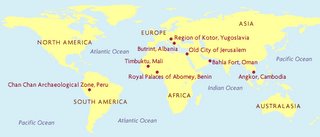
"Save Our History is The History Channel's global campaign dedicated to historical preservation and history education. The History Channel has partnered with UNESCO's World Heritage Center to help preserve some of the world's most endangered sites."

The History Channel's map of the sites.
Design 21 prizes
Read the full UNESCO media release.
"Seven young designers will be awarded the international DESIGN 21 prizes during a ceremony at Headquarters on November 14 (Segur Hall, 6.30 pm). UNESCO Director-General Koïchiro Matsuura and Kazuhiko Yazaki, President of the Felissimo Group, will present the awards for the fifth edition of this international contest. Launched in 1995 by UNESCO and the Felissimo Group (Japan) the contest encourages young amateur designers between 18 and 35 years of age to submit projects linked to daily life: the home, fashion, new technologies, tools and gadgets in the area of communication, work, domestic tasks, travel, and alimentation.
"The theme 'Love/Why?' was chosen for this year’s contest to stimulate thinking on the need to imagine new concepts adapted to today’s lifestyles, and based on understanding and harmony between people and peoples. This theme also illustrates the main objective of the DESIGN 21 project to favour human relationships through design.
"The US$10,000 Grand Prize was awarded to Tamar Meshulam from Israel. The jury also awarded three first prizes of US$3,000 each to Kunio Osawa from Japan, Zhanar Turekulov from Kazakhstan, and Carla Tennenbaum from Brazil. Karen Olze & Gisa Wilkens from Germany and David Altit from Israel received, respectively, the Special Jury Prize and the Special Felissimo Prize, each worth $1,000."
International Symposium on UNESCO's History
Go to the website for the Symposium.
UNESCO was born on November 16, 1945. On the occasion of its 60th anniversary, UNESCO is hosting, from 16th to 18th November 2005, an international symposium on the Organization’s history, which will take place at its Headquarters in Paris.
More than sixty historians, anthropologists, philosophers and other scholars will speak at round table sessions or in plenary on major themes of UNESCO’s history, such as the birth of the Organization, the vision of humanism and peace, the race question, ideals challenged in the context of cold war and decolonisation, reconciliation, reconstruction, dialogues, education for all, cultural heritage and the social responsibility of the sciences.
This is part of a 60 week long celebration of the anniversary. During the period, "UNESCO endeavours not so much to celebrate its accomplishments but to revive the power of the inspiration that guided its founding fathers. This means rekindling their sense of hope and vision with a view to the future.
Sixty themes were selected to punctuate the sixty weeks between 5 September 2005 and 4 November 2006, anniversary of the coming into force of the International Convention constituting the UNESCO.
Note especially these two websites, "60 Years of Culture", and "60 Years of Education".
Saturday, November 12, 2005
"Education for All: Global Monitoring Report 2006"

Read the full report online.
The 2006 report has just been published. The following is taken from UNESCO's media release on the report:
"Governments and donor countries are curtailing progress towards Education for All (EFA) – and broader poverty reduction – by according only marginal attention to the 771 million adults living without basic literacy skills, says the fourth edition of the EFA Global Monitoring Report, “Literacy for life”.* “Literacy is a right and a foundation for further learning that must be tackled through quality schooling for all children, vastly expanded literacy programmes for youth and adults, and policies to enrich the literate environment,” says Nicholas Burnett, the Report’s director.
"This three-fold strategy places literacy at the core of Education for All. It calls for measures to accelerate progress towards universal primary education, to scale up literacy programmes for youth and adults and to support libraries, the media, book publishing and access to information.
"'The powerful links that exist between adult literacy and better health, higher income, more active citizenship and children’s education should act as strong incentives for governments and donors to be much more proactive on addressing the literacy deficit,' says UNESCO’s Director-General Koïchiro Matsuura.
"According to the Report, three-quarters of the world’s adult illiterates live in 12 countries. South and West Asia has the lowest regional adult literacy rate (58.6%), followed by Sub-Saharan Africa (59.7%), and the Arab States (62.7%). Countries with the lowest adult literacy rates in the world are Burkina Faso (12.8%), Niger (14.4%) and Mali (19%).
"Reflecting deep-seated gender inequalities in many societies, women account for 64% of the adults worldwide who cannot read or write with understanding. This figure is virtually unchanged from 63% in 1990.
"Although adult literacy rates doubled in Sub-Saharan Africa, the Arab States and South and West Asia from 1970 to 2000, the rate of progress has slowed considerably since 1990. On present trends, only 86 percent of the world’s adults will be literate by 2015, up from 82 percent today.
"Severe poverty correlates strongly with low literacy rates: in Bangladesh, Ethiopia, Ghana, India, Mozambique and Nepal, where three-quarters or more of the population live on less than US$2 per day, adult literacy rates are below 63% and the number of illiterates exceeds 5 million.
"Driven by the expansion of schooling, the literacy rate for those aged between 15 and 24 in developing countries rose from 66% to 85% between 1970 and 2000-2004. Worldwide, however, more than 132 million people in this age group are still unable to read and write even at a minimum level."
Thursday, November 10, 2005
Another View of the Convention on Cultural Diversity
Read the full IrelandOn-Line article from October 17, 2005.
I am posting excerpts this article from last month because it gives a view of the deliberations from Ireland, a strong ally of the United States which has both a strong policy for preservation of Gaelic culture and an open economy.
"Culture clash pits US against allies"
"The US today found itself isolated at the UN?s cultural agency, with even traditional ally Britain in the opposing camp over a proposed pact on cultural diversity that the US ambassador said could be used to erect trade barriers against cultural exports.
?'This has been a very disappointing experience, both in terms of the process and the substance. This is not the way most negotiations go in multilateral international organisations,' US Ambassador to Unesco Louise Oliver said........
"The majority of Unesco?s member states support the project, including Britain. British ambassador Timothy Craddock said the draft text was 'clear, carefully balanced, consistent with the principles of international law and fundamental human rights.'
"He also said the European Union believes that the convention was 'frequently and thoroughly negotiated by all parties, most of whom have made several compromises during this process.'
"He spoke on the EU?s behalf because Britain currently holds the 25-nation bloc?s rotating presidency.........
"French Culture Minister Renaud Donnedieu de Vabres hailed the text as a recognition of France?s long-held contention that cultural activities should be given separate consideration in trade talks and are 'not a merchandise like any other.'.........
"Asked if the US is again thinking of withdrawing from Unesco, Oliver said: 'That?s not under discussion.'.........
"She told the Unesco meeting that negotiations seemed to have been driven by 'a desire for speed, rather than a demand for a quality consensus text.'
?'The door to negotiations that might have led to consensus ... was slammed shut in the face of unresolved, legitimate and reasonable US concerns,' she said."
Fears that the United States may withdraw from UNESCO over Convention on Cultural Diversity
Read the full story published by Embassy (Canada's Foreign Policy Newsweekly).
"UNESCO Cultural Treaty On the Rocks, Fearing U.S. Withdrawal"
"A new international pact to protect creative expression from the threat of globalization is so strongly opposed by the United States that a diplomat in Ottawa fears Washington may withdraw from UNESCO for the second time.
"'We are very worried that U.S. foreign policy is rowing against the current,' says Carlos Carrasco, Bolivia's Ambassador to Canada. 'There are rumours that the United States might drop out [of the United Nations Education, Scientific and Cultural Organization] or withhold funds.'
"For 18 years Mr. Carrasco was his country's representative to UNESCO in Paris, and then director for Latin America and the Caribbean. Last month in France he represented Bolivia at UNESCO's general meeting where 148 countries approved a new instrument that preserves the right of nations to promote and support their own audiovisual industries, such as film, music and literature. Two nations -- the United States and Israel -- voted against the treaty, four abstained, and dozens of other countries failed to attend the vote, which Mr. Carrasco describes as a move to appear neutral in a polarizing debate.
"The United States argues the treaty could be used to build trade barriers to cultural trade and services, and that trade agreements and World Trade Organization rules enjoy supremacy over UNESCO conventions. The U.S. Ambassador to UNESCO, Louise Oliver, also says it could be used to justify censorship. She stopped short of saying her objection to the treaty could cause the U.S. to quit the organization or withhold funding.
"'I would say that we're not currently considering any such possibilities, but obviously this process is going to raise some questions that will have to be discussed when I get back to Washington,' says Ms. Oliver, according to an Associated Press article."
Tuesday, November 08, 2005
U.S. Ambassador to UNESCO Louise Oliver With Foreign Journalists

Read the transcript of Ambassador Oliver's videoconference of October 21, 2005.
QUESTION: Ambassador, I'm Jyri Raivio, Helsingin Sanomat of Finland. You mentioned that U.S. was not able to support the acceptance of the UNESCO budget but what's the practical consequence of this decision? And how big the part of this budget does the U.S. take?
AMBASSADOR OLIVER: The budget is -- we have program and budget for the next two years. UNESCO is on a two-year cycle so this is the $610 million program and budget for the next two years. In order to be adopted, two-thirds of UNESCO's member states need to support the program and budget. That did occur. So therefore, this program and budget will be used as a basis for UNESCO's work for the next two years.
The fact that we voted no on this budget, again, emphasizes the fact that we are unhappy with the budget in terms of the fact that it does support a Convention that we oppose. But as I said in my statement a few minutes ago, we also do not think that UNESCO has gone far enough in terms of focusing on activities, focusing on its priorities so that it can have quality programs that really make a difference around the world. Almost every country in UNESCO has stated over and over again, in the last two years since we've been part of this organization, that education is the priority of priorities. And so we are saying put resources in education, put resources in areas -- science and other areas, which are areas where UNESCO could really make a difference -- put funds, put resources in real natural and cultural preservation. And there are programs in UNESCO that do that.
Our question has been a broader question, which is, what is the role of UNESCO's programs versus its normative instruments -- a well thought out normative instrument, a well thought declaration or convention that achieves consensus, can perhaps do something real and positive.
But, I repeat, a convention that was negotiated quickly, that seemed to be more interested in being negotiated as quickly as possible so that it could be adopted at this General Conference, where speed seems to be something that people cared about more than quality -- well, that is something that we would -- we do have concerns about.
Editorial: Expand the Functions of the U.S. National Commission for UNESCO
I have sought not to insert personal opinions on this blog, but only to provide information on UNESCO. I depart from that practice on this occasion, invoking blogger’s privilege, to editorialize. The following opinions are mine alone.
The Mission of the U.S. National Commission for UNESCO (NatCom) as currently defined is too narrow. The NatCom is an exceptional resource for the nation, and we should broaden its functions in order to utilize its capabilities more fully. UNESCO’s multilateral approach serves U.S. interests in the fight for peace, the war against poverty, and the effort to control terrorism. A strong, fully-functioning U.S. National Commission can help to realize UNESCO’s mission and help to achieve U.S. foreign policy objectives.
A more fully involved U.S. NatCom is fully appropriate to this nation’s open, democratic government, and the leading role civil society has played in the nation’s life. As the United States promotes democracy in other nations, we stress the importance of civil society. A participatory network of National Commissions for UNESCO with strong civil society participation is vital to U.S. interests in the governance of UNESCO, and serves as an ally too in our global democratization efforts. It would set a very poor precedent were the U.S. Government to limit the role of civil society in the U.S. NatCom!
UNESCO was created in the aftermath of World War II by political leaders who believed then, as I believe now, that war is created in the minds of men and so too must a lasting peace be created in the minds of men. UNESCO’s role was then to work with the educators, the scientists, the cultural leaders, and the communicators in all nations, bringing them together in order to improve mutual understanding, and to advance peace.
UNESCO’s network of National Commissions is a unique feature within the entire U.N. system. When the Constitution of UNESCO was adopted in November 1945, Article VII stipulated that
The network of NatComs has grown over the past years as the number of nations belonging to UNESCO has grown. So too, have the roles and responsibilities of National Commissions evolved over the years. Initially entrusted with the tasks of consultation and liaison by the Constitution of UNESCO in 1945, National Commissions were later called upon to take up the functions of information and execution by the General Conference at its 14th session in 1966. The Charter of National Commissions for UNESCO, adopted in 1978, was an important milestone in the evolution of National Commissions. That Charter states:
John A. Daly
The Mission of the U.S. National Commission for UNESCO (NatCom) as currently defined is too narrow. The NatCom is an exceptional resource for the nation, and we should broaden its functions in order to utilize its capabilities more fully. UNESCO’s multilateral approach serves U.S. interests in the fight for peace, the war against poverty, and the effort to control terrorism. A strong, fully-functioning U.S. National Commission can help to realize UNESCO’s mission and help to achieve U.S. foreign policy objectives.
A more fully involved U.S. NatCom is fully appropriate to this nation’s open, democratic government, and the leading role civil society has played in the nation’s life. As the United States promotes democracy in other nations, we stress the importance of civil society. A participatory network of National Commissions for UNESCO with strong civil society participation is vital to U.S. interests in the governance of UNESCO, and serves as an ally too in our global democratization efforts. It would set a very poor precedent were the U.S. Government to limit the role of civil society in the U.S. NatCom!
UNESCO was created in the aftermath of World War II by political leaders who believed then, as I believe now, that war is created in the minds of men and so too must a lasting peace be created in the minds of men. UNESCO’s role was then to work with the educators, the scientists, the cultural leaders, and the communicators in all nations, bringing them together in order to improve mutual understanding, and to advance peace.
UNESCO’s network of National Commissions is a unique feature within the entire U.N. system. When the Constitution of UNESCO was adopted in November 1945, Article VII stipulated that
“each Member State shall make such arrangements as suit its particular conditions for the purpose of associating its principal bodies interested in educational, scientific and cultural matters with the work of the Organization, preferably by the formation of a National Commission broadly representative of the government and such bodies”.In the six decades since the founding of UNESCO, global efforts to fight poverty have come to the forefront. Poverty too must be fought in the minds of men. Most recently, the United States has embarked on a global war against terrorism. Terrorism too is born in the minds of men, and the ways of thinking of terrorists and their supporters must change if terrorism is to be controlled.
The network of NatComs has grown over the past years as the number of nations belonging to UNESCO has grown. So too, have the roles and responsibilities of National Commissions evolved over the years. Initially entrusted with the tasks of consultation and liaison by the Constitution of UNESCO in 1945, National Commissions were later called upon to take up the functions of information and execution by the General Conference at its 14th session in 1966. The Charter of National Commissions for UNESCO, adopted in 1978, was an important milestone in the evolution of National Commissions. That Charter states:
1. The function of National Commissions is to involve in UNESCO’s activities the various ministerial departments, agencies, institutions, organizations and individuals working for the advancement of education, science, culture and information, so that each Member State may:According to the Charter of the U.S. National Commission for UNESCO, however, the functions of the U.S. NatCom are very limited:(a) Contribute to the maintenance of peace and security and the common welfare of mankind by participating in the activities of UNESCO which aim to advance the mutual knowledge and understanding of peoples, give fresh impulse to popular education and to the spread of culture, and preserve, increase and diffuse knowledge;2. For this purpose, National Commissions:
(b) Play an ever-increasing role in UNESCO’s work, and particularly in the formulation and execution of its programmes.(a) Cooperate with their governments and with services, organizations, institutions and individuals concerned with questions within UNESCO’s competence;3. In addition, and depending on the requirements and arrangements of each Member State, National Commissions may:
(b) Encourage participation of national, governmental and nongovernmental institutions and various individuals in the formulation and execution of UNESCO’s programmes so as to secure for the Organization all the intellectual, scientific, artistic or administrative assistance that it may require;
(c) Disseminate information on the objectives, programme and activities of UNESCO and endeavour to arouse public interest in them.(a) Participate in the planning and execution of activities entrusted to UNESCO which are undertaken with the assistance of the United Nations Development Programme (UNDP), the United Nations Environment Programme (UNEP), the United Nations Population Fund (UNFPA) and other international programmes;4. National Commissions collaborate with each other and with UNESCO’s regional offices and centres in fostering regional, subregional and bilateral cooperation in education, the sciences, culture and information, particularly through the joint formulation and execution of programmes. This cooperation may bear upon the preparation, implementation and evaluation of projects and may take the form of joint surveys, seminars, meetings and conferences and exchanges of information, material and visits.
(b) Participate in the search for candidates for UNESCO posts financed under the regular programme or from extra-budgetary sources, and in the placement of UNESCO fellowship holders;
(c) Participate with other National Commissions in joint studies on matters of interest to UNESCO;
(d) Undertake on their own initiative other activities related to the general objectives of UNESCO.
The functions of the Commission shall be advisory, and any determination to be made or action to be taken on the basis of Commission recommendations shall be made or taken by appropriate officers of the Untied States Government. The Commission shall offer recommendations with respect to the consideration of issues related to education, science, communications and culture, and the formulation and implementation of U.S. policy toward UNESCO.It might be argued that a broader role for the NatCom is not allowed by the Federal Advisory Committee Act (FACA). However, FACA in Section 9 specifically permits advisory committees to undertake other functions when those functions are “specifically provided by statute or Presidential directive”. The NatCom charter must be renewed after two years, and I recommend that the Presidential directive for the renewal specifically include the broader functions envisioned in the UNESCO documents. The current NatCom members should be asked now for advice on the revision of their Charter.
John A. Daly
Monday, November 07, 2005
Friday, November 04, 2005
"UNESCO honors 'Zorba the Greek' composer"

Read the full report from AFP/Yahoo! News.
"UNESCO awarded its International Music Prize 2005 to 'Zorba the Greek' composer Mikis Theodorakis for his contributions to understanding between cultures and the advancement of peace.
"The 80-year-old known to most Greeks simply as 'Mikis' accepted the award in the western city of Aachen saying he "could never have been anything else but a musician". He was chosen among 40 nominees for the prize, initiated in 1975."
Read the UNESCO media release on the award.
Launch of the Education for All Global Monitoring Report 2006 : “Literacy for Life”
Go to the media release from UNESCO
The Report is to be launched on Wednesday, November 9, 1 p.m, in London.
Literacy suffers severe neglect in national and international policy, keeping hundreds of millions of adults on the sidelines of society and limiting progress towards the six Education for All goals and overall poverty reduction, says the new edition of the EFA Global Monitoring Report. The Report focuses on the world’s 771 million adults living without minimal literacy skills, and points out that while the challenge is predominant in developing regions, significant numbers of young people and adults possess weak literacy skills even in highly developed countries.
The report maps this global challenge and suggests priorities for scaled-up programmes for youth and adults. It also analyses progress towards universal primary education and gender parity: despite steady advances in some of the world’s poorest countries, the pace of progress remains insufficient.
The Report's Education for All Development Index ranks 123 countries according to their progress towards the six EFA goals set at the World Education Forum in Dakar, Senegal, in 2000.
"The goals are still achievable, states the Report. However, reaching them will require an immediate acceleration of activity in developing countries and an approximate doubling of the international community’s aid to basic education, even above the levels implied by the G8 pledges made at Gleneagles in July 2005."
UNESCO International Symposium: Cultural diversity and East-West dialogue
Read the full UNESCO media release.
An International Symposium on 'Cultural Diversity and Transversal Values: East-West Dialogue on Spiritual-Secular Dynamics' will take place at UNESCO from November 7 to 9. The meeting will focus on the origins and nature of cultural values shared by East Asia and the West through concrete examples of intercultural meetings throughout history. It is to bring together scholars, intellectuals and philosophers of different cultures to reflect and debate on the themes of cultural diversity and the East-West dialogue.
The Symposium is organized jointly by UNESCO and the Research Centre for Moral Science (Japan), in partnership with the Ecole Pratique des Hautes Etudes (EPHE) and the International Council for Philosophy and Humanistic Studies (ICPHS) as well as the Permanent Delegation of Japan to UNESCO and the French National Commission for UNESCO.
Thursday, November 03, 2005
"Students’ perceptions of science and technology"
Read the full article in the current edition of Connect, UNESCO's International Science, Technology and Educational Newsletter.
This is a very interesting article on the attitudes of 15 year old students in a number of countries on science and technology. The graphs plotting the differences in attitudes among countries are especially striking. Unfortunately, students from the United States were not included in the study, but it seems likely that they would share many of the opinions expressed by students from other developed nations. Excerpts from the article follow.
"In most OECD countries there is a concern about the lack of interest among young people to pursue studies and careers in science, engineering and technology (SET). Many wealthy nations ‘solve’ their recruitment problems by importing able students from poorer countries. About half of the PhD students in SET in the US come from such countries, mainly from Asia2.
"Such a ‘brain drain’ has positive as well as negative effects on both parts, and will not be discussed here. It is, however, noteworthy that the recent preoccupation with the ‘fight against terror’ has complicated the migration of these able students, in particular to the US.
"It is a paradox that the most SET driven economies in the world experience a lack of interest in SET studies and careers among young people. The economic significance for a country to have a high number of skilled scientists and engineers is well accepted.
"But young people do not choose their studies or careers because it is good for the economy of their country. They base their choices (when they have them) on their own interests, values and priorities. It is obvious that SET studies and jobs do not have the same appeal to students in wealthier countries as they used to some decades ago.
"The lack of interest in SET in schools and further studies is not only a problem for the economy. It is also a threat to democracy, since most decisions in modern societies are highly dependent on considerations that involve weighting scientifi c arguments against value judgements. A scientifi cally illiterate voting population can easily be manipulated by propaganda in a voting process.
"From the above perspectives, it becomes urgent to get to know the SET-related attitudes, priorities and interests of the young generation. The ROSE-study has the ambition to do so."
ROSE (The Relevance Of Science Education)
"ROSE is an international comparative study that taps into the diversity of interests, experiences, priorities, hopes and attitudes that children in different countries bring to school (or have developed at school). The underlying hope is to stimulate an informed discussion on how one may make science education more relevant and meaningful for learners in ways that respect gender differences and cultural diversity. It is also hoped that light will be shed on how students’ interest in choosing SET-related studies and careers can be stimulated. Through deliberations that involved science educators from all continents, ROSE has developed an instrument with around 250 single items that tries to map out attitudinal or affective perspectives as seen by 15 year old learners. All items are simple in wording and the responses are given on a 4-point Likert scale. This justifies the use of standard statistical methods like calculations of means, correlations etc. About 40 000 students from 35 countries are taking part in ROSE on whose data 10 students from different countries will base their theses. A full report on the project rationale, development and logistics is available which includes reports on data collection from the participating countries. Data collection for international reporting is now finalized. Several articles and international reports with comparisons will be published during 2005 and the following years. Networks of science educators like ESERA (European Science Education Research Association); NARST (National Association for Research in Science Teaching) – US-based but with international outreach - and in particular, IOSTE (International Organization for Science and Technology Education), have been used to establish the network of research partners."
UNESCO World Report: Towards Knowledge Societies

This is the first in a new series of UNESCO reports, to be published every two years, focusing on subjects at the heart of the Organization’s mission.
"Towards Knowledge Societies clearly makes the distinction between knowledge societies and the information society. While the information society is based on technological breakthroughs, knowledge societies “encompass broader social, ethical and political dimensions.” The Report focuses in particular on the foundations on which knowledge societies that will optimize sustainable human development are constructed.
"The Report analyses the increasingly important role played by knowledge in economic growth and advances that it can serve as a new springboard for development in the countries of the South. It also presents a detailed analysis of the factors blocking the access of many countries to the opportunities offered by information and communication technologies, especially the growing digital divide and restrictions on freedom of expression. Finally, it makes a series of recommendations to improve the situation."
The report is now available for sale (Click here to transfer to the UNESCO website), priced at € 25.00.
Table of Contents
List of boxes, figures and tables, p. 11
List of abbreviations and acronyms, p. 14
Introduction, p. 17
Overview, p. 24
1. From the information society to knowledge societies, p. 27
Knowledge societies as a source of development, p. 27
Digital solidarity, p. 29
Freedom of expression as the touchstone of knowledge societies, p. 36
2. Network societies, knowledge and the new technologies, p. 45
Knowledge economy in network societies, p. 45
The impact of the new technologies on knowledge networks, p. 47
From memory-based societies to knowledge societies? p. 52
3. Learning societies, p. 57
Towards a culture of innovation? p. 57
Learning, a key value of knowledge societies, p. 60
The availability of knowledge, p. 63
4. Towards lifelong education for all? p. 69
Basic education for all, p. 71
Lifelong education for all, p. 76
New inputs for education: institutional reform, pedagogical research, teacher training and quality of education, p. 81
“E-learning”: new technologies and distance education, p. 84
5. The future of higher education, p. 87
Towards a market in higher education? Issues of funding, p. 87
University networks yet to be invented, p. 91
The new missions of higher education, p. 95
6. A research revolution? p. 99
New research locations, p. 99
The new frontiers of science, p. 111
Research and development: future challenges, p. 114
7. Science, the public and knowledge societies, p. 119
A good governance for science and technology, p. 119
A crisis in science education? p. 126
Fostering a scientific culture, p. 128
8. Risks and human security in knowledge societies, p. 133
Knowledge as a risk panacea? Foresight and disaster anticipation, p. 133
Knowledge societies, a source of new risk? Global risks, strategic risks and new forms of criminality, p. 137
Knowledge societies, human security, human rights and the fight against poverty, p. 139
Towards sustainable development societies? p. 142
9. Local and indigenous knowledge, linguistic diversity and knowledge societies, p. 147
Preserving local and indigenous knowledge, p. 148
Linguistic diversity and knowledge societies, p. 151
Pluralism, translation and knowledge sharing, p. 156
10. From access to participation: towards knowledge societies for all, p. 159
From the knowledge divide to knowledge sharing, p. 159
Women in knowledge societies, p. 167
Universal access to knowledge: knowledge sharing and intellectual property protection, p. 169
The renewal of democratic public forums in knowledge societies, p. 178
Conclusion, p. 185
Recommendations, p. 191
References, p. 195
Notes, p. 211
Tuesday, November 01, 2005
UNESCO at WSIS
Go to the UNESCO website for its WSIS participation.
16-18 November 2005, Tunis, Tunisia
At the Summit meeting in Tunis in November 2005, UNESCO is to be an active participant and contributor organizing three events and an exhibitoin building on UNESCO’s concept of “knowledge societies”:
* A High-Level Round Table on “Shaping the Future through Knowledge”.
(17 November 2005, 3-6 p.m.)
* A Round Table on the "Role of UNESCO in the Construction of Knowledge Societies through the UNITWIN/UNESCO Chairs Programme”.
(18 November 2005, 9 a.m.-1 p.m.)
* A Workshop on "ICT and Persons with Disabilities". The workshop will look at policies that promote accessibility in the digital world, especially in developing countries, and at how access to cyberspace for people with disabilities can be enhanced.
(16 November 2005, 9 a.m.-1 p.m.)
* A stand showing how UNESCO is contributing to the implementation of the WSIS Action Plan and a space for meeting colleagues and friends and for exchanging ideas and experiences on how to build knowledge societies.
(Throughouth WSIS, ICT4All Exhibition)
High Level Round Table: Shaping the Future through Knowledge
Visit UNESCO's website for the Round Table.
Date: 17 November 2005
Hour: 3-6 p.m.
Place: Tunis, Tunisia
The UNESCO High-Level Round Table “Shaping the Future through Knowledge“ is to discuss how to build equitable and inclusive knowledge societies; in particular, how the potential of knowledge can be harnessed and released for sustainable development of all the world’s peoples.
Heads of government and state, eminent scientists, visionaries and leaders from civil society and the private sector will share experience and visions on how knowledge can influence, if not drive human and societal development towards a fair, equitable and inclusive future. Leadership at all levels and in all walks of life will be critical.
Construction of Knowledge Societies
Go to the Round Table website.
A Round Table on the Role of UNESCO in the Construction of Knowledge Societies through the UNITWIN/UNESCO Chairs Program is to take place as part of the World Summit on the Information Society (WSIS), on November 10, 2005 in Tunis. WSIS is sponsored by the International Telecommunications Union (ITU) and the United Nations Educational, Scientific and Cultural Organization (UNESCO). UNITWIN is UNESCO's Universities Twinning and Networking Scheme.
The Round Table will address the role of higher education in the construction of knowledge societies and the challenges facing university systems in effectively contributing to the social, economic and cultural development of nations.
"A number of crucial challenges will be discussed, such as:
The round table will be conducted in three languages - Arabic, English and French - with simultaneous interpretation.
A Round Table on the Role of UNESCO in the Construction of Knowledge Societies through the UNITWIN/UNESCO Chairs Program is to take place as part of the World Summit on the Information Society (WSIS), on November 10, 2005 in Tunis. WSIS is sponsored by the International Telecommunications Union (ITU) and the United Nations Educational, Scientific and Cultural Organization (UNESCO). UNITWIN is UNESCO's Universities Twinning and Networking Scheme.
The Round Table will address the role of higher education in the construction of knowledge societies and the challenges facing university systems in effectively contributing to the social, economic and cultural development of nations.
"A number of crucial challenges will be discussed, such as:
* equity and quality of higher education,
* barriers to harnessing ICT in education,
* under-development of research,
* diminishing government financial support to higher education,
* the brain drain,
* language barriers preventing access to information on the Internet, and
* bridging the knowledge gap."
The round table will be conducted in three languages - Arabic, English and French - with simultaneous interpretation.
WSIS Prepcom to Resume in November
PrepCom-3 of the Tunis phase of the World Summit on the Information Society (WSIS) will be reconvened on 13 November 2005, in Tunis, for a three-day session (13-15 November 2005). The resumed PrepCom-3 will start with a short organizational Plenary meeting. The modalities of work of the resumed PrepCom-3 will follow the Rules of Procedure of the PrepCom, including the participation of observers in Plenary and Subcommittee meetings.
Subscribe to:
Posts (Atom)