Friday, September 10, 2010

U.S. Financial Contributions to UNESCO

U.S. funds to UNESCO
are allocated by the Congress

There is a formula used by the United Nations and other agencies of the UN system to determine the portion of the assessed contributions to be paid by each member nation. According to this computation, the United States contributes 22 percent to the regular budget of UNESCO; the approved regular budget for the two years 2010 and 2011 is $653 million. In addition to the assessed budgetary contributions, UNESCO received voluntary extrabudgetary contributions. These are an important part of the Organization's financial resources amounting to an estimated $463 million for the same two years.

The U.S. contributes close to $3.7 million dollars in extra-budgetary funds to UNESCO each year in addition to its assessed dues. Those funds are devoted to specific projects:


Read more about:

Wednesday, September 08, 2010

World Conference on Early Childhood Care and Education


Moscow (Russia), 27-29 September 2010


Early childhood is a critical period. Children are most vulnerable and most dependent then on relationships for survival, emotional security and cognitive development. Yet large proportions of the world’s children are denied access to the benefits of Early Childhood Care and Education (ECCE), which in turn limits the development potential of countries and regions.
Wealth should not be defined as material gain alone. It should also take account of whether countries are able to nurture their human capital with values important in a globalized world: tolerance, a sense of justice and cooperation, respect for diversity and for the environment. The first World Conference on Early Childhood Care and Education addresses the importance of starting early.

Monday, September 06, 2010

UNESCO launches new Knowledge and Innovations Network for Literacy (KINL)

© UNESCO/Vidal

UNESCO is launching a new Knowledge and Innovations Network for Literacy (KINL) that will enable researchers and practitioners all over the world to link up and share information and best practices. The network’s launch will be a highlight of International Literacy Day celebrations* on 8 September at UNESCO Headquarters in Paris.

In addition, UNESCO’s Director-General Irina Bokova will be in New York to give a keynote address at the international conference “Literacy: an essential foundation for development” at the United Nations. The opening address will be given by former First Lady of the United States Laura Bush, who is Honorary Ambassador for the UN Literacy Decade (UNLD).

Created with support from Verizon Foundation and Microsoft, the Network is a virtual workplace where literacy researchers and practitioners can link up, share knowledge and debate literacy topics on line. The network will generate knowledge and innovation in support of the acquisition and use of literacy, and promote advocacy, policy formulation and programme delivery, as well as cooperation and partnerships. It will be operational beginning 1 November 2010. Participating in the launch will be UNESCO Goodwill Ambassador Cheick Modibo Diarra, who is Microsoft Corporation’s Chairman for Africa and Literacy Champion; and Marc Gosselin, representative of Verizon Foundation.

“Promoting literacy requires action from both the public and private sectors; we are all stakeholders in the fight to eradicate illiteracy,” said Dr. Diarra about KINL. “Microsoft shares UNESCO’s belief that technology can play an important role in doing so by providing access to education solutions and curriculum for both basic and digital literacy and helping more people participate in the global information society.”

Verizon Foundation President Patrick Gaston said, “If we are to create a seismic shift in the literacy landscape, education and literacy leaders from around the world must be able to communicate with one another and collaborate. The Knowledge and Innovations Network for Literacy will provide literacy leaders from every nation with easy access to the resources needed to ensure that every child is literate. The Verizon Foundation is proud to partner with UNESCO on this transformational project.”

UNESCO Director-General Irina Bokova argues for greater literacy effort

Saturday, September 04, 2010

The International Day for the Remembrance of the Slave Trade and its Abolition

23 August 2010

The night of 22 to 23 August 1791, in Santo Domingo (today Haiti and the Dominican Republic) saw the beginning of the uprising that would play a crucial role in the abolition of the transatlantic slave trade.

The International Day for the Remembrance of the Slave Trade and its Abolition is intended to inscribe the tragedy of the transatlantic slave trade in the memory of all peoples. Bringing to light all aspects of slavery is essential to constructing an overall dispassionate vision of this tragedy.


UNESCO's Slave Route project endeavors to promote such research that helps to explain, understand and reconstruct the threads of sometimes conflicting narratives and fill the silences of the past.
On the International Day for the Remembrance of the Slave Trade and its Abolition, we remember the battles our predecessors fought to overcome the scourge of slavery, and the persistence of a twisted logic that continues to deny people the right to live freely even today.
Susan Rice
U.S. Ambassador to the United Nations


Recommended: A Profile of UNESCO's Chief, Irina Bokova


Irina Bokova was elected to the position of Director General of UNESCO in October 2009 by the General Conference of the Organization as the winner of a close contest among nine formal candidates for the position. She assumed the office in November, and has since led the organization as it faced major challenges such as responding to the Haitian earthquake and the Pakistani floods. She is the first woman to head UNESCO and the first citizen of a former Communist country.

Toute l'Europe has provided this very useful profile of DG Bokova and her priorities as she leads the Organization.

Friday, September 03, 2010

How Florida's Lee County Libraries Celebrate UNESCO's World Literacy Day

Source: "Library: Emphasis on literacy during special observance," JACKIE FLING, NEWS-PRESS.COM, SEPTEMBER 1, 2010

The Lee County Library System branches have traditionally set up displays and given literacy a special emphasis for the week that surrounds International Literacy Day. Some of these include:

- The Ready Collection - Materials on the Ready have been selected to help adults gain reading and writing English skills. In addition, materials designed to improve basic mathematics skills and prepare for GED examinations are located here, as well as in the regular collection. Books to help literacy teachers and tutors as they work with basic literacy or English as a second language students are on the Ready Shelf. All materials are available with a Lee County library card.

- Information and referrals to help adult learners locate local classes and other learning opportunities.

- English Cafe - Practice your English speaking skills, with these free informal sessions for adult ESOL/ESL students. Topics include everyday situations, current events and cultural issues. Advance registration not necessary, although participants should have basic English skills. At the East County Regional Library English Cafe classes are at 10 a.m. Fridays. Participants may start at any time.

- The Lee County Library System's website provides links to literacy organizations, literacy issues and information on local literacy providers. To access: Log on to www.lee-county.com/library, scroll down to Location and Services - double click and then double click on Literacy.

Education at the Millennium Development Goals Summit, 20-22 September


Preparations are well under way for the High-Level Plenary Meeting on the Millennium Development Goals (MDGs)  to be held at United Nations in New York on 20-22 September 2010.


The eight goals set worldwide objectives for a wide range of issues from maternal health to combating HIV and AIDS. Although Goal 2 specifically targets universal primary education, UNESCO argues that without education, none of the MDG targets can be reached.

“A quality inclusive education for all is the key to achieving each and every one of the Millennium Development Goals, from reducing poverty to improving health, empowering women and ensuring environmental sustainability,” asserts Irina Bokova, UNESCO’s Director-General. Ms Bokova is expected to attend the MDG Summit along with some 100 Heads of State and Government as well as leaders from the private sector, foundations and civil society organizations.

World Teachers’ Day, October 5


World Teachers’ Day, held annually on 5 October since 1994, commemorates the anniversary of the signing in 1966 of the UNESCO/ILO Recommendation Concerning the Status of Teachers. It is an occasion to celebrate the essential role of teachers in providing quality education at all levels. 

Thursday, September 02, 2010

UNESCO's History

Should UNESCO play a greater role in promoting truthful histories to foster peace?

In her book Dangerous Games: The Uses and Abuses of History Margaret MacMillan discusses the "History Wars" that go on over the history curricula in schools. She cites examples of the abuses of history such as false information purporting to be factual and selective use of history to bias student understanding, but she also cites examples such as:

  • joint development of textbooks for France and Germany to provide balanced views of the history of war and disputes between those countries,
  • a collaboration between an Israeli and a Palestinian to develop high school history texts to be used in both countries which would present both Israeli and Palestinian history side by side,
  • the revision of Japanese curricula in the 1970 to teach Japanese children about the death and devastation that had been wreaked on the Chinese by Japanese troops decades earlier,
  • the revision of the South African school curricula to deal honestly with apartheid as a result of the work of the Truth and Reconciliation Commission.
UNESCO of course has for decades published major historical series, giving voice to historians in Africa, the Caribbean, Islamic countries and other regions of the developing world. In general, UNESCO does not seem to categorize its educational programs by the disciplines that are to be taught, but it does cite specific examples such as:
 Indeed, one of the very first UNESCO programs initiated immediately after World War II was a review of textbooks in use to assure that the historical and other distortions that had been introduced by Fascist governments before and during the war were corrected.

UNESCO is uniquely placed to provide a forum for discussion and a laboratory of ideas on how history teaching can be made more accurate, and especially how such accuracy can be a tool for reconciliation of groups within countries and better understanding between countries.

Check out the UNESCO Guidebook on Textbook Research and Textbook Revision in a new edition, describing how nations can work together to research and revise their textbooks.


International Literacy Day, 8 September


On International Literacy Day each year, UNESCO reminds the international community of the status of literacy and adult learning globally.
Despite many and varied efforts, literacy remains an elusive target: some 759 million adults lack minimum literacy skills which means that one in five adults is still not literate; 72 million children are out-of-school and many more attend irregularly or drop out. 

Tuesday, August 31, 2010

Public Interest in UNESCO


Asian sites win UNESCO world heritage status
Inquirer.net - Jul 8 2008   
2,500 languages threatened with extinction: UNESCO
Times of India - Feb 19 2009   
UNESCO launches World Digital Library
Deutsche Welle - Apr 21 2009   
UNESCO strips Dresden of World Heritage site title
Vancouver Sun - Jun 25 2009   
Bulgarian diplomat wins UNESCO race
Philadelphia Inquirer - Sep 22 2009   
UNESCO adds 7 sites to World Heritage List
Ynetnews - Aug 1 2010  

The graph is from Google Trends. The top graph indicates that the number of search requests on Google for the term UNESCO has gone down since 2004. Three of the recent peaks in interest correspond to specific news related to UNESCO's World Heritage program, one to the launch of the World Digital Library (an initiative led by the United States Library of Congress), one to a UNESCO report on the threatened disappearance of many endangered minority languages, and one to the election of the Director General of the Organization.

The bottom graph indicates that the number of news articles recognized by Google about UNESCO has shown an increasing trend over the period from 2004.

Friday, August 27, 2010

Donate to UNESCO to help it help Pakistan Recover from the Floods


I quote extensively from the New York Times article today on the flood in Pakistan:
The destruction could set Pakistan back many years, if not decades, further weaken its feeble civilian administration and add to the burdens on its military.......

The flooding, which began with the arrival of the annual monsoons late last month, has by now affected about one-fifth of the country — nearly 62,000 square miles — or an area larger than England, according to the United Nations.

At the worst points, the inundation extends for scores of miles beyond the banks of the overflowing Indus River and its tributaries, said Cmdr. Iqbal Zahid, a Pakistani Navy battalion commander in charge of rescue operations in Sindh Province.

“You have to highlight that the infrastructure all the way from Khyber-Pakhtunkhwa to Sindh is ruined,” Commander Zahid said, referring to Pakistan’s northernmost and southernmost provinces. “It will take years to rebuild.”

Nearly 20 million people have been significantly affected, about the population of New York State, the United Nations said. The number in urgent need is now about eight million and expected to rise. More than half of them are without shelter.
UNESCO has a very limited budget, but with more money it could respond to:

  • help Pakistan's school system help Pakistan's kids deal with the trauma caused by the floods;
  • help Pakistan to plan to rebuild the schools it has lost;
  • help Pakistan protect its World Heritage sites and cultural heritage from the damage of the floods;
  • help Pakistan improve its hydrology and prepare to prevent such damaging floods in the future;
  • help Pakistan improve its disaster warning systems.
UNESCO has established a website to allow you to make donations to assist it in these efforts.

Sunday, August 15, 2010

UNESCO Report on Waterton-Glacier International Peace Park Calls for Additional Protections


"Efforts by the governments of British Columbia, Montana, and the United Statesseemingly have removed mining-related threats to Glacier National Park andWaterton Lakes National Park. But an international team of scientists believes both Canada and the United States must work harder to protect the resources of the International Peace Park.
"Though the field team's final report to the United Nations Educational, Scientific and Cultural Organization's World Heritage Committee presented in July in Brazil did not differ in tone from some of the tidbits that leaked out following the field team's visit to the two parks last September, its formal presentation put on record the team's concerns over the long-term health of the two national parks."

Fotopedia and UNESCO Launch World Heritage Application


Fotopedia, in collaboration with the UNESCO World Heritage Center, has created a new application for the iPhone and iPad. The app builds on the concept of a coffee table book, updating and enhancing the browsing experience for the web.
UNESCO World Heritage “seeks to encourage the identification, protection and preservation of cultural and natural heritage around the world considered to be of outstanding value to humanity.” Now you can access these sites as one comprehensive collection via your hand held device, thanks to the Fotopedia Heritage project.
This project was possible due to Creative Commons, as over 18,000 of the pictures in Fotopedia Heritage book are under one of the CC licenses. The pictures come from all around the world; as individual photographers and organizations license their high quality photos under Creative Commons, the book will only grow as a community contributed and shareable resource.

New figures from UNESCO on aid to education


According to new analysis by the Global Monitoring Report team, in 2008 global aid spending on basic education remained unchanged at US$4.7 billion.
Only US$2 billion of this aid went to the poorest countries compared to the US$16 billion in aid required annually for these countries to meet their basic education goals by 2015.

Thursday, August 12, 2010

Education and the Millennium Development Goals

Education is a major catalyst for human development. As nations prepare for the High-level Meeting on the Millennium Development Goals (MDG Summit) at the UN on 20-22 September, UNESCO looks at how rapid advances in education can help to achieve all of the MDGs.  In the year 2000, 147 heads of State and Government, and 189 nations pledged to halve extreme poverty by the year 2015.

UNESCO has developed a website to help those interested to understand UNESCO's programs in support of education for the MDGs. Click here to go to that website!

Wednesday, August 11, 2010

A Report from The Second World Conference on Arts Education:

The Second World Conference on Arts Education was held last May in Seoul, Korea under the auspices of UNESCO and the Korean Government. Now a report is available summarizing the conclusions of the meeting.

The main outcome of the Conference was the Seoul Agenda: Goals for the Development of Arts Education, a comprehensive plan of action for all arts education stakeholders. In preparation for the Conference UNESCO prepared an Analysis of the Roadmap for Arts Education.

I heard from Joanna Tawfilis, the Executive Director of The Art Miles Mural Project, that the meeting was a "wonderful endeavor" due in part to the "incredible South Korean partners and colleagues in Seoul."

More on the Art Miles Mural Project

Tuesday, August 10, 2010

UNESCO Chief on the occasion of the International Day of the World’s Indigenous People

International Day of the World’s Indigenous People

9 August 2010

The world’s 350 million indigenous people are unique custodians of our planet’s biological and cultural diversity, beholders of traditional knowledge systems and ways of life developed over centuries in coexistence with nature. Sustainable development is indeed what best characterizes indigenous peoples’ relationship to their environment, from the natural to the cultural and spiritual.

Despite significant advances in recognizing their rights and heritage, indigenous peoples are still not the real designers and drivers of their own development initiatives. Earlier this year in New York, the United Nations Permanent Forum on Indigenous Peoples’ issues highlighted the disconnect that still exists between dominant development models and indigenous peoples’ cultures and worldviews.

The indigenous peoples’ claim for “development with culture and identity,” guided by the landmark 2007 United Nations Declaration on the Rights of Indigenous Peoples, must be fully respected and taken on board by governments and the international community. This claim resonates strongly with UNESCO’s mandate and expertise.

Friday, August 06, 2010

The World Orchestra for Peace Designated UNESCO Artist for Peace


The World Orchestra for Peace, an exceptional ensemble of musicians representing more than 40 countries, was designated a UNESCO Artist for Peace by the Director-General of UNESCO, Irina Bokova. The formal designation took place on 5 August in the Royal Albert Hall in London). Later that day, Ms Bokova attended the BBC Proms concert celebrating the Orchestra’s 15th anniversary. The orchestra includes several musicians from the United States.  Read more!

News from the World Heritage Meeting

Hawaiian Archipelago, including the Papahānaumokuākea Marine National Monument
On July 30, UNESCO's World Heritage Committee inscribed Hawaii's Papahānaumokuākea Marine National Monument on the prestigious World Heritage List. This is the first new U.S. World Heritage site in fifteen years. Papahānaumokuākea is a vast and isolated linear cluster of small, low lying islands and atolls, with their surrounding ocean, roughly 250 km to the northwest of the main Hawaiian Archipelago and extending over some 1931 km. Read more!


In another action by the Committee, the Everglades National Park in Florida has been listed on the UNESCO World Heritage Danger List. The park was first inscribed as a World Heritage site in 1979 due to the exceptional variety of its water habitats. Read more!

Mt. Vernon, the historic home of George Washington, was withdrawn from consideration at this meeting. Apparently the nomination can be reconsidered at a future meeting of the committee. Read more!

Thursday, August 05, 2010

A Recommendation to the U.S. Permanent Representative to UNESCO

Boston’s Robert Gould Shaw Memorial, a sculpture by Saint-Gaudens

I recommend that the U.S. delegation to UNESCO arrange for a showing of the American Masters show on Augustus Saint-Gaudens. He was the greatest American sculptor of the 19th and early 20th century, and his sculpture includes important tributes to Lincoln and the Civil War memorial shown above. His work is included in the most important American museums, He was also the first American sculptor to be recognized in France. The Saint-Gaudens home and studio in New Hampshire, which was the center of an important art colony, is now maintained by the National Park service as a national historical site.

The hour long show is very good, and its showing by the U.S. delegation would both be entertaining and help acquaint the UNESCO related community in Paris with the depth and history of American high culture.

John Daly
(The recommendation is mine alone, and does not necessarily represent that of Americans for UNESCO).

Monday, August 02, 2010

The United Nations Foundation has decided to close the World Heritage Alliance and Friends of World Heritage.

The United Nations Foundation appreciates and acknowledges the important impact the World Heritage Alliance has had on World Heritage sites and communities in the seven countries where it operated. The World Heritage Alliance also demonstrated the important, yet often untapped, potential for multi-sector action for conservation and sustainable development in and around World Heritage sites.

The World Heritage Alliance will transfer appropriate training materials and other tools to the Tourism Sustainability Council for continued use. Linking with the Tourism Sustainability Council may be a logical next step for World Heritage Alliance members interested in improving their sustainability performance and receiving recognition for their work.

The Friends of World Heritage and World Heritage Alliance initiatives culminated in 2010, after four years of successful collaborations to protect and preserve World Heritage while promoting sustainable tourism.

Friday, July 30, 2010

U.S. College Returns Stolen Renée Descartes Letter to Institut de France

Haverford College President Emerson returns Descartes letter to Institut de France Chancellor Gabriel de Broglie (Studio Reporter)
On June 8, a rare four-page letter, written by the French philosopher René Descartes and stolen from the Institut de France in the 19th century, was returned to the Institut from the U.S. by the President of Haverford College, Steven G. Emerson.

The letter had been donated to Haverford College’s library in 1902, by the widow of a collector who had not known its history. When it was discovered to be stolen earlier this year, President Emerson immediately contacted Institut de France Chancellor Gabriel de Broglie, who gladly accepted his offer to return the letter, describing it as “a wonderful discovery for science.”

The United States is currently a member of UNESCO’s “Intergovernmental Committee for Promoting the Return of Cultural Property to its Countries of Origin or its Restitution in Case of Illicit Appropriation” and works closely with UNESCO on the preservation of cultural property.

Congressional Research Service UNESCO Related Reports

The Congressional Research Service of the Library of Congress has from time to time produced reports on UNESCO related topics. Here are links to some of them:


Also of interest with respect to UNESCO:

Friday, July 23, 2010

New World Heritage Sites up for Consideration Next Week.


The Klondike is one of the sites to be considered for World Heritage status at the World Heritage Committee meeting in Brasilia next week. The nomination has been submitted by Canada.

Wednesday, July 21, 2010

Fulbright Scholar Helps Generate $75,000 for UNESCO’s Creative Cities Network

A U.S. Fulbright scholar, Jacqueline Bishop, recently completed her four-month fellowship at UNESCO with a big win: working with the U.S. Mission to UNESCO, she submitted a project proposal that has been awarded $75,000 in funding from the State Department. During her fellowship Ms. Bishop was placed in the Creative Cities Network at UNESCO, where she discovered that there was a need to help less developed cities become part of the network.

UNESCO’s Creative Cities Network connects cities who want to share experiences, ideas and best practices for cultural, social and economic development. There are currently twenty-one cities in the network, including Iowa City, Iowa and Santa Fe, New Mexico.


6th International Festival of Human Rights Cinema: "The 7th Eye is Yours"

For our Spanish speaking followers, this introduction to the festival of human rights films.

From 12 to 24 July 2010, Sucre becomes for the sixth consecutive year a place of intercultural dialogue on values of human rights and cultural diversity and presents a panorama of movies and documentaries on social issues by film-makers from all around the world. For two weeks, the capital of Bolivia hosts the International Festival of Human Rights Cinema: The 7th Eye is Yours, organized by the Bolivian non-governmental organization the Cultural Centre Pukañawi. This important event in the public life of the country is dedicated this year to the memory of all disappeared persons and martyrs for the justice and coincides with the commemoration of 30 years after the last coup d'état in Bolivia.

Thursday, June 10, 2010

Regional Meeting of the National Commissions

Delegates at the 2008 Regional Consultation

The UK National Commission for UNESCO hosted the UNESCO Director-General’s Regional Consultation with National Commissions for UNESCO of Europe and North America on the Preparation of the Draft Programme and Budget for 2012-2013 (36C/5) from 5-8 June 2010, in London.

Read

Meeting of the U.S. NatCom

The long-awaited annual meeting of the U.S. National Commission for UNESCO (U.S. NatCom) took place May 25-27 in downtown Washington, D.C. and, reportedly turned out much quite successful in spite of an unusually tight schedule. It was difficult to know the exact number of Commissioners in attendance but 40-50 is a reasonable estimate plus various invited guests and the not too numerous "public" of whom six were members of the AU Board.

Though not described as having overall themes, the meeting featured science, women and youth in the presence of Dr. Gretchen Kalonji, the new UNESCO ADG/SC due to assume her duties July 1st. An American young woman, former participant in the Young Professional Program, now a staff member in the Science Sector described her entry into the UNESCO world with enthusiasm. Another young woman was equally enthusiastic about her participation in the Youth Forum (held during last year's General Conference). Finally, the United States contribution to various aspects of UNESCO's work in the field of water was eloquently described by the President and Director of the Woods Hole Oceanographic Institute, Dr. Susan Avery, and two US scientists dealing with the International Hydrological Program.

Wednesday, June 09, 2010

World Day Against Child Labor - 12 June

Hundreds of millions of girls and boys throughout the world are engaged in work that deprives them of adequate education, health, leisure and basic freedoms, violating their rights. Of these children, more than half are exposed to the worst forms of child labor such as work in hazardous environments, slavery, or other forms of forced labor, illicit activities such as drug trafficking and prostitution, as well as involvement in armed conflict.

The International Labor Organization (ILO) launched the first World Day Against Child Labour in 2002 as a way to highlight the plight of these children. The day, which is observed on June 12th, is intended to serve as a catalyst for the growing worldwide movement against child labor.


UNESCO too seeks to combat child labor and support learning opportunities for children.

Thursday, June 03, 2010

Joseph H.P. Carney

Joe Carney died peacefully on Sunday, May 30, 2010 at his home in Fairfax, VA after a long illness. He was 71 years old. Dr. Carney held a Ph.D. in African Studies from St. John''s University, NY, and M.S. in American History from Scranton University, PA, and M.A.s in Religious Education and Theology from the Maryknoll Graduate School of Theology and the University of the State of New York. Dr. Carney joined the United States Foreign Service in 1978. Joe worked with USAID, serving in Jamaica, Indonesia, and several countries in Africa. At his retirement in 2009, Dr. Carney was the USAID Director of the Office of Education and a U.S. delegate to UNESCO.

Friday, May 21, 2010

Editorial: The U.S. Intellectual Community should be more involved in UNESCO.


Francesco Bandarin mentioned in his talk to the Board of Directors of Americans for UNESCO that the new administration of UNESCO will give high priority to strengthening the participation of the U.S. educational, scientific and cultural and communications and information communities in UNESCO's efforts and networks. That participation languished during the years in which the United States was not a member of UNESCO, and has not been fully restored since the United States reentered UNESCO in 2003.

From the point of view of the UNESCO Secretariat, the desire to strengthen U.S. participation in UNESCO is obvious. Not only does the United States contribute 22 percent to the regular budget of UNESCO, but:
  • The U.S. education community is very strong. Thus one study finds 55 of the top 100 universities in the world are in the United States.
  • The U.S. scientific community is very strong. According to the NSF the United States provides one-third of the world's funding for research and development and produces more scientific and technological journal articles per year than any other country.
  • The U.S. cultural community is very stron. According to the UNESCO Institute of Statistics, the United States leads the world in trade of cultural goods.
  • The United States is a leader in the development of the information society. U.S. innovations include the transistor, the semiconductor chip, the personal computer and the Internet.
The effort to strengthen the participation of the U.S. intellectual community in UNESCO's programs should be welcomed by the Government and those communities. Through participation in UNESCO's activities and networks Americans can promote understanding of the United States by others while improving our understanding of other cultures. UNESCO provides a neutral forum in which key issues can be discussed by representatives of many nations.
  • It can provide a venue for discussions of the ethics of climate change and the responsibilities of nations to reduce greenhouse gas emissions and to ameliorate the damages done by global warming.
  • It continues to be the place in which countries discuss and monitor global progress on education.
  • It not only has catalyzed a number of global networks tackling critical scientific problems, but it provides an umbrella under which nations (even nations with fundamental disagreements among themselves) can collaborate on mutually beneficial scientific projects.
  • It provides a forum in which countries can work to develop a global culture of peace, and provides fora for discussion to help bridge the gaps between U.S. and Islamic culture and between Christian and Islamic religions. It can help protect world heritage while promoting cultural changes needed to enhance economic development.
  • It provides a useful emphasis on the development of knowledge societies to balance the increasing global interest in development of information societies.
The United States participated fully in the creation of UNESCO after World War II, modifying its Constitution in ways designed to make it a better instrument in achieving the goal of building teh defenses of peace in the minds of men. The United States reentered UNESCO in 2003 based on a consensus that the perceived problems of the organization that led to our withdrawal had been overcome and that membership in the organization would advance U.S. global interests. This history would itself justify full participation in UNESCO's efforts. More importantly, the more fully the U.S. educational, scientific and cultural communities participate in UNESCO, the more fully UNESCO will meet our expectations and achieve that which we hope for it to achieve.

John Daly
The opinions expressed above are those of the author and do not necessarily reflect those of Americans for UNESCO.


Meeting of the Board of Directors

The Board of Directors of Americans for UNESCO met yesterday. Francesco Bandarin, current director of the World Heritage Center and Assistant Director General designate for Culture opened the meeting with a most informative overview of the new developments in UNESCO.

Discussions in the meeting focuses on next week's meeting of the U.S. National Commission for UNESCO and the expectations of the Board for the future of the National Commission. The National Commission has been relatively inactive since it was reestablished and the consensus of the the Board is that it should be reorganized and rechartered to become more active in the future.

The Board also discussed the future of the UNESCO seminar that Board members have given at George Washington University in each of the last four Spring semesters. The course appears to be well received by students and to be a useful means of developing a cadre of young people knowledgeable about UNESCO. It was agreed that it should be continued and a small group was appointed to study ways and means of doing so.

Thursday, May 20, 2010

13th Annual US/ICOMOS International Symposium


Economic Benefits, Social Opportunities, and Challenges of Supporting Cultural Heritage for Sustainable Development

20-22 May, 2010
Washington, DC

The 13th Annual US/ICOMOS International Symposium, organized in partnership with the World Bank and co-sponsored by the Italian Trust Fund for Cultural Heritage and the National Park Service, will focus on the increasingly complex relationships between cultural heritage and the world’s market economies. It will look at real world problems and practical solutions through formal presentations, round tables and group discussions. More....

The International Council on Monuments and Sites (ICOMOS) is an association of professionals that currently brings together approximately 9500 members throughout the world. ICOMOS serves as an advisory body to the UNESCO World Heritage Center, providing peer review and other advisory services related to the World Heritage list.

Wednesday, May 19, 2010

UNESCO helps save Waterton Glacier from Mining

Source: "UNESCO sites to be saved and savored," The Boston Globe, Kari Bodnarchuk, May 16, 2010.

"A pristine section of land stretching from northern Montana into British Columbia, Canada, contains stunning mountain ranges, prairies, tundra, and lakes. It has endangered trout, the highest concentration of grizzly bears in the United States, and water quality that ranks among the best in the world. Gold exploration, coal-bed methane drilling, or construction of a coal mine might have irreversibly damaged this fragile environment.

"This land, known as the Waterton Glacier International Peace Park, is on the United Nations Educational, Scientific, and Cultural Organization’s (UNESCO) World Heritage List, a designation currently held by 890 natural and cultural sites worldwide because of their “outstanding universal value.’’ In February, British Columbia and Montana signed an agreement stating that no mining will be allowed in the region.

“'All of the values that make this park of international significance would have been threatened,' says Stephen Morris, chief of the Office of International Affairs at the US National Park Service. 'The World Heritage designation of Waterton Glacier definitely played a role in helping to protect the park from this mining development.’"

UNESCO Strategic Program Objective Evaluations Completed 2008-2010

Member states of UNESCO are currently formulating suggestions as to the priorities for the next biennium. UNESCO has suggested that thes evaluations of accomplishments under UNESCO's strategic program objectives may provide valuable information for that purpose. Those evaluations are:

UNESCO Program Priorities


UNESCO is in the process of defining priorities for the next biennial budget and plan of action. It will do so within the priorities defined in the Medium Term Strategy 2008-2013. Those priorities are summarized in the chart reproduced above.

Tuesday, May 18, 2010

Irina Bokova's message for World Expo 2010 in Shanghai -12 May 2010

World Day for Cultural Diversity for Dialogue and Development


21 May

The Day provides us with an opportunity to deepen our understanding of the values of cultural diversity and to learn to “live together” better. UNESCO continues to promote greater awareness of the crucial relationship between culture and development and the important role of information and communication technologies in this relationship.

Read more:

Saturday, May 15, 2010

US Foundation helps to support China's application for a World Heritage site designation

Frédérique Darragon samples
wood for radiocarbon analysis.

Source: "PROFILE: FRÉDÉRIQUE DARRAGON: Unraveling a Riddle in Plain Sight," Richard Stone, Science, 7 May 2010: Vol. 328. no. 5979, pp. 685 - 687
DOI: 10.1126/science.328.5979.685

"Amateur archaeologist Frédérique Darragon has spent 12 years documenting hundreds of mysterious towers in Southwest China—and winning over skeptical academics." As part of her research, under the auspices of the Unicorn Foundation, a U.S. nonprofit that Darragon founded in 2001 with seed money from cable TV mogul Ted Turner, wood samples from 77 towers—54 in Sichuan and 23 in Tibet—have been radiocarbon-dated by Beta Analytic in Miami, Florida.

"Drawing on Darragon's work, the State Administration of Cultural Heritage of China (SACH) is expected to soon nominate dozens of the more imposing structures to UNESCO's World Heritage list as the Diaolou Buildings and Villages of Tibetan and Qiang Ethnic Groups Cultural Landscapes. The towers 'represent an extraordinary heritage and tradition, and deserve to be fully preserved," says Francesco Bandarin, assistant director-general for culture at UNESCO."
Western Sichuan's star-shaped Bamei tower, restoration of which was completed last year, likely was built in the 13th or 14th century.

Friday, May 14, 2010

Education under Attack: Violence against Students, Teachers and Schools in Armed Conflicts

On May 17, the Center for Universal Education at the Brookings Institution will host a discussion of UNESCO’s "Education under Attack 2010" report and of the action taken by the Coalition for Protecting Education from Attack.

The discussion will feature:
  • Brendan O’Malley, author of the UNESCO report;
  • Chris Talbot of Education Above All and chair of the Global Coalition for Protecting Education from Attack;
  • Bede Sheppard of Human Rights Watch; and Major Carroll Connelley of the Lejeune Leadership Institute.
Brookings Fellow Rebecca Winthrop, co-director of the Center on Universal Education, will provide introductory remarks and moderate the discussion.


Wednesday, May 12, 2010

Powerful, Pro-Israel House Democrat Praises Obama's Strategy of Engagement at the UN


The chairman of the House Foreign Affairs Committee, Howard Berman, recently wrote a "Dear Colleague" letter to fellow members of Congress in which he stated:
"(S)ince rejoining UNESCO in 2005, the U.S. has exerted much effort to reform the organization and to ensure that it does not become another venue that unfairly singles out Israel for criticism. In that regard, I was pleased to see the attached letter from Israeli Foreign Minister Avigdor Lieberman thanking Secretary of State Hillary Clinton for recent U.S. efforts at UNESCO that prevented the adoption of a number of anti-Israel resolutions. Had the U.S. chosen not to engage with UNESCO, we would have been unable to rally the votes to block these anti-Israel resolutions."

Thursday, May 06, 2010

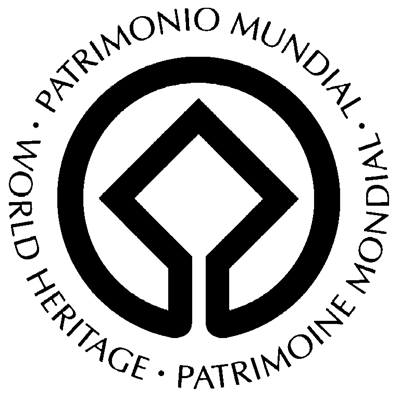
The World Heritage Emblem

Thanks to the commentator on the previous posting, I was able to find the following World Heritage Emblem.


The following is from the World Heritage Center's website on the emblem:
The World Heritage emblem represents the interdependence of the world’s natural and cultural diversity. It is used to identify properties protected by the World Heritage Convention and inscribed on the official World Heritage List, and represents the universal values for which the Convention stands. While the central square symbolizes the results of human skill and inspiration, the circle celebrates the gifts of nature. The emblem is round, like the world, a symbol of global protection for the heritage of all humankind.

Designed by Belgian artist Michel Olyff, it was adopted as the official emblem of the World Heritage Convention in 1978.

Tuesday, May 04, 2010

A UNESCO World Heritage Flag?


This flag, which I found on the Internet, has "World Heritage" written in Spanish and Norwegian as well as English. I wonder whether it is an authorized flag, or simply one that was created in Scandinavia for specific world heritage sites.

This is the so called Roerich Peace Flag. The Roerich Peace Pact, signed in 1935 by 35 countries in the Western Hemisphere, provided that cultural properties marked by this flag would be protected in times of war much as the Red Cross/Red Crescent flag is used to protect medical facilities in time of war. Is it a precursor to a UNESCO World Heritage flag?

Annual Meeting of the U.S. National Commission for UNESCO

The U.S. National Commission for UNESCO will host its Annual Meeting on Wednesday, May 26, 2010 and Thursday, May 27, 2010 at the Embassy Suites in Washington, D.C. (900 10th Street NW).

The Commission will host a series of informational plenary sessions and subject-specific committee and thematic break-out sessions on Wednesday, May 26. The Commission will meet in plenary session to discuss its final recommendations on Thursday, May 27, 2010, from 9:00 a.m. until 1:00 p.m.

The meetings will be open to the public, and those who wish to attend should contact the U.S. National Commission for UNESCO (202-663-0026; DCUNESCO@state.gov) no later than Wednesday, May 19th for further information about admission, as seating is limited. Requests for reasonable accommodation should also be made before that dat