
Showing posts with label Literacy. Show all posts
Showing posts with label Literacy. Show all posts
Monday, September 15, 2014


Friday, December 06, 2013

Saturday, September 03, 2011
International Literacy Day, 8 September

On International Literacy Day each year, UNESCO reminds the international community of the status of literacy and adult learning globally.
Despite many and varied efforts, literacy remains an elusive target: some 793 million adults lack minimum literacy skills which means that about one in six adults is still not literate; 67.4 million children are out-of-school and many more attend irregularly or drop out.
>> UNESCO International Literacy Prizewinners 2011
Tuesday, August 09, 2011
U.S. Organization Shares UNESCO Literacy Award for 2011

The US-based Room to Read shared the Confucius Prize for Literacy for its program promoting gender equality and literacy through local language publishing. Operating in nine countries – Bangladesh, Cambodia, India, Laos, Nepal, South Africa, Sri Lanka, Viet Nam and Zambia – the program has assisted communities in developing culturally relevant reading materials in local and minority languages.
Monday, September 06, 2010
UNESCO launches new Knowledge and Innovations Network for Literacy (KINL)

© UNESCO/Vidal
UNESCO is launching a new Knowledge and Innovations Network for Literacy (KINL) that will enable researchers and practitioners all over the world to link up and share information and best practices. The network’s launch will be a highlight of International Literacy Day celebrations* on 8 September at UNESCO Headquarters in Paris.
In addition, UNESCO’s Director-General Irina Bokova will be in New York to give a keynote address at the international conference “Literacy: an essential foundation for development” at the United Nations. The opening address will be given by former First Lady of the United States Laura Bush, who is Honorary Ambassador for the UN Literacy Decade (UNLD).
Created with support from Verizon Foundation and Microsoft, the Network is a virtual workplace where literacy researchers and practitioners can link up, share knowledge and debate literacy topics on line. The network will generate knowledge and innovation in support of the acquisition and use of literacy, and promote advocacy, policy formulation and programme delivery, as well as cooperation and partnerships. It will be operational beginning 1 November 2010. Participating in the launch will be UNESCO Goodwill Ambassador Cheick Modibo Diarra, who is Microsoft Corporation’s Chairman for Africa and Literacy Champion; and Marc Gosselin, representative of Verizon Foundation.
“Promoting literacy requires action from both the public and private sectors; we are all stakeholders in the fight to eradicate illiteracy,” said Dr. Diarra about KINL. “Microsoft shares UNESCO’s belief that technology can play an important role in doing so by providing access to education solutions and curriculum for both basic and digital literacy and helping more people participate in the global information society.”
Verizon Foundation President Patrick Gaston said, “If we are to create a seismic shift in the literacy landscape, education and literacy leaders from around the world must be able to communicate with one another and collaborate. The Knowledge and Innovations Network for Literacy will provide literacy leaders from every nation with easy access to the resources needed to ensure that every child is literate. The Verizon Foundation is proud to partner with UNESCO on this transformational project.”
Friday, September 03, 2010
How Florida's Lee County Libraries Celebrate UNESCO's World Literacy Day

The Lee County Library System branches have traditionally set up displays and given literacy a special emphasis for the week that surrounds International Literacy Day. Some of these include:
- The Ready Collection - Materials on the Ready have been selected to help adults gain reading and writing English skills. In addition, materials designed to improve basic mathematics skills and prepare for GED examinations are located here, as well as in the regular collection. Books to help literacy teachers and tutors as they work with basic literacy or English as a second language students are on the Ready Shelf. All materials are available with a Lee County library card.
- Information and referrals to help adult learners locate local classes and other learning opportunities.
- English Cafe - Practice your English speaking skills, with these free informal sessions for adult ESOL/ESL students. Topics include everyday situations, current events and cultural issues. Advance registration not necessary, although participants should have basic English skills. At the East County Regional Library English Cafe classes are at 10 a.m. Fridays. Participants may start at any time.
- The Lee County Library System's website provides links to literacy organizations, literacy issues and information on local literacy providers. To access: Log on to www.lee-county.com/library, scroll down to Location and Services - double click and then double click on Literacy.
Thursday, September 02, 2010
International Literacy Day, 8 September

On International Literacy Day each year, UNESCO reminds the international community of the status of literacy and adult learning globally.
Despite many and varied efforts, literacy remains an elusive target: some 759 million adults lack minimum literacy skills which means that one in five adults is still not literate; 72 million children are out-of-school and many more attend irregularly or drop out.
Saturday, December 05, 2009
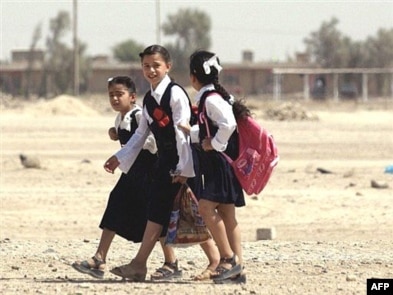
Once Seen As A Model, Iraq Struggles To Rebuild Its Education System
 Source: Radio Free Europe/Radio Liberty
"Despite the brutality of its former regime, Iraq was once seen as a model of education in the Arab world. The country boasted some of the region’s highest literacy rates, justifying the Arabic saying, “The Egyptians write, the Lebanese publish, the Iraqis read.”
"Today, up to one-quarter of Iraq's adults are illiterate.......
"International Literacy Day on September 8, which is sponsored by the United Nations Educational, Scientific,and Cultural Organization (UNESCO), is an opportunity to address these issues.
"This year, the UN agency is putting the spotlight on literacy’s importance for civic participation, citizenship, and social and human development.
"The message will be delivered in Iraq, where economic sanctions imposed in the 1990s and six years of occupation and violence have dramatically affected the education system."
"Today, up to one-quarter of Iraq's adults are illiterate.......
"International Literacy Day on September 8, which is sponsored by the United Nations Educational, Scientific,and Cultural Organization (UNESCO), is an opportunity to address these issues.
"This year, the UN agency is putting the spotlight on literacy’s importance for civic participation, citizenship, and social and human development.
"The message will be delivered in Iraq, where economic sanctions imposed in the 1990s and six years of occupation and violence have dramatically affected the education system."
Interview with Laura Bush
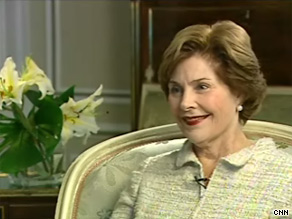 Recently, CNN Zain Vargee interviewed Laura Bush in Paris where she was attending a UNESCO meeting. I quote from the transcript:
Zain: You're here in Paris, for an important event, you're going to be talking about literacy worldwide. What is your one key message?
Laura: Well, the one key message is how important it is to read and how governments really need to focus their priorities on making sure everybody in their countries can read and that's what UNESCO does. UNESCO is the big U.N. agency that has education as part of its charge and this is the decade of literacy and the decade will be over in 2012 so we've got a lot of work to do to make sure people learn to read between now and then.
Zain: How do you make governments have literacy a priority? Because if you look at Africa, you look at Asia and so many other places around the world, governments have to struggle with so many other things there's corruptions and there's.... how do you do it?
Laura: Well, what UNESCO is trying to do is focus on the 34 most illiterate countries the countries with the highest rates of illiteracy. They have two programs, one is an assessment program, so they will help governments really assess how many people are illiterate who they are, where they are and what they can do to intervene in their lives... and then the other program out of UNESCO is called LEAP and it's an adult literacy program and its an adult literacy program and of course most of the people who are illiterate in the world... and they think... 700 million people who are illiterate I think it is, it's really a lot around the world that are illiterate... Watch the full interview with Laura Bush »
Zain: So it's really a way to put pressure on governments?
Laura: That's right and to help them in whatever way they can, because you're right, the countries with the highest illiteracy are also the poorest, they are the countries with the least capacity to be able to build education systems.
Wednesday, September 23, 2009
Media Literacy 101: Of Toilets, UNESCO and Demand-Side News
 The Eiffel Tower out the window of UNESCO's 13th floor ladies' room.
Susan Moeller has an article in The Huffington Post based on her participation in a UNESCO meeting of those interested in including curriculum in K through 12 education to help kids evaluate what they see in the media. (Moeller suggests that people treated to the views of Paris from UNESCO's headquarters, such as the one above, may tend to feel that they are especially favored.) She sees the long term effort to improve "media literacy" of the public as complementary to the Obama administration efforts to help media news, analysis and opinion sources survive the social transformations being driven by the Internet Revolution. I recommend the article.
Thursday, September 03, 2009
UNESCO celebrates the power of literacy, September 8
 A visit by Mrs Laura Bush, an awards ceremony and the launch of a touring classroom in a truck form part of UNESCO’s International Literacy Day celebrations in Paris.
This year’s theme, Literacy for Empowerment, highlights the staggering 776 million – or one in five - adults worldwide who still lack basic reading and writing skills. Two thirds of them are women.
Thursday, August 20, 2009
International Literacy Day, 8 September

On International Literacy Day each year, UNESCO reminds the international community of the status of literacy and adult learning globally.
Despite many and varied efforts, literacy remains an elusive target: some 776 million adults lack minimum literacy skills which means that one in five adults is still not literate; 75 million children are out-of-school and many more attend irregularly or drop out.
Saturday, April 25, 2009
The Literacy Project
 Google hosts this resource for teachers, literacy organizations and anyone interested in reading and education, created in collaboration with LitCam, Google, and UNESCO’s Institute for Lifelong Learning. The site provides materials in five languages.
Check out this great set of innovative projects on the Literacy Project website!
Wednesday, April 08, 2009
Promote The Big Read to Help a Big Cause
In less than two weeks on April 20 through the 26, the Global Campaign for Education will have its Global Action Week highlighting one of the most neglected Education for All goals: literacy. Now is the time to plan big and small ways to support this extremely worthy endeavor!

UNESCO, as the chief coordinator of EFA and of the United Nations Literacy Decade (2003-2012) , fully supports this cause and will have events worldwide related to the Big Read. Director-General Koïchiro Matsuura, for example, will host an event at UNESCO headquarters on April 23 to commemorate the week. Listings of more events and other information can be found here.
As UNESCO and others strive to realize the EFA goal of cutting literacy in half, it is essential for all to promote literacy in every way possible. For more information on the campaign for literacy, see
UNESCO, as the chief coordinator of EFA and of the United Nations Literacy Decade (2003-2012) , fully supports this cause and will have events worldwide related to the Big Read. Director-General Koïchiro Matsuura, for example, will host an event at UNESCO headquarters on April 23 to commemorate the week. Listings of more events and other information can be found here.
As UNESCO and others strive to realize the EFA goal of cutting literacy in half, it is essential for all to promote literacy in every way possible. For more information on the campaign for literacy, see
and information on
Wednesday, April 01, 2009
Upcoming: World Digital Library
In a significant step in expanding the availability of global materials and resources, UNESCO and other partners will unveil the World Digital Library (WDL) April 21, 2009, at a reception at UNESCO headquarters. The materials will come in many media forms in an effort to share knowledge from a diverse group of voices and to promote international and intercultural understanding. Further, these materials will also be completely free and offered in multilingual formats in order to most effectively share information with the global community.
 The idea for the WDL originated from a June 2005 speech delivered by Librarian of Congress James H. Billington to the U.S. National Commission for UNESCO. Since then, the project has developed into an initiative drawing more than 32 partners and interest from around the world. A progression of the WDL project can be found here.


 The idea for the WDL originated from a June 2005 speech delivered by Librarian of Congress James H. Billington to the U.S. National Commission for UNESCO. Since then, the project has developed into an initiative drawing more than 32 partners and interest from around the world. A progression of the WDL project can be found here.
Content in the library will include items gathered from global educational institutions and libraries, and descriptions of each item alongside videos and other materials for selected items hope to ignite interest in cultural artifacts and events. Materials will be easily searchable:
WDL is looking for others to become involved! Surveying what has been done, identifying important collections for WDL, and developing plans to build capacity all need institutional support and collaboration. For more information on how to become involved, see the WDL involvement page.
Sunday, March 01, 2009
New UNESCO Partnership for online Literacy Training
The UNESCO Institute for Lifelong Learning has with Gatlin International LLC, a firm headquartered in Fort Worth Texas, to provide a new Adult Literacy online training course.
The course is accessible at:
This non-credit course can help individuals with real-life dialog, discussions, negotiations and conversations. It contains a full range of computer-based activities including listening tasks, text display options and interactive speaking exercises.
The course is accessible at:
This non-credit course can help individuals with real-life dialog, discussions, negotiations and conversations. It contains a full range of computer-based activities including listening tasks, text display options and interactive speaking exercises.
Tuesday, September 23, 2008
UNESCO launches new fund to advance Global Literacy
First Lady Laura Bush announced today that UNESCO will receive more than $2 million from the United States Agency for International Development (USAID) to launch the United Nations Literacy Decade (UNLD) Fund, a new initiative that will advance global literacy. UNESCO is the lead agency for the coordination of the UN Literacy Decade.
Monday, September 22, 2008
Training-the-Trainers in Information Literacy

Information Literacy is the set of skills needed to find, retrieve, analyze, and use information.Information and media literacy enables people to interpret and make informed judgments as users of information and media, as well as to become skillful creators and producers of information and media messages in their own right. UNESCO encourages the development of national information and media literacy policies, including in education.
The American Library Association
In September 2007, the Bureau of the Intergovernmental Council for the Information for All Program (IFAP) decided to fund a global scale-up project on information literacy and agreed on a series of regional Training-The-Trainers workshops in information literacy.
The project foresees to organize a series of 11 Training-the-Trainers workshops in information literacy, to be held from 2008 to 2009 in several institutions of higher education covering all regions of the world.
Saturday, September 20, 2008
White House Symposium on Literacy
 Mrs. Bush, who serves as an Honorary Ambassador
to the United Nations Decade of Literacy,
addresses a UNESCO roundtable in 2007.
First lady Laura Bush will host a symposium titled “Advancing Global Literacy: Building a Foundation for Freedom,” in New York on September 22, 2008.
First Ladies from over 80 countries, ministers of education and other high-ranking representatives are expected to underscore how literacy helps build a strong foundation for freedom during this White House Symposium.
Subscribe to:
Posts (Atom)